

Ahmed Kamel – Egypt Daily News
Despite a deadly escalation in Gaza that left at least 45 Palestinians dead, U.S. President Donald Trump has confirmed that the ceasefire between Israel and Hamas remains in effect, downplaying the renewed violence as the result of internal dissent within the Palestinian group rather than a breakdown in the agreement itself.
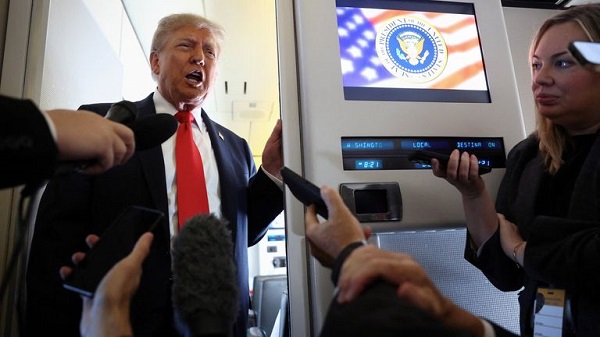
Speaking to reporters aboard Air Force One on Sunday, Trump stated unequivocally, “Yes, the ceasefire is still in place.” His comments came just hours after Israeli airstrikes pounded parts of southern Gaza, marking the most serious flare-up since the truce was declared over a week ago. The strikes, which targeted what Israel claimed were Hamas positions, came in response to what it described as an attack on its troops.
The escalation shattered nine days of relative calm following an internationally brokered ceasefire aimed at halting weeks of cross-border violence. While both Israel and Hamas accused each other of violating the terms of the agreement, Trump emphasized that the leadership of Hamas was not responsible for Sunday’s violence, attributing the incident to “some rogue elements within the movement.”
“We want to make sure things stay peaceful with Hamas,” Trump added, noting the United States’ ongoing diplomatic engagement to sustain the fragile truce.
45 Killed in Israeli Strikes
According to the Gaza Civil Defense, 45 people were killed in the latest Israeli bombardment, which struck densely populated areas in Rafah in the southern part of the Gaza Strip. The Israeli military reported the deaths of two soldiers in the same area, which it described as a response zone following attacks by Hamas fighters.
Israeli Prime Minister Benjamin Netanyahu, meanwhile, blamed Hamas for breaking the ceasefire and ordered military commanders to take “strong action against terrorist targets in Gaza.” He claimed that Hamas had violated the truce and justified the strikes as necessary for Israel’s security.
Hamas, for its part, denied any knowledge of the attack on Israeli forces and reiterated its commitment to the ceasefire. In a statement, the group said it remained dedicated to the terms of the agreement and accused Israel of provoking the violence.
Washington’s Regional Strategy
As the situation on the ground grew increasingly complex, U.S. officials continued to emphasize the importance of regional security infrastructure. Vice President J.D. Vance called on the Gulf States to step up efforts to help disarm Hamas and ensure long-term stability in the region.
“The Gulf countries are our allies, but they still lack the necessary security infrastructure to ensure the disarmament of Hamas,” Vance said, suggesting that a more robust regional approach was essential to supporting the ceasefire and preventing future flare-ups.
His remarks hint at a broader American strategy that goes beyond immediate crisis management and seeks to build long-term deterrence capabilities among U.S. allies in the Middle East.
A Fragile Peace
Sunday’s violence underscored just how precarious the current ceasefire remains. Although both sides publicly insist they are committed to maintaining calm, tensions on the ground remain high, and the risk of miscalculation or further escalation is ever-present.
Trump, who played a direct role in mediating the current ceasefire through backchannel diplomacy with regional partners, is keen to maintain what the White House has described as a “delicate but durable pause in hostilities.” The President’s reassurance that Hamas leadership is not actively undermining the truce appears aimed at preserving diplomatic momentum and preventing broader regional fallout.
Observers say the latest developments highlight the deeply entrenched divisions within both Israeli and Palestinian leaderships, as well as the limitations of temporary ceasefires in the absence of a political solution.
For now, despite the bloodshed, the ceasefire formally remains in effect, a tenuous calm underpinned by both hope and uncertainty.
