

Ahmed Kamel – Egypt Daily News
Egypt has proposed the creation of a dedicated Japanese industrial zone inside the Suez Canal Economic Zone (SCZone), a move that could significantly deepen economic ties with Tokyo and strengthen Cairo’s ambitions to become a regional manufacturing and export hub linking Africa, Europe and the Middle East.
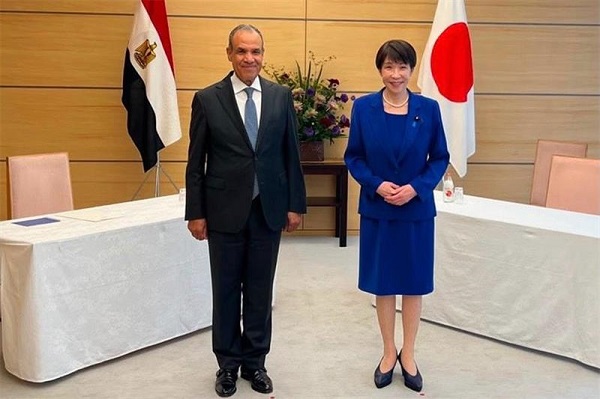
The proposal was presented by Foreign Minister Badr Abdelatty during talks with Japanese Prime Minister Sanae Takaichi on Wednesday as Egypt seeks to attract a new wave of foreign investment from Asia amid shifting global supply chains and rising geopolitical uncertainty.
The initiative would provide Japanese manufacturers with a strategic production base near one of the world’s busiest trade routes while giving them access to Egypt’s extensive network of trade agreements covering Arab, African and European markets.
Cairo Eyes Bigger Japanese Industrial Presence
During the meeting, Abdelatty delivered a message from President Abdel-Fattah El-Sisi outlining Cairo’s vision for expanding the Egyptian-Japanese strategic partnership and encouraging greater Japanese participation in Egypt’s economic transformation.
According to the Foreign Ministry, the Egyptian side highlighted opportunities available within the SCZone, where investors benefit from tax incentives, customs advantages and direct access to international shipping lanes through the Suez Canal.
Egyptian officials believe a dedicated Japanese industrial cluster could attract manufacturers seeking alternatives to traditional production centers while strengthening industrial integration between the two countries.
The proposal comes as governments and corporations worldwide continue reassessing supply chains in response to geopolitical tensions, trade disruptions and evolving global market conditions.
Strategic Partnership Moves Beyond Development Aid
Relations between Cairo and Tokyo have expanded considerably since the two countries elevated ties to a Strategic Partnership in 2023.
While Japanese involvement in Egypt has historically been associated with development assistance and infrastructure financing, both governments are increasingly focusing on investment, technology transfer, innovation and industrial cooperation.
Abdelatty emphasized Egypt’s efforts to improve the business environment through economic reforms and called for greater participation by Japanese companies in sectors ranging from manufacturing and logistics to digital transformation and scientific research.
Officials view Japanese expertise in advanced industry and technology as an important component of Egypt’s broader plans to modernize its economy and increase value-added exports.
Education Cooperation Becomes Model for Broader Partnership
Education remains one of the strongest pillars of Egyptian-Japanese cooperation and is increasingly being used as a template for wider collaboration.
Joint projects such as the Egypt-Japan University of Science and Technology (E-JUST) have become flagship examples of knowledge transfer between the two countries, while Egyptian-Japanese Schools continue to expand across the country.
The government expects more than 100 Egyptian-Japanese schools to be operating by the 2026-27 academic year, with long-term plans targeting hundreds more institutions nationwide.
Egyptian officials see the model as a successful blend of Japanese educational practices and local curricula, helping prepare a new generation of students with skills aligned to future labor-market demands.
Recent discussions between Egyptian and Japanese education officials have also focused on artificial intelligence, software development, vocational training and advanced technology programs.
Africa Opportunities Featured in Talks
Beyond bilateral cooperation, Abdelatty encouraged greater Japanese engagement in Africa through partnerships with Egypt.
The foreign minister presented Egypt as a gateway for Japanese companies seeking access to African markets, highlighting the country’s geographic position, transport infrastructure and trade links across the continent.
He also invited Japan to participate in the upcoming Alamein-Africa Business Forum, which aims to connect international investors with emerging opportunities across African economies.
Officials hope the event will strengthen commercial ties between Asian and African markets while showcasing Egypt’s role as a platform for regional investment.
Regional Stability Remains Key Factor
The discussions also touched on developments across the Middle East, including ongoing crises in Gaza, Sudan and the Horn of Africa.
Egyptian officials briefed the Japanese side on Cairo’s diplomatic efforts to contain regional tensions and support political solutions to ongoing conflicts.
Japanese officials reaffirmed support for Egypt’s role in promoting stability and welcomed continued dialogue on regional security issues.
As Cairo works to attract foreign investment and accelerate industrial growth, officials increasingly see economic partnerships with countries such as Japan as a cornerstone of Egypt’s long-term development strategy. The proposed Japanese industrial zone would represent one of the most significant steps yet in transforming the strategic partnership into a deeper economic alliance centered on manufacturing, technology and regional trade.
