

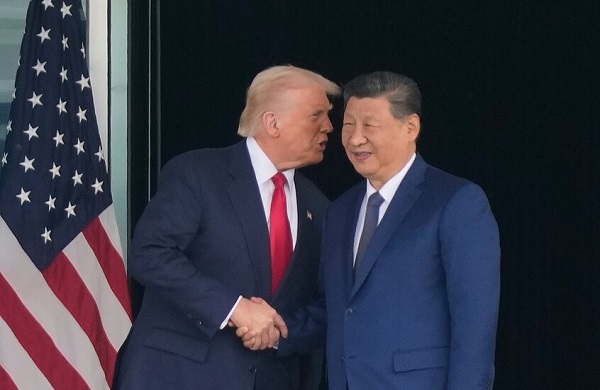
Ahmed Kamel – Egypt Daily News
U.S. President Donald Trump announced that he and Chinese President Xi Jinping reached a series of broad agreements covering trade, energy, and drug enforcement during their meeting on the sidelines of the Asia-Pacific Economic Cooperation (APEC) Summit in Busan on Thursday. Both leaders described the talks as constructive, signaling a potential easing of long-standing tensions between Washington and Beijing.
In a post on his social media platform Truth Social, Trump said that he and Xi had “agreed on many things,” with several critical issues now “very close to resolution.” He claimed the new understandings would “bring prosperity and security to millions of Americans.”
Among the key points Trump highlighted was China’s commitment to increase purchases of American agricultural products. “I am deeply honored that President Xi agreed to begin buying vast quantities of soybeans, sorghum, and other agricultural goods,” Trump wrote. “Our farmers will be very happy!”
Trump also stated that China would maintain an “open and free supply” of rare earth elements, base metals, and magnets materials vital to U.S. manufacturing and technology industries. Additionally, he said that Beijing had pledged to work closely with Washington to stem the flow of fentanyl and related synthetic opioids into the United States, calling it a “serious and much-needed step toward ending the fentanyl crisis.”
Energy cooperation also featured prominently in the discussions. According to Trump, China expressed interest in purchasing U.S. energy resources, including oil and gas from Alaska, with the possibility of what he described as a “massive deal” in the near future.
In a parallel announcement, China’s Ministry of Commerce said the United States would suspend port fees on Chinese vessels for one year, with China planning to take reciprocal measures afterward a gesture seen as part of the broader effort to stabilize bilateral trade relations.
For his part, President Xi said that the two countries had reached a “basic consensus” and made “encouraging progress” on key issues of mutual concern. Speaking after the meeting, Xi emphasized that trade and economic cooperation should remain the “driving force” in U.S.-China relations, not an obstacle. He called for sustained communication “at all levels and through all channels” to foster better understanding and prevent future misunderstandings.
The tone of the Busan meeting marked a notable shift from previous years of friction over tariffs, technology restrictions, and geopolitical disputes. While both leaders stopped short of announcing a formal trade pact, the discussions appeared to lay the groundwork for renewed economic engagement between the world’s two largest economies.
Diplomatic observers noted that even limited cooperation on agricultural trade, rare earth exports, and drug enforcement could help stabilize relations at a time when global markets are increasingly sensitive to U.S.-China tensions. Whether the goodwill expressed in Busan translates into lasting policy changes, however, remains to be seen.
