

Ahmed Kamel – Egypt Daily News
Zohran Mamdani was sworn in as New York City’s mayor on New Year’s Day, pledging to lead a new era for the nation’s largest city while remaining firmly committed to the democratic socialist principles that propelled his unlikely rise to national prominence.
In remarks delivered at his public inauguration, Mamdani framed the start of his administration as a moment of renewal for a city weary of political cynicism, economic pressure and deepening inequality. While striking a unifying tone, he made clear that his victory would not translate into ideological retreat.
“My fellow New Yorkers, today begins a new era,” Mamdani said, addressing a crowd that included political allies, skeptics and national figures. He acknowledged both those who voted for him and those who did not, promising to serve all residents regardless of political affiliation. “If you are a New Yorker, I am your mayor,” he said. “Regardless of whether we agree, I will protect you, celebrate with you, mourn alongside you, and never hide from you.”
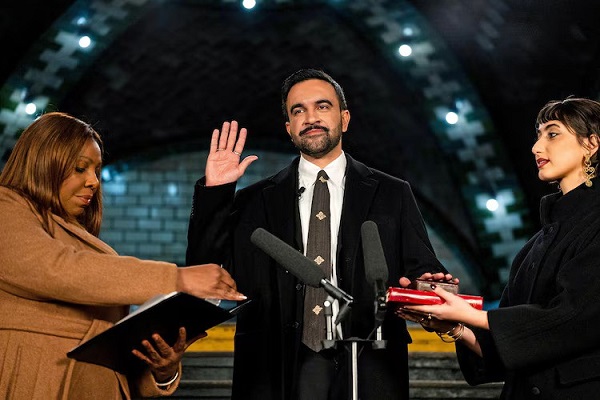
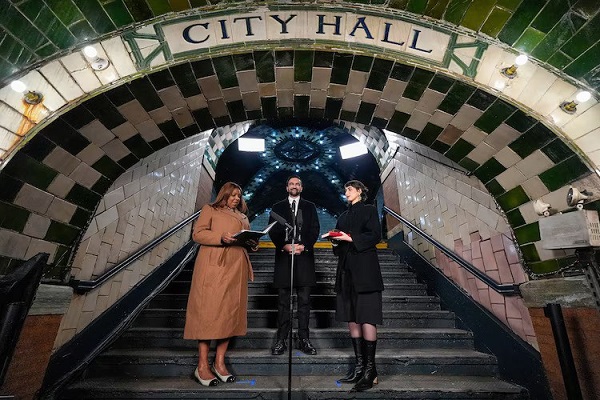
Mamdani, a former state assemblyman, was formally sworn in at midnight on January 1, 2026, during a private ceremony officiated by New York Attorney General Letitia James at the long-closed original City Hall subway station. The location, renowned for its ornate arches and tiled ceilings, underscored Mamdani’s emphasis on public infrastructure and transit as central to the city’s future. He took the oath of office on a centuries-old Qur’an from the New York Public Library’s collection, marking a historic milestone as the city’s first Muslim mayor and its first mayor of South Asian descent.
“This is truly the honor and privilege of a lifetime,” Mamdani said after the midnight ceremony, calling the former subway station a symbol of the enduring importance of public transit to New York’s vitality.
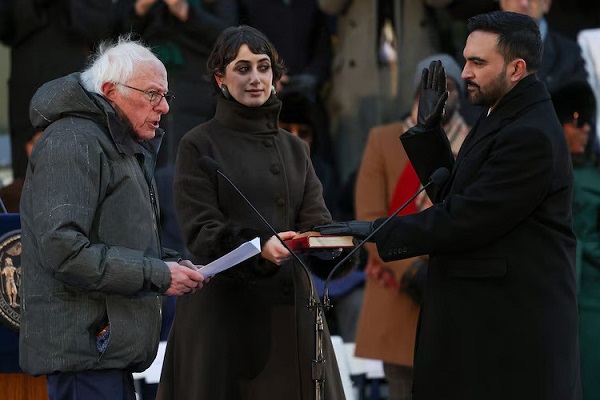
Later in the day, Vermont Sen. Bernie Sanders, a longtime ideological ally, administered the ceremonial oath at the public inauguration. Sanders framed Mamdani’s election as part of a broader national movement, telling the crowd that New York had offered the country “hope and the vision that we can create government that works for all, not just the wealthy and the few.”
Rep. Alexandria Ocasio-Cortez echoed that message, highlighting both the historic nature of Mamdani’s ascent and his broad appeal. She described him as the first Muslim mayor, the youngest mayor in generations and the first immigrant mayor in over a century, but emphasized that “most importantly, Zohran will be a mayor for all of us.”
Mamdani also thanked a wide range of figures, from New York Gov. Kathy Hochul and labor leaders to members of the Democratic Socialists of America. He offered public gratitude to his predecessor, Eric Adams, despite a contentious mayoral campaign that often exposed sharp ideological divides.
Although Mamdani moderated some of his positions on policing and public safety during the campaign and made pragmatic choices during the transition, such as committing to keep Police Commissioner Jessica Tisch—he used his inauguration to reaffirm his political identity.
“I was elected as a democratic socialist, and I will govern as a democratic socialist,” he said to loud applause. “We will govern without shame and insecurity, making no apology for what we believe.”
His victory followed a hard-fought race against independent former Gov. Andrew Cuomo and Republican nominee Curtis Sliwa, centered largely on affordability. Mamdani’s platform included a rent freeze for rent-stabilized apartments, free bus fares and universal free childcare for young children, ambitious proposals that will require cooperation from the City Council and the state government, which controls key fiscal levers.
Urban policy experts say the challenge now lies in translating rhetoric into results. Mitchell Moss, a professor at New York University, noted that the presence of Sanders at the inauguration signaled Mamdani’s national ambitions and ideological roots. Moss added that early, tangible progress will be essential. “No one expects a new mayor to do everything they promise,” he said, “but they have to be making progress on their promises.”
Mamdani will also need to navigate a complex relationship with Washington, where Republicans control the federal government. Despite months of sharp exchanges during the campaign, Mamdani struck a surprisingly cordial tone during a post-election meeting with President Donald Trump, who later said he hoped the new mayor would succeed.
Political observers say that moment highlighted Mamdani’s ability to balance ideology with pragmatism, a skill that may prove decisive as he confronts soaring housing costs, strained public services and the expectations of a diverse electorate.
As he begins his term, Mamdani has cast his leadership as both historic and forward-looking, promising bold action while insisting that New York’s government can reflect the city’s diversity, ambition and enduring belief in collective progress.
