

Ahmed Kamel – Egypt Daily News
Iranian drone strikes targeted key energy and security sites across the Gulf on Monday, triggering fires at Saudi Arabia’s major Ras Tanura oil refinery and prompting widespread air defense responses, while a separate friendly-fire incident resulted in the downing of three U.S. fighter jets over Kuwait.
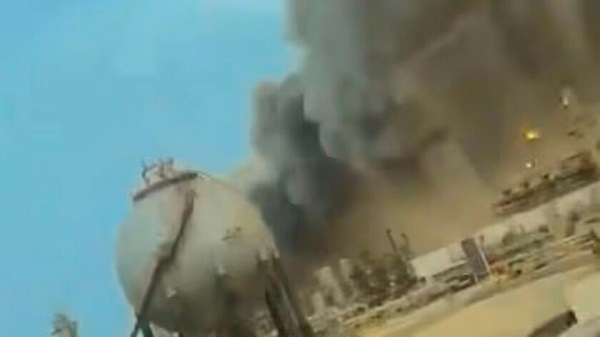
Saudi authorities said Iranian drones struck the Ras Tanura refinery near Dammam early Monday, igniting a fire at the facility. A Saudi military spokesperson said incoming drones were intercepted, but debris from the engagement appeared to have caused damage on the ground. Video circulating online showed thick black smoke rising from the complex.
An official source at the Saudi Ministry of Energy, cited by the Saudi Press Agency, said some operational units at the refinery were temporarily shut down as a precaution. The ministry stressed that petroleum supplies to domestic markets were not affected.
Ras Tanura is one of the kingdom’s most significant oil processing facilities, with a capacity exceeding half a million barrels of crude per day. The incident underscores the vulnerability of critical energy infrastructure as regional hostilities intensify.
Elsewhere in the Gulf, Kuwait reported intercepting multiple drones targeting the country at dawn. Around the same time, alarms sounded at the U.S. embassy compound in Kuwait City after what officials described as an Iranian attack in the vicinity. The embassy urged personnel and the public to shelter in place, warning of an ongoing threat from missile and unmanned aerial vehicle strikes. No damage or casualties were immediately reported.
The day’s tensions were compounded by an aviation incident involving U.S. forces. U.S. Central Command later confirmed that three U.S. Air Force F-15E Strike Eagle jets were mistakenly shot down by Kuwaiti air defenses while responding to Iranian aerial threats. According to the U.S. military, all six crew members ejected safely and were recovered in stable condition.
Kuwait’s defense ministry had earlier reported that several U.S. warplanes crashed within Kuwaiti territory but said the crews survived and were transported to hospital for evaluation. Officials in both countries said the cause of the incident remains under investigation.
Reports of explosions also emerged from Dubai and Bahrain, though details remained limited. Qatar’s Foreign Ministry condemned the attacks, warning that Iran would “have to pay a price” and that such actions could not go unanswered.
Iranian strikes also extended to the United Arab Emirates. French Defense Minister Catherine Vautrine said a French military installation in Abu Dhabi was hit by an Iranian drone the previous day. She reported that the damage was limited to material losses and that no injuries were recorded, adding that French forces remain on high alert.
The wave of attacks follows a sharp escalation in regional conflict after joint U.S. and Israeli strikes on Iran over the weekend reportedly killed Supreme Leader Ayatollah Ali Khamenei and other senior figures in Tehran’s leadership.
In a joint statement, the United States and several Gulf allies including Kuwait, Saudi Arabia, Bahrain, Qatar, Jordan and the UAE, described Iran’s actions as a dangerous escalation threatening regional stability. The statement condemned attacks on civilian areas and non-combatant states as reckless behavior and reaffirmed the countries’ right to self-defense.
According to the joint statement, Iranian strikes have affected multiple locations across the region, including Bahrain, Iraq, Jordan, Kuwait, Oman, Qatar, Saudi Arabia and the United Arab Emirates, raising fears of a broader regional confrontation.
