

Ahmed Kamel – Egypt Daily News
U.S. Secretary of State Marco Rubio said Washington launched preemptive strikes against Iran after determining that Israeli military action was imminent and American forces in the region would likely face retaliation, remarks that triggered sharp criticism from lawmakers and commentators across the political spectrum.
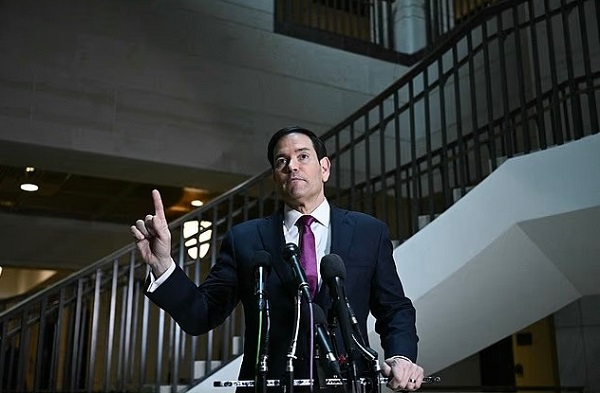
Rubio made the comments Monday during a classified briefing on Capitol Hill with senior congressional leaders about the joint U.S.-Israel offensive.
“There absolutely was an imminent threat,” Rubio said, explaining that U.S. officials believed Iran would quickly target American forces if Israel moved forward with an attack. “We were not going to sit there and absorb a blow before we responded.”
Preemptive rationale
Rubio said defense officials concluded that remaining in a purely defensive posture after an Israeli strike would expose U.S. personnel to greater risk. Five American service members have been killed so far in the fighting, according to the administration.
“We went proactively in a defensive way to prevent them from inflicting higher damage,” he said.
The secretary added that failing to act could have led to congressional scrutiny over why the administration did not move earlier to prevent casualties.
Political backlash grows
The remarks quickly drew criticism from both Democrats and Republicans, some of whom argued Rubio’s explanation suggested the United States was pulled into conflict by Israel’s actions.
Representative Joaquin Castro wrote on X that Rubio’s comments indicated Israel “put U.S. forces in harm’s way” and accused the administration of joining the conflict rather than trying to restrain it.
Conservative commentator Matt Walsh also criticized the remarks, writing that Rubio appeared to admit the United States entered the war because Israel “forced our hand.”
Rubio defended the decision, saying Iranian missile forces had already been placed on high alert.
“Within an hour of the initial attack on the leadership compound, the missile forces in the south and in the north… had already been activated to launch,” he said, though he did not specify which U.S. targets were believed to be at risk.
Gang of Eight briefing
The briefing was delivered to the so-called “Gang of Eight,” the small bipartisan group of congressional leaders routinely notified of highly sensitive intelligence matters.
Participants included House Speaker Mike Johnson, House Minority Leader Hakeem Jeffries, Senate Majority Leader John Thune, Senate Minority Leader Chuck Schumer, House Intelligence Chairman Rick Crawford and ranking member Jim Himes, along with Senate Intelligence Chairman Tom Cotton and Vice Chairman Mark Warner.
The group had also been briefed prior to the strikes, officials said.
War powers fight looms
Despite the limited notification, many Democrats in both chambers have criticized the administration led by President Donald Trump, for not informing a broader group of lawmakers before military action began.
Rubio pushed back, saying the administration had complied fully with legal requirements.
“The law says we have to notify them 48 hours after beginning hostilities. We’ve done that,” he told reporters, arguing that notifying all 535 members of Congress in advance could jeopardize operational security.
Lawmakers in both the House and Senate have already drafted war powers resolutions aimed at limiting the president’s unilateral authority to conduct strikes against Iran, though the Republican-controlled Congress has so far not passed the measures.
Rubio acknowledged Congress has the authority to pursue such votes but argued similar efforts have historically failed and would likely face constitutional challenges.
“We’ve complied with the law 100 percent,” he said.
