

Ahmed Kamel – Egypt Daily News
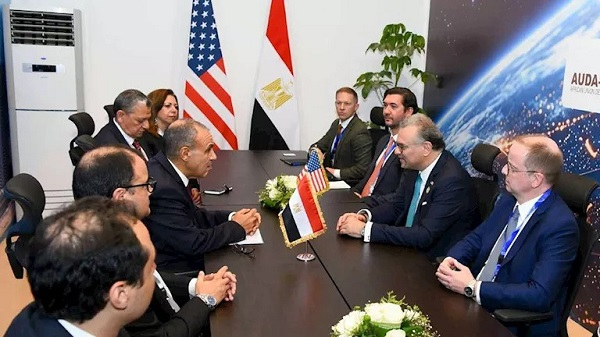
Egyptian Foreign Minister Badr Abdelatty has called for the rejection of unilateral measures affecting the Nile during discussions with Massad Boulos, the senior adviser to the US president on Arab and African affairs.
The talks took place on the sidelines of the Alamein Africa Forum and focused on Egypt-US relations, regional security developments and a number of political crises across Africa and the Middle East. The meeting also addressed ways to strengthen the strategic partnership between Cairo and Washington through broader cooperation in political, economic and investment-related fields.
According to Egypt’s Foreign Ministry, Abdelatty emphasized the importance of expanding cooperation in areas that serve the shared interests of both countries. The discussion reflected Cairo’s desire to maintain close communication with Washington on regional issues, particularly those involving the Nile Basin, the Horn of Africa, Sudan and Libya.
The Nile issue was one of the most significant subjects raised during the meeting. Abdelatty reiterated Egypt’s position that the use and management of shared water resources must be governed by international law. He also stressed Cairo’s opposition to any unilateral action in the Nile Basin.
Egypt considers water security a vital national interest because the Nile is the country’s main source of fresh water. The river supports households, agriculture, industry and other economic activities, making any potential disruption to its flow a major concern for Egyptian authorities.
Although the statement did not name a specific project, Egypt’s position is closely linked to the long-running dispute over the Grand Ethiopian Renaissance Dam. Cairo has repeatedly called for a legally binding agreement regulating the dam’s filling and operation, while Ethiopia maintains that the project is essential for electricity production and national development.
The disagreement has continued despite years of negotiations involving Egypt, Ethiopia and Sudan. Egypt has warned that uncoordinated operation of the dam could threaten downstream water supplies, particularly during periods of drought. Ethiopia has rejected what it considers attempts to limit its right to use its natural resources.
During the meeting, Boulos praised Egypt’s role in Africa and described the country’s decision to host African events in New Alamein as evidence of its growing involvement in promoting cooperation across the continent. He specifically highlighted the importance of increasing economic and investment partnerships between African countries.
The officials also discussed Libya, where Egypt continues to support the country’s unity, sovereignty and territorial integrity. Abdelatty said Cairo remains committed to strengthening Libya’s national institutions and supporting a political process capable of ending the country’s division.
Egypt has called for a comprehensive Libyan settlement led by Libyans and supported by regional and international actors. Cairo has also backed efforts to prepare the country for simultaneous presidential and parliamentary elections, arguing that a unified political framework is necessary to restore stability.
The minister stressed the importance of coordinating international and regional initiatives related to Libya. He said outside efforts should support a sustainable political agreement that reflects the will of the Libyan people and protects the unity of the state.
Developments in the Horn of Africa were another central topic. Abdelatty urged the parties involved to contain tensions and rely on political channels rather than unilateral or military actions. He also emphasized the importance of preserving the authority of national institutions and respecting the sovereignty and territorial integrity of countries in the region.
Egypt has increasingly linked developments in the Horn of Africa to its broader national security interests. The region is close to the Red Sea, the Suez Canal and the Nile Basin, making instability there a concern for Egypt’s economic and strategic interests.
Abdelatty also criticized Israel’s recognition of what he described as “Somaliland,” arguing that such a move violated international law and undermined Somalia’s sovereignty and territorial integrity. He warned that actions of this kind could deepen instability in the Horn of Africa and create additional risks for the security of the Red Sea.
The situation in Sudan was also discussed during the talks. Abdelatty reaffirmed Egypt’s support for Sudan’s unity, sovereignty and territorial integrity, as well as the preservation of its state institutions and national resources.
He called for stronger efforts to end the fighting and create conditions for a political settlement based on dialogue and negotiations. Egypt has repeatedly warned against the fragmentation of Sudan and the creation of parallel governing structures, saying such developments could produce long-term instability and threaten neighboring countries.
The discussions demonstrated the wide range of issues shaping the relationship between Egypt and the United States. For Cairo, the Nile remains a core national security issue, while the crises in Libya, Sudan and the Horn of Africa are closely connected to regional stability.
By raising these issues with a senior American official, Egypt sought to reinforce its diplomatic message that regional disputes should be managed through international law, political dialogue and respect for national sovereignty. The talks also highlighted Cairo’s effort to position itself as a central partner in efforts to address Africa’s political, economic and security challenges.
