

Ahmed Kamel – Egypt Daily News
African leaders used a summit in New Alamein to call for a new approach to financing development, placing greater emphasis on domestic capital, African businesses and institutions capable of turning continental plans into completed projects.
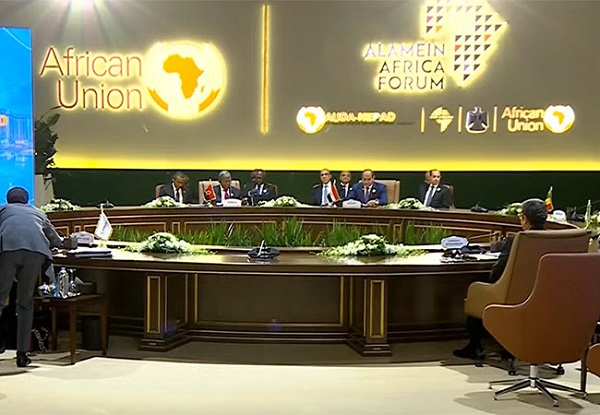
The meeting brought together the five countries that established the New Partnership for Africa’s Development, or NEPAD, 25 years ago. President Abdel Fattah El-Sisi and Angolan President João Lourenço co-chaired the gathering, which also included representatives from Algeria, Nigeria and Senegal, along with the current chair of the African Union, officials from the African Union Commission and the leadership of the African Union Development Agency-NEPAD.
At the conclusion of the summit, participants adopted the Alamein Declaration, a document reaffirming NEPAD’s role in supporting Africa’s development priorities and implementing the objectives of Agenda 2063. The declaration came as governments across the continent face persistent shortages of infrastructure, limited access to affordable finance and growing pressure to create jobs for a rapidly expanding population.
President El-Sisi said Africa could no longer depend primarily on outside funding or foreign-led development models. He urged governments to strengthen their ability to raise and invest African capital, arguing that long-term progress would depend on the continent’s own institutions, businesses and people.
The Egyptian president’s message reflected a broader concern among African policymakers: major projects are frequently announced but delayed by weak preparation, insufficient financing, regulatory uncertainty and a lack of coordination between governments and investors.
To address those challenges, President El-Sisi called for more effective African financing mechanisms and stronger cooperation between the public and private sectors. He said governments needed to create an environment in which local companies and investors could participate more actively in national and regional development.
That environment, he said, would require dependable infrastructure, transparent legislation, simpler business procedures and greater legal and political stability. Such conditions are essential not only for attracting international investment but also for encouraging African businesses to invest beyond their home markets.
The summit was held alongside the Alamein Africa Business Forum, which Egypt is promoting as a regular meeting point for governments, companies, financial institutions and project developers. The forum is expected to be held every two years, with the aim of connecting investment capital to projects linked to the African Union’s development agenda.
The initiative is designed to address one of the continent’s longstanding economic weaknesses: the limited interaction between African businesses and markets. Although African countries have substantial natural resources, large consumer populations and a growing entrepreneurial class, companies often face difficulties obtaining information, finding partners and navigating regulatory systems in neighboring states.
A permanent business platform could help improve those connections by presenting investment opportunities, bringing project owners together with lenders and creating a mechanism for tracking agreements reached during the meetings.
The Egyptian presidency said the forum’s programme would include discussions on financing, infrastructure and follow-up procedures for recommendations and commitments. This emphasis on monitoring is significant, as many continental initiatives have struggled to move from policy documents to implementation.
During the summit, President El-Sisi also highlighted proposals linked to the Team Africa initiative, including the possible establishment of an African Union development fund. Such a fund would be intended to increase the continent’s collective ability to prepare and finance major projects while giving international partners greater confidence in Africa’s capacity to manage its own development priorities.
The need for stronger financing has become especially urgent as African governments seek to expand transport networks, electricity generation, digital connectivity, agricultural production, manufacturing and human-capital development. These areas are central to Agenda 2063, the African Union’s long-term plan for building more integrated and prosperous economies.
NEPAD was created in 2001 to help translate Africa’s development ambitions into practical programmes. Over time, its work has expanded to include infrastructure, agricultural modernization, industrial development, skills, regional integration and initiatives designed to improve the continent’s ability to attract investment.
President El-Sisi described the agency as a central institution in Africa’s development system but said its growing responsibilities would require stronger capabilities and more efficient methods of operation. The agency, he argued, must continue adapting to changes in the global economy and to the increasing importance of technology.
Digital transformation and innovation were prominent themes at the meeting. President El-Sisi said technology was changing the way countries build productive economies and deliver public services. African governments, he added, must invest in knowledge, education and skills if they are to compete in a global economy increasingly shaped by digital industries.
Youth employment was closely linked to that challenge. Africa has one of the world’s youngest populations, making the creation of productive jobs a central test for governments. President El-Sisi said youth empowerment, entrepreneurship and investment in people should remain at the heart of continental development policies.
The business forum’s focus on innovation and African entrepreneurship was intended to complement the political discussions at the summit. By bringing entrepreneurs and investors into the same setting as policymakers, organizers sought to encourage partnerships that could generate employment and expand production.
Angola is expected to build on Egypt’s work when it assumes the next phase of responsibility within NEPAD’s leadership structure. President El-Sisi thanked President Lourenço and Angola for co-hosting the summit and contributing to the discussions.
The adoption of the Alamein Declaration and the launch of a recurring business forum gave the meeting two practical outcomes. One established a shared political position on the future role of NEPAD; the other created a platform intended to connect that vision with investment, enterprise and project implementation.
For African governments, the challenge now is to ensure that the new commitments produce measurable results. Greater reliance on African financing will require stronger financial institutions, better-prepared projects and a regulatory environment capable of supporting investment across borders. It will also require governments to work more closely with businesses and communities.
The summit’s message was therefore both political and economic: Africa must mobilize more of its own resources, strengthen its institutions and give its private sector a larger role in shaping development. Only then can the goals set out in Agenda 2063 move beyond long-term aspirations and become visible improvements in infrastructure, employment and living standards.
