

Ahmed Kamel – Egypt Daily News
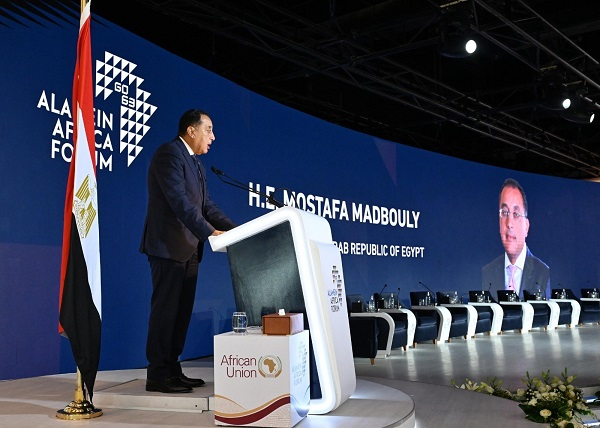
Egyptian Prime Minister Mostafa Madbouly has called for a continent-wide shift in the way African cities are planned, financed and managed, arguing that rapid urbanization should be treated not only as a demographic challenge but also as a major opportunity for economic transformation.
Speaking during a plenary session on cities and urban development at the inaugural Alamein Africa Business Forum in New Alamein City, Madbouly said African governments must move beyond simply accommodating population growth and instead use urban development to drive industrialization, productivity, employment and regional integration.
Madbouly said Africa is experiencing one of the world’s fastest rates of urbanization, with the continent’s urban population expected to double by 2050. That expansion will create enormous demand for housing, transport, water, energy, public services and digital infrastructure. However, he warned that unplanned growth could widen inequalities, increase the cost of providing infrastructure and place additional pressure on natural resources.
“The question is not only how to accommodate urban growth,” Madbouly said, according to the text of his address. “It is how to turn this growth into a driving force for comprehensive development and structural transformation in our economies.”
The prime minister argued that cities should no longer be viewed simply as collections of buildings, roads and residential districts. Instead, they should be treated as interconnected economic, social and environmental systems in which transport, housing, industry, energy, water, communications, public services and green spaces are planned together.
This approach, he said, places people, economic activity and environmental sustainability at the center of urban development. It also requires African countries to anticipate future challenges rather than respond to them after they emerge.
Climate resilience was a central theme of Madbouly’s remarks. He said cities unable to cope with heatwaves, flooding, water shortages or energy pressures would struggle to attract investment, sustain production or provide residents with a decent quality of life. Climate adaptation, he added, should therefore be incorporated into urban plans from the beginning rather than introduced as a corrective measure after disasters occur.
Technology also featured prominently in the prime minister’s vision. He said digital systems had become essential to modern urban management, helping authorities improve the use of resources, regulate traffic, monitor energy and water networks, deliver government services and make decisions based on timely data.
Madbouly presented Egypt’s experience with new urban communities as a potential source of expertise for other African countries. Over recent years, Egypt has pursued a policy of developing new cities to absorb population growth, reduce pressure on established urban centers and redistribute economic activity across the country.
The government’s strategy includes improving connections between cities, strengthening local economic development, enhancing land management and building communities designed to support residential, commercial, industrial, educational and tourism activities. Egypt adopted a new national urban development policy at the end of 2023, according to the prime minister’s remarks.
Madbouly also highlighted what Egypt describes as “fourth-generation cities.” These developments are intended to go beyond housing projects by combining residential areas with employment centers, public services, tourism, education, industry and modern infrastructure.
Among the examples he cited were the New Administrative Capital, New Alamein and New Mansoura. The New Administrative Capital has been developed as a government and business center with digital infrastructure, while New Alamein is being promoted as a year-round urban, tourism and investment destination rather than a seasonal coastal resort. New Mansoura has been associated with efforts involving energy efficiency, sustainability, digital services and climate adaptation.
New Alamein’s selection as the venue for the African business forum was itself presented as symbolic. Egyptian officials have described the city as an example of how long-term planning, infrastructure investment and political backing can transform a previously underdeveloped area into a modern urban center capable of hosting economic, tourism and cultural activities.
The prime minister said Egypt’s urban experience was not limited to domestic projects. Egyptian companies have participated in major infrastructure schemes in several African countries, including the Julius Nyerere Hydropower Plant in Tanzania, road and bridge projects in Uganda and transport infrastructure in Ghana.
The Julius Nyerere project was carried out by an Egyptian consortium involving Arab Contractors and Elsewedy Electric. Madbouly also referred to the Saka road and bridge project in Uganda and the Winneba–Takoradi road project in Ghana as examples of Egyptian companies working in different African environments.
He emphasized that Egypt was not proposing a single urban model for the continent. Each country, he said, has its own geographic, economic, social and institutional conditions. Cooperation should therefore focus on sharing planning principles, technical knowledge and implementation capacity rather than copying one city or development formula.
Financing remains one of the greatest obstacles. Madbouly said governments alone could not meet Africa’s infrastructure, housing and urban-service requirements. He called for stronger partnerships involving public authorities, private companies, development banks, investment funds and other long-term financiers.
He also stressed the need to direct more long-term capital toward sustainable infrastructure and affordable housing. Without adequate financing for lower-income households, rapid urbanization could contribute to the expansion of informal settlements and deepen social inequality.
Egypt’s government has targeted the launch of 310,000 housing units during the 2025–2026 fiscal year, including 285,000 units designated for social housing. The figures form part of a wider national effort involving new urban communities, subsidized housing, water and sanitation projects and initiatives for different income groups.
Madbouly further called for greater African cooperation on urban development through bilateral agreements and continental institutions. He pointed to the African Urban Forum, whose creation followed a 2022 meeting in Cairo of the African Union’s specialized committee dealing with public service, local administration, urban development and decentralization.
The forum is intended to support dialogue on smart cities, affordable housing, water management, urban transportation, clean energy, digital infrastructure and municipal finance. Madbouly said it should help African countries move from exchanging experiences to designing joint projects and building long-term institutional partnerships.
He concluded by arguing that Africa’s future will depend heavily on the future of its cities. With better planning, appropriate financing, effective technology and stronger links between urban development and productive economic activity, he said, the continent’s cities could become centers of manufacturing, innovation, trade and employment.
The objective, he added, should be to create cities that are resilient, competitive and inclusive—places where young people can find work, entrepreneurs can develop new businesses, investors can operate with confidence and residents can access reliable services and a dignified standard of living.
