

Ahmed Kamel – Egypt Daily News
Egypt has declared an Ethiopian diplomat persona non grata and ordered him to leave the country within 48 hours, responding to a similar decision by Addis Ababa against a member of the Egyptian diplomatic mission in Ethiopia.
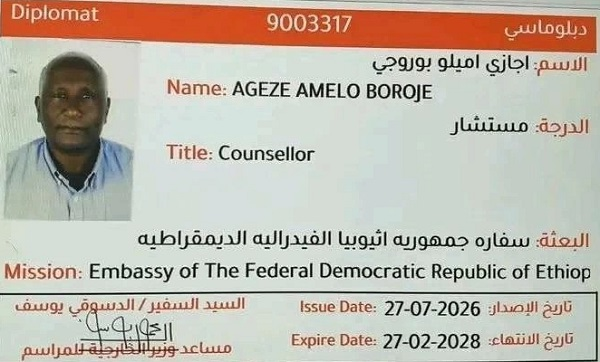
The Ethiopian official identified in reports as the subject of Egypt’s decision is Agazi Mello Broguy, a counsellor at the Ethiopian Embassy in Cairo. His expulsion marks a significant escalation in the already tense relationship between the two countries and reflects the increasingly confrontational nature of their diplomatic exchanges.
The dispute began when Ethiopia announced that an Egyptian diplomat serving at its embassy in Addis Ababa had been declared persona non grata. Ethiopian authorities instructed the diplomat to leave the country within 48 hours. The Ethiopian Foreign Ministry referred to the Vienna Convention on Diplomatic Relations as the legal basis for its decision but did not publicly disclose the specific reason behind the expulsion.
The ministry also did not identify any alleged violation or misconduct by the Egyptian diplomat. No detailed explanation was released concerning whether the decision was connected to a particular statement, activity or diplomatic dispute.
Egypt responded by taking an equivalent measure against Broguy, who was serving as a counsellor at the Ethiopian Embassy in Cairo. Egyptian authorities also gave him 48 hours to leave the country, describing the action as a response based on the principle of reciprocity.
A senior Egyptian source characterized Ethiopia’s decision as regrettable and unjustified. The source said Egypt had consistently rejected interference in the internal affairs of other countries and had avoided commenting on domestic developments in Ethiopia.
According to the Egyptian position, Cairo’s policy is based on respect for international law, the United Nations Charter and the principle of non-interference. Egyptian officials have argued that the country does not seek to become involved in Ethiopia’s internal political affairs and has maintained a similar position toward other states.
The Egyptian source also accused the Ethiopian government of attempting to blame outside parties for internal problems. Cairo claimed that Ethiopian authorities had repeatedly attributed domestic crises and administrative failures to alleged interference by foreign actors.
The exchange of expulsions comes against the backdrop of longstanding disagreements between Egypt and Ethiopia, particularly over the Grand Ethiopian Renaissance Dam on the Blue Nile. Egypt has repeatedly expressed concern that the dam could affect the flow of water reaching its territory, which depends heavily on the Nile for drinking water, agriculture and industry.
Ethiopia, meanwhile, views the dam as a major national development project and a source of electricity and economic growth. Addis Ababa has consistently argued that the project is necessary to support development and that it will not cause significant harm to downstream countries.
Sudan is also involved in the broader dispute because of its geographic position between Ethiopia and Egypt. The three countries have held numerous negotiations over the dam’s filling and operation, but they have not reached a comprehensive and binding agreement covering all outstanding issues.
Although the two governments have not directly linked the latest diplomatic measures to the dam dispute, the broader relationship has been affected by years of political disagreement and mutual suspicion. The absence of public explanations for the expulsions has left open questions about the immediate trigger behind the decisions.
Declaring a diplomat persona non grata is a recognized measure under international diplomatic practice. A host country does not generally have to publicly explain its decision, although the move can carry serious political consequences. When one government responds with a similar expulsion, the action is commonly understood as a reciprocal diplomatic protest.
The 48-hour deadline given to both diplomats indicates that the two governments wanted to demonstrate a firm position while keeping the dispute within established diplomatic procedures. Neither side announced a complete breakdown in diplomatic relations, and there was no indication that embassies would be closed or ambassadors withdrawn.
The expulsions could nevertheless complicate communication between Cairo and Addis Ababa. Diplomatic counsellors often help manage political relations, maintain contact between governments and report on developments affecting bilateral cooperation. Removing one of these officials may limit the channels available for dialogue at a time when the two countries already face deep disagreements.
The immediate identity of the Ethiopian official is therefore clear: Agazi Mello Broguy, a counsellor at Ethiopia’s embassy in Cairo. The reason for his expulsion, however, has not been publicly explained in detail. Egypt has framed the decision as a reciprocal response to Ethiopia’s removal of an Egyptian diplomat, while Ethiopia has not disclosed the specific circumstances behind its original action.
The incident adds a new diplomatic dispute to the difficult relationship between Egypt and Ethiopia, with future developments likely to depend on whether the two governments choose to contain the confrontation or allow it to widen into a broader crisis.
