

Ahmed Kamel – Egypt Daily News
A Flydubai passenger flight traveling from Dubai to Tel Aviv was diverted to Saudi Arabia on Wednesday after a violent confrontation in the cockpit left both pilots injured and caused the aircraft to lose altitude sharply.
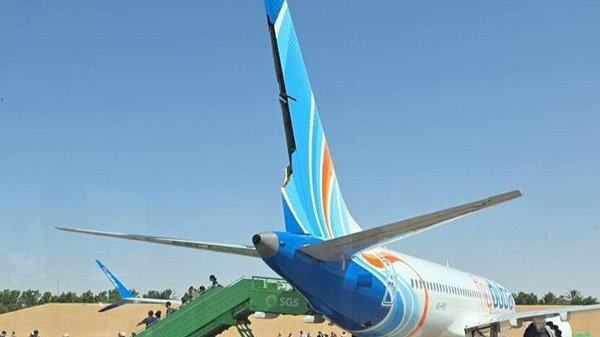
Flight FZ1073, operated by a Boeing 737 Max 8, had more than 170 passengers on board, most of them Israeli nationals. The aircraft was approaching Israel when it transmitted an emergency signal, changed course and eventually landed safely at Prince Sultan bin Abdulaziz International Airport in Tabuk, northwestern Saudi Arabia.
Flydubai said an incident occurred in the flight deck during the journey but did not initially disclose details about what had happened. The airline said the aircraft was secured by qualified Flydubai crew members who were traveling on board and that all passengers and crew were safe and accounted for.
“At this early stage, the underlying reasons and motives behind this event are unknown and remain subject to a formal investigation,” the airline said, urging the public and media to avoid premature conclusions.
The incident caused alarm in Israel after the aircraft activated an emergency transponder code and temporarily disappeared from some flight-tracking systems. Israeli officials initially feared that the plane might have been hijacked. Security authorities conducted urgent consultations as the aircraft moved away from its planned route toward Tel Aviv.
The plane’s flight path showed an unusually steep descent shortly before the emergency diversion. Data from flight-tracking services indicated that the aircraft dropped more than 14,000 feet in approximately 29 seconds, descending from above 30,000 feet to below 17,000 feet. The sharp loss of altitude intensified fears that the aircraft had suffered a serious mechanical failure or that someone had attempted to take control of it.
Later reports from Israeli officials and passengers pointed to a physical struggle between the two pilots. Prime Minister Benjamin Netanyahu said one pilot stabbed the other and appeared to have attempted to crash the plane. He credited passengers and crew members with intervening, overpowering the attacker and helping prevent a major disaster.
According to accounts cited by Israeli media, passengers heard screams from the forward section of the aircraft before several people entered or forced their way into the cockpit. Witnesses described a chaotic scene in which at least one member of the flight crew was bleeding and the aircraft began to shake and descend rapidly.
The accounts have not all been independently confirmed, and important details remain under investigation. Flydubai’s official statement described an “altercation” in the flight deck but did not confirm the identities of those involved, the use of a knife or the motive behind the confrontation.
Authorities at Tabuk airport said both the captain and first officer were injured and taken to hospital for treatment. Airport officials also coordinated with Flydubai to provide assistance to the passengers and arrange replacement aircraft. The passengers were later flown from Saudi Arabia to Israel, arriving at Ben Gurion Airport several hours after their scheduled landing time.
Israeli Defense Minister Israel Katz characterized the incident as an attempted jihadist terrorist attack. Other Israeli officials also suggested that the incident may have been an intentional attempt to bring down the aircraft. However, the airline and some Israeli authorities cautioned that the investigation had not yet established the cause or motive.
A spokesman for the Israeli prime minister said the incident was not being treated as a confirmed hijacking. The distinction is significant because the emergency signal and diversion initially triggered a security response consistent with the possibility that the aircraft had been seized or deliberately redirected.
The episode prompted an immediate security alert in Israel. Prime Minister Netanyahu held urgent consultations with senior security officials, while the country’s military and intelligence agencies assessed whether the incident was connected to a broader threat. Israel also reviewed security procedures for incoming flights operated by Flydubai and considered additional inspections for aircraft arriving from the United Arab Emirates.
The emergency unfolded against a backdrop of heightened political and military tensions across the Middle East. Because the flight was carrying a large number of Israeli passengers and was traveling through the airspace of several countries, any loss of communication or sudden course change had the potential to produce a rapid regional response.
Saudi Arabia’s role in the incident was also notable. The country does not have formal diplomatic relations with Israel, but its airport accepted the emergency landing and provided medical care and assistance to the passengers. The safe landing demonstrated the importance of established aviation coordination mechanisms even between countries whose political relations remain sensitive.
Flydubai later arranged additional aircraft to transport the stranded passengers and crew. An alternative flight reached Tel Aviv, where emergency medical teams and airport officials were waiting to assess travelers and assist families.
The incident has raised questions about cockpit security, crew monitoring and procedures for dealing with a pilot who becomes incapacitated or behaves violently. Commercial aviation relies heavily on strict cockpit access controls, coordinated crew procedures and the ability of other trained personnel to stabilize an aircraft during an emergency. The presence of additional Flydubai crew members on the flight reportedly played a decisive role in helping regain control, although investigators will need to establish exactly how the aircraft was stabilized and diverted.
Investigators in Saudi Arabia, Israel and the United Arab Emirates are expected to examine cockpit recordings, flight-data records, medical reports, witness statements and security procedures. They will also determine whether the event resulted from a personal dispute, a mental-health crisis, a deliberate act of violence or a politically motivated attack.
The pilot suspected of carrying out the stabbing was reportedly detained by Saudi authorities for questioning. Israeli officials said they were examining his background and how he had been cleared to operate a route to Tel Aviv. Those inquiries are preliminary, and no final determination about responsibility or motive has been announced.
For the passengers, the emergency ended without a crash or mass casualties, but the flight remains one of the most serious in-flight incidents involving a commercial aircraft in the region in recent years. The sudden descent, reported cockpit assault and emergency landing created the conditions for a potentially catastrophic event.
The investigation will now focus on reconstructing the sequence of events inside the cockpit and determining how passengers and crew were able to intervene. Until that process is complete, the central questions surrounding the incident including whether it was terrorism, attempted sabotage or a personal confrontation remain unresolved.
