

Ahmed Kamel – Egypt Daily News
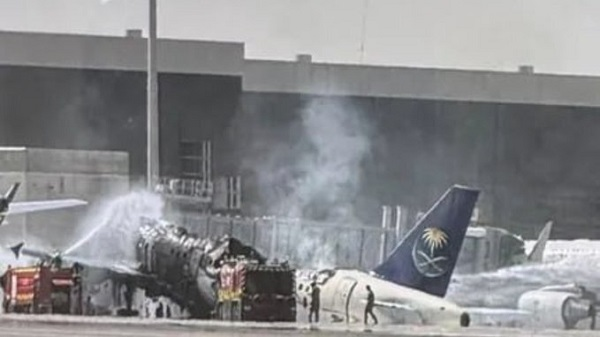
Three Saudi nationals were killed and several other people injured in attacks targeting Riyadh’s King Khalid International Airport on Thursday, Saudi authorities said. A Saudia aircraft on the ground was damaged, and the airline confirmed that one of its pilots, Captain Hamoud Ali Alkalthami, had died.
The events have disrupted flights and sharpened concerns about the widening conflict between Saudi Arabia and Yemen’s Houthi movement. The group claimed responsibility for a missile attack on the airport, but public accounts do not establish that a missile directly struck the aircraft or that the pilot was aboard it when it was damaged.
Saudi Arabia’s General Authority of Civil Aviation said the attacks hit airport facilities and a plane belonging to the national carrier. It reported that the injuries ranged from minor to severe and said airport operations had resumed. Saudia announced Alkalthami’s death in a statement, but did not publicly explain the circumstances linking his death to the aircraft fire. No passengers were believed to be on board the damaged plane.
Video from the airport showed heavy smoke and flames rising near the terminal. The blaze was later extinguished. People briefed on the incident said the stationary aircraft may have been hit by debris from an intercepted missile or another projectile; the precise cause has not been officially established. That uncertainty matters: the damage to the plane, the pilot’s death and the Houthi claim occurred in the same sequence of attacks, but the available details do not prove that the aircraft was deliberately targeted or that the pilot died in the fire.
The Houthis said they had attacked Riyadh airport with missiles and also claimed strikes on an airport in Najran and an airbase in Khamis Mushait. Saudi authorities had not confirmed those additional claims. The group has threatened further attacks on Saudi airports and energy infrastructure, warning airlines and other businesses to stay away from sites it considers targets.
The airport incident followed other deadly attacks earlier in the week. Saudi officials said strikes on airports in Riyadh and Abha had killed three people. The latest attacks add to the danger facing civilians, airport workers and travellers as military action intensifies. Residents of Riyadh reported hearing loud booms, while some companies in the capital’s King Abdullah Financial District told employees to work remotely or leave offices. Some diplomatic missions and schools also took precautionary measures.
The violence has had immediate consequences for aviation. Lufthansa Group suspended flights to Riyadh through October 16, while Air India and Akasa Air cancelled services through October 10. IndiGo also halted flights to the Saudi capital for a shorter period. The cancellations caused widespread disruption, with nearly half of Riyadh’s scheduled departures reportedly cancelled by mid-afternoon on Thursday. Travellers were advised to check directly with their airlines before heading to the airport.
The attacks are part of a renewed escalation in Yemen’s long-running war. The Houthis say their campaign against Saudi Arabia is a response to the kingdom’s support for Yemen’s internationally recognized government. Riyadh, in turn, says it is backing that government’s effort to recover territory from the rebels. The latest fighting is unfolding amid broader regional conflict, raising the risk that military operations and retaliatory strikes could spread beyond Yemen’s front lines.
The humanitarian consequences in Yemen remain severe. Years of conflict have displaced millions of people and damaged the country’s infrastructure and economy. Any expansion of the fighting risks worsening conditions for civilians already affected by food insecurity, displacement and limited access to essential services. Saudi strikes and Houthi attacks each carry risks of civilian casualties, particularly when military operations occur near populated areas or transport infrastructure.
Saudi Arabia has been seeking assistance from partners as it faces the latest attacks. Pakistan has said its forces stationed in the kingdom would help defend Saudi territory under a mutual-defense arrangement, while Turkey has offered mainly defensive and technical support, including equipment and intelligence cooperation. These moves underline the growing regional stakes, though they do not indicate that all partners intend to take part in offensive operations inside Yemen.
For now, the airport remains a symbol of how quickly the conflict can affect civilian life and international travel. Authorities say operations have returned to normal, but airline suspensions and security concerns may persist. The central unanswered questions are how the aircraft was damaged, what caused the pilot’s death, and whether the parties will intensify their attacks despite the risks to civilians and regional stability.
