
The Presidency
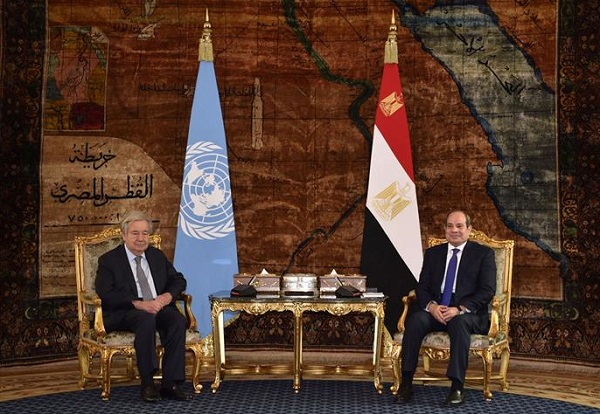
Today, President Abdel Fattah El-Sisi received Secretary-General of the United Nations Mr. António Guterres, in the presence of Minister of Foreign Affairs, International Cooperation and Egyptian Expatriates Dr. Badr Abdelatty. The UN side was represented by Assistant Secretary-General for Africa in the Departments of Political and Peacebuilding Affairs and Peace Operations Mr. Martin Kimani; UN Resident Coordinator in Egypt Mr. Gianluca Rampolla del Tindaro; Director of the Political Affairs, Peacekeeping, Humanitarian Affairs and Human Rights Unit at the Office of the Secretary-General Mr. Emad Aziz Sedrak; Senior Political Affairs Officer at the Office of the Secretary-General Mr. Aguinaldo Baptista; and Head of the United Nations Liaison Office to the League of Arab States Ms. Tamara El-Zayat.
The Spokesman for the Presidency, Ambassador Mohamed El-Shennawy, stated that President El-Sisi welcomed the Secretary-General and expressed his appreciation for the efforts made by Mr. Guterres during his two terms in office since 2017 to uphold the multilateral system, preserve the pivotal UN role in maintaining international peace and security, promote sustainable development, and advance the UN response to humanitarian challenges. President El-Sisi also commended the positions of Mr. Guterres on various issues, particularly the Palestinian issue and the need for its just and comprehensive settlement.
President El-Sisi underscored the importance Egypt attaches to strengthening UN efforts and restoring confidence in the multilateral system, including through adherence to the UN Charter.
The President reaffirmed Egypt’s support for preserving the central role of the United Nations, as reflected in Egypt being one of the largest contributors of highly qualified personnel to UN peacekeeping operations, in addition to hosting dozens of UN offices and agencies. President El-Sisi stressed the need for concerted international efforts to support the role of the United Nations in settling conflicts through peaceful means. The President also emphasized the need to reform the Security Council to reflect international balances, reaffirming Egypt’s commitment to comprehensive reform and enhanced representation of African countries on the Council.
Mr. Guterres expressed his profound pride in visiting Egypt and meeting with President El-Sisi to convey his sincere appreciation for the President’s continued support for the Secretary-General, the United Nations, and the multilateral system. He praised Egypt’s key role in resolving conflicts and consolidating peace and stability in the Middle East, noting that Egypt is best placed to play this role effectively and influentially. He added that he had often wondered about the fate of the Palestinian people without Egypt’s essential role in supporting their rights and defending their cause.
He welcomed Egypt’s efforts to consolidate the ceasefire agreement in the Gaza Strip and expressed his deep appreciation for Egypt’s role in facilitating the entry of humanitarian aid into the Strip and ensuring that it reaches those in need.
The Secretary-General affirmed that lasting and sustainable peace in the region cannot be achieved without a just settlement of the Palestinian cause, stressing that it will remain the central issue in the Middle East until a final resolution is reached. He also expressed deep concern over the ongoing developments in the West Bank, emphasizing the need to take all necessary measures to halt such practices and urging the international community to fulfill its responsibilities to ensure an end to the violations and practices to which Palestinians are subjected in both the Gaza Strip and the West Bank.
The Secretary-General praised Egypt’s efforts to avert escalation in the Gulf region, pointing to an opportunity to reach understandings that could contribute to ensuring freedom of navigation through the Strait of Hormuz and addressing the issue of Iran’s nuclear program through peaceful means. He also expressed his readiness to exert every effort to prevent tensions from escalating or returning to the cycle of conflict.
In addition to the Palestinian issue, talks touched on developments in the Horn of Africa, Sudan, and Libya. Both sides underscored the importance of settling conflicts through peaceful means and respecting the principles of international law. Both sides affirmed the need to move forward with reforming the United Nations system, including the Security Council, in a manner that enhances its representation and fairness and strengthens its ability to respond effectively to contemporary international challenges and crises.
