
Ahmed Kamel – Egypt Daily News
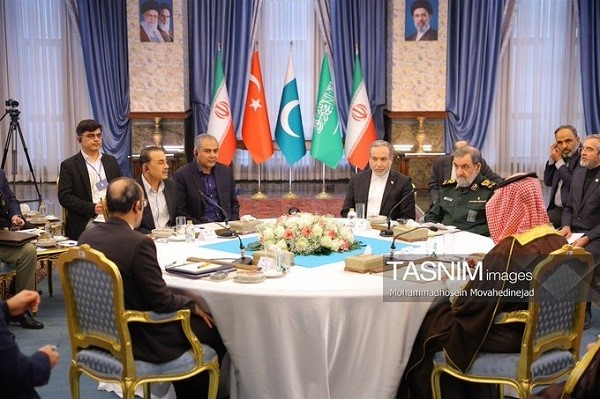
Senior officials from Iran, Saudi Arabia, Pakistan and Turkey began a four-way meeting in Tehran on Monday, October 26, to discuss regional security and stability. The talks bring Iranian officials together with representatives of the three countries that formed the Mecca defense pact, as attacks on Saudi Arabia and tensions involving Iran raise the stakes for regional diplomacy.
Iranian state broadcaster IRIB announced that the meeting had begun. Iran’s Foreign Ministry spokesman, Esmail Baghaei, said earlier that the gathering could help move the region toward a security framework shaped by the interests and decisions of countries in the region, rather than relying primarily on outside powers.
The initiative was proposed during a recent visit to Tehran by Pakistan’s army chief, Field Marshal Asim Munir, and was welcomed by Iran, Baghaei said. He described the meeting as an opportunity to discuss issues affecting regional security and stability, and said that efforts to establish shared security mechanisms or reconsider existing ones were a positive step.
According to Saudi Deputy Foreign Minister Raed Qarmali, the visiting officials include Saudi Defense Minister Prince Khalid bin Salman, Munir and Turkish intelligence chief Ibrahim Kalin. Iranian media reported that the delegations were also expected to meet President Masoud Pezeshkian and Mohsen Rezaei, secretary of Iran’s Supreme National Security Council.
The agenda includes developments in the Palestinian territories and Lebanon, as well as the consequences of a U.S. military attack on Iran, Baghaei said. Tehran’s position is that regional security discussions cannot be separated from these conflicts and their wider effects. The discussions therefore bring together countries with different relationships to Iran and the United States, but with shared concerns about the risk of a broader regional confrontation.
Qarmali said the talks form part of continuing efforts by the Mecca pact countries to reduce tensions, encourage dialogue and support diplomatic solutions. He also cited mediation efforts by Qatar and Pakistan, and described the three-country group as having an important role in regional stability. His comments framed the meeting as a diplomatic effort to contain the crisis, rather than an announcement of a military operation.
The meeting comes as the defense pact faces a serious test. Saudi Arabia, Pakistan and Turkey agreed to deepen their defense cooperation and treat an armed attack against one member as an attack against all. The three governments have recently discussed putting their commitments into practice and providing agreed military personnel and capabilities to Saudi Arabia. The Tehran meeting now brings Iran into direct, high-level contact with all three pact members during a period of escalating security concerns.
The immediate trigger for the talks, according to the account provided by officials, is an increase in attacks on Saudi Arabia by Yemen’s Houthi movement, which is allied with Iran. The meeting marks the first high-level contact between Tehran and all three members of the pact since the attacks intensified. The participants’ presence in Tehran suggests a willingness to communicate even as the countries consider collective defense commitments and disagree over the regional conflicts.
Iranian officials have presented the talks as a potential step toward a regionally designed security system. Baghaei emphasized trust and cooperation among neighboring countries, while rejecting dependence on external actors as the basis for lasting stability. That outlook contrasts with the military and diplomatic role of the United States, which remains central to security calculations across the Gulf.
The meeting does not, by itself, establish a new regional security arrangement or resolve the parties’ disagreements. Its significance lies in the fact that senior representatives of Iran and the three pact members are meeting at a moment of heightened tension. The talks create a channel for direct discussion about Saudi security, the conflict’s regional consequences and diplomatic efforts to prevent further escalation.
Whether the Tehran discussions lead to practical steps remains unclear. The public statements describe shared aims de-escalation, dialogue and regional stability but do not set out specific agreements, commitments or a timetable. For now, the meeting offers a rare diplomatic forum where officials from Iran, Saudi Arabia, Pakistan and Turkey can address the crisis directly, while Qatar and Pakistan continue to support mediation efforts.
