

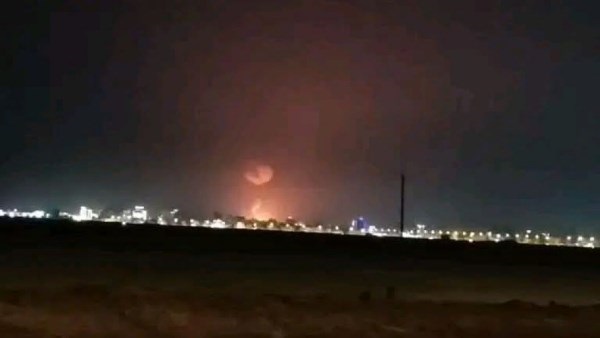
Fighting between Saudi Arabia and Yemen’s Houthi movement intensified on Sunday, November 22, as Saudi authorities said they had intercepted incoming projectiles aimed at the kingdom and the Houthis reported a new wave of air and missile attacks across Yemen.
Saudi coalition spokesman Turki al-Maliki said air defenses intercepted a Houthi drone heading toward Riyadh, following the interception of a ballistic missile aimed at western Saudi Arabia and another drone headed toward the capital. The coalition also said it had destroyed three ballistic missiles launched toward Riyadh on Saturday. The claims could not be independently verified.
The exchanges mark a sharp escalation in a conflict that had seen a relative lull before hostilities surged again this summer. The internationally recognized Yemeni government is backed by Saudi Arabia, while the Houthis, also known as Ansar Allah, control the capital, Sanaa, and much of northern Yemen. The group is supported by Iran, though the extent of Tehran’s operational involvement in particular attacks is disputed.
Saudi authorities issued a civil-defense alert warning of a potential danger in the Mecca region, then later announced that the threat had passed. The alerts came as residents of Riyadh faced reports of incoming missiles and drones. The coalition did not immediately provide details on damage or casualties in Saudi Arabia.
The Houthis accused Saudi forces of carrying out 71 airstrikes and missile attacks over a 24-hour period, targeting provinces including al-Bayda, Amran, Hajjah, Saada, Lahj, Taiz, al-Jawf and Marib. The movement’s military spokesman, Yahya Saree, said the strikes had caused civilian deaths and injuries, but did not provide a confirmed toll. He put the number of air and missile attacks since the latest escalation began at 5,500, a figure that could not be independently confirmed.
Houthi-affiliated media reported that Saudi aircraft struck sites in Sanaa, including a station and the headquarters of the Yemen Petroleum Company on Sixty Street. The reports said six employees were injured and the site sustained material damage. The movement also reported strikes in Hodeidah and its airport, and attacks on areas in Taiz, Lahj, Saada and al-Bayda. Saudi officials did not immediately confirm the reported targets or damage.
In Taiz, government forces said they had fought off Houthi attacks on western front lines and around al-Shaqb in Saber al-Mawadem district. Government representatives also reported three airstrikes against Houthi positions and gatherings in southern Taiz, including two in al-Ma’eena, al-Masrakh district, and one in Jabal Habashi. Separately, Taiz health officials accused the Houthis of targeting an ambulance carrying wounded people. The allegations were not independently verified.
The government’s military spokesperson, Majed al-Nuzaili, said government forces had carried out 816 operations in the preceding 24 hours as part of the “Dawn of Yemen” campaign, launched in October. He said the total comprised 699 artillery attacks, 65 drone operations, 38 rocket-launcher attacks and 14 airstrikes. According to his account, the operations killed or wounded 149 Houthi fighters and destroyed or damaged 71 military vehicles and pieces of equipment. Those figures, like the Houthi casualty claims, could not be independently verified.
Al-Nuzaili said government forces had thwarted Houthi attempts to advance in Lahj, Abyan and al-Dhale, and remained engaged on front lines in Taiz, Marib and al-Jawf. He also described the southern port city of Aden as secure, saying forces assigned to defend it and other southern provinces were operating under unified command.
The escalating clashes raise the risk that the conflict could expand beyond air raids and cross-border attacks into a renewed ground campaign. Analysts have previously warned that repeated exchanges increase the chance that either side could miscalculate, particularly as Houthi and government forces continue to fight along multiple internal front lines.
The latest violence follows a period of growing attacks and counterattacks. Regional security assessments have described an increase in Houthi operations inside Yemen and against Saudi targets, alongside efforts by government-aligned forces to strengthen command structures. Airstrikes alone have not ended the Houthi movement’s ability to mount attacks, while a major Saudi-backed ground offensive would carry risks of further casualties and retaliation.
The human impact of the latest round remains unclear. The opposing sides have issued competing accounts of the number of attacks, casualties and damage, and independent verification is limited in many of the affected areas. Reports of strikes near fuel infrastructure, airports, communications networks and urban neighborhoods have also raised concerns about disruption to civilian services.
With projectiles reportedly aimed at Riyadh and strikes reported across Yemen, the immediate question is whether the exchanges will continue or be followed by diplomatic efforts to contain them. Neither side had announced a ceasefire by Sunday.
