

Ahmed Kamel – Egypt Daily News
Egypt seeks de-escalation with Iran and joint efforts with Oman to reopen Strait of Hormuz, FM says on Wednesday, warning that further escalation could damage security and disrupt the global economy.
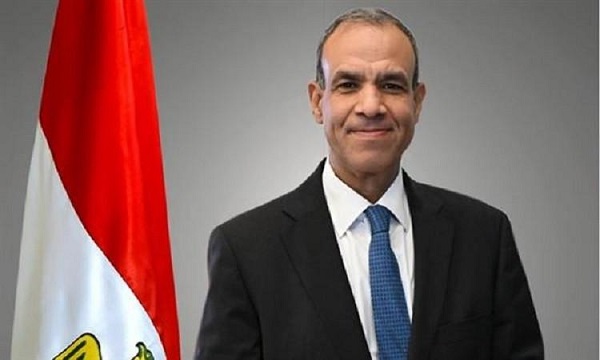
Foreign Minister Badr Abdelatty said Cairo is coordinating with Iran and other regional and international actors as part of an effort aimed at “de-escalation” and a return to negotiations. He said the approach is rooted in the belief that political and diplomatic channels remain the only sustainable way to manage the crises affecting the region.
“There are contacts with the Iranian side, particularly related to efforts to lower tensions and persuade them to come back to the negotiating table,” Abdelatty said in remarks to Al Arabiya.
Abdelatty added that Egypt is also working with Oman on a draft joint declaration intended to reinforce freedom of navigation through Hormuz. He emphasized that the principle of allowing ships to travel through international straits and waterways is non-negotiable for Egypt.
The minister warned that intensifying the confrontation would carry serious consequences not only for regional security, but also for the global economy. He said disruptions to shipping lanes threaten supply chains and energy markets, potentially pushing up prices across sectors that depend on uninterrupted transport.
Egypt has also been involved in efforts to address risks to maritime routes beyond Hormuz. Abdelatty said Cairo participated in discussions about a proposed multinational maritime coalition to protect shipping in the Red Sea and around Bab al-Mandeb from attacks by the Houthi movement. He said Egypt is evaluating the idea closely, particularly any arrangements that might include military commitments, before deciding whether to join.
In stressing Egypt’s red lines, Abdelatty said prolonged blockage or disruption of sea traffic could contribute to higher energy and food costs and place additional stress on global supply networks.
Gaza policy and the U.S. peace plan
Turning to Gaza, Abdelatty said Egypt backs full implementation of U.S. President Donald Trump’s peace plan rather than selectively applying parts of it. He said the plan’s second phase calls for disarmament in Gaza, the collection and registration of weapons, and a complete Israeli withdrawal.
He said there has been progress among Palestinian factions regarding steps related to registering and handing over weapons. Abdelatty said the weapons would be transferred to the National Committee for the Administration of Gaza (NCAG), while the finer details such as mechanisms and timelines are still under negotiation.
Egypt, he said, is also coordinating with Doha, Ankara, and Washington to encourage Palestinian parties to meet their commitments. Abdelatty called for the NCAG to temporarily administer Gaza before an international stabilization force (ISF) is deployed.
Abdelatty rejected any proposal that would involve forcibly moving Palestinians out of the Gaza Strip, warning against any attempt to “liquidate the Palestinian cause.” He said that making living conditions unbearable in order to force people to leave cannot be considered voluntary displacement.
“Keeping the Palestinian people on their land is a red line for Egypt,” he said.
Water security and GERD stance
On the Grand Ethiopian Renaissance Dam (GERD), Abdelatty said Egypt opposes the construction of additional dams or any unilateral measures that could affect Egypt’s water interests. He said Cairo continues to seek a legally binding agreement that safeguards Egypt’s water rights, while also acknowledging development interests in the region.
He said Egypt does not oppose development in other African countries and pointed to Cairo’s efforts to support development and dam-related projects in several Nile Basin states. However, he said development must be balanced against the interests of downstream countries.
Somalia, ports, and regional sovereignty
Abdelatty also reiterated Egypt’s support for Somalia’s unity and sovereignty. He said Egypt rejects attempts to establish military access to the sea without the consent of the state concerned. On commercial port use, he said such activities should be carried out in coordination with sovereign governments, warning that unilateral arrangements could lead to instability.
Syria, Libya, and Sudan
Egypt is also working to strengthen relations with Syria, Abdelatty said, adding that arrangements are under way for him to visit Damascus, though no date has been set. He reaffirmed Cairo’s support for Syria’s security, stability, and territorial integrity.
Regarding Libya, Abdelatty said Egypt is pressing for the unification of state institutions and for simultaneous presidential and parliamentary elections, describing the country’s political division as a threat to Egyptian national security.
On Sudan, he reiterated Egypt’s support for the unity of Sudan and its state institutions and its rejection of parallel governing entities. Abdelatty said Cairo is calling for a truce that leads to a ceasefire and then a political process based on “purely Sudanese ownership.”
