

Ahmed Kamel – Egypt Daily News
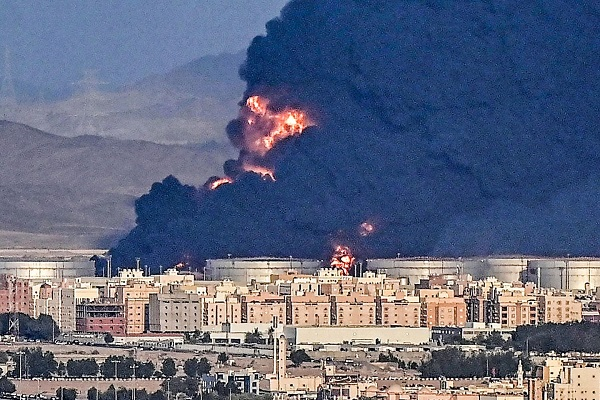
A wave of missile and drone strikes launched by Yemen’s Houthi rebels hit southern Saudi Arabia on Tuesday, injuring at least 73 people and starting fires at oil facilities and utility sites, Saudi authorities said.
The attacks marked a significant escalation between Saudi Arabia and the Iran-backed group, raising fears that the latest violence could widen an already unstable regional conflict and place additional pressure on global energy markets.
Saudi officials said the strikes targeted civilian and economic sites in Abha, Jazan, Najran and Khamis Mushait. Maj. Gen. Turki al-Malki, a spokesman for the Saudi-led coalition operating in Yemen, said women and children were among those injured. He described the assault as a serious escalation and warned that Saudi Arabia would respond.
The Energy Ministry said fires broke out at several oil installations and utility facilities in the kingdom’s southern region. Operations were temporarily halted at the affected sites while emergency crews worked to contain the flames.
The region includes the Jazan oil complex, a major industrial facility with a refining capacity of approximately 400,000 barrels per day. Jazan is also home to a large industrial and logistics hub on Saudi Arabia’s Red Sea coast. The area’s proximity to key maritime routes has made it a repeated target during periods of heightened tension with the Houthis.
In a recorded statement, Houthi military spokesman Brig. Gen. Yahya Saree claimed responsibility for the attacks. He said the group had fired dozens of ballistic missiles and launched drones against Saudi oil and economic infrastructure, as well as an air base.
Saree said the targets included the Jazan City for Primary and Downstream Industries, Aramco-related facilities in Najran and Abha, and King Khalid Air Base in Khamis Mushait. He portrayed the operation as a response to Saudi military actions in Yemen and warned that further attacks would follow if what he called aggression against the Yemeni people continued.
The strikes came only hours after the Houthis accused Saudi Arabia of carrying out an airstrike on a prison in Yemen’s northern Jawf province. Houthi officials said at least seven people, including a child, were killed and seven others wounded in that incident.
Saudi Foreign Minister Prince Faisal bin Farhan rejected the Houthi justification for the attacks, saying the rebels were using violence to advance their own interests rather than seeking a political settlement for Yemen.
Speaking during a visit to Moscow alongside Russian Foreign Minister Sergei Lavrov, Faisal said Saudi Arabia had repeatedly offered opportunities for negotiations but would not hesitate to protect its territory and population.
The renewed fighting has raised concerns that Yemen’s long-running civil war could return to the levels of violence seen before a truce helped reduce hostilities. The conflict began in 2014, when the Houthis seized control of Sanaa and large parts of northern Yemen, forcing the internationally recognised government to relocate. Saudi Arabia intervened the following year at the head of a regional coalition that sought to restore the government.
The war has killed at least 150,000 people, according to United Nations estimates, while millions have faced food shortages, disease and repeated displacement. Although a truce reduced cross-border attacks and eased some fighting, the underlying conflict was never resolved.
Recent clashes have already caused a sharp increase in casualties. The World Health Organization reported that at least 194 people were killed and more than 880 wounded between August 23 and September 5. The United Nations said more than 21,000 people had been displaced in a short period, including approximately 18,500 in the southwestern provinces of Taiz and Hodeida.
Humanitarian officials said many of those forced to flee had already been displaced multiple times. Abdusattor Esoev, who heads the International Organization for Migration mission in Yemen, said families were arriving without shelter, food or reliable information about whether it was safe to return home.
The latest escalation followed a dispute over access to Sanaa. In July, the Houthis attempted to operate a flight from Tehran to the Yemeni capital, challenging the Saudi-led coalition’s air and naval restrictions on the country. Coalition aircraft subsequently struck the runway at Sanaa airport, preventing the plane from landing.
The Houthis responded with missile and drone attacks against Saudi territory and assaults on Saudi-linked shipping in the Red Sea. The attacks effectively ended the relative calm that had prevailed since a 2022 truce.
Fighting has also intensified inside Yemen. Government forces and their allies have reclaimed some territory in Hodeida and Taiz and have launched operations against Houthi positions in Jawf, Marib and Bayda. The rebels, in turn, have increased attacks on government-held areas and Saudi targets.
The violence also threatens important shipping routes. The Houthis have targeted vessels connected to Saudi Arabia near the Red Sea and the Bab el-Mandeb Strait, a narrow passage linking the Red Sea with the Gulf of Aden. The waterway is vital to the movement of oil and commercial goods between the Middle East, Europe and Asia.
Those risks have grown as tensions elsewhere in the region have disrupted energy supplies and restricted traffic through the Strait of Hormuz. Any further attacks on Saudi oil infrastructure or nearby shipping routes could create additional uncertainty for global markets.
The Houthis are part of a wider network of Iranian-backed groups operating across the Middle East. They have intensified attacks on regional shipping, Israel and neighbouring countries in response to wars in Gaza and Lebanon, as well as the broader confrontation between Iran, Israel and the United States.
Although the rebels frequently coordinate with Tehran, they have also pursued their own military and political objectives. Tuesday’s attacks demonstrated their continuing ability to threaten Saudi energy infrastructure and underscored the risk that Yemen’s unresolved conflict could once again become a major source of regional instability.
