

Ahmed Kamel – Egypt Daily News
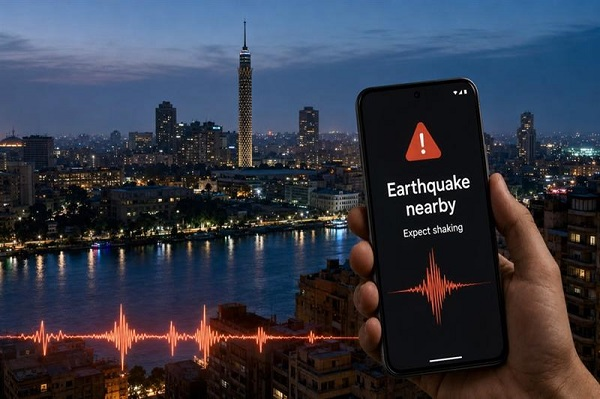
Millions of Egyptians woke up in the early hours of Monday, August 3, 2026, to an unusual notification flashing across their Android smartphone screens. The urgent pop-up warned of an ongoing earthquake seconds before their physical surroundings actually began to shake. Following the 5.7-magnitude tremor centered near Suez, a wave of curiosity swept across major social media networks, with residents questioning if Google could somehow predict earthquakes in advance, and why some mobile users received the warning while others did not.
The underlying reality does not involve predicting seismic activity, as no modern scientific technology can accurately forecast the exact day, hour, or minute an earthquake will strike. Instead, the timely notifications are powered by the Android Earthquake Alerts System, a crowd-sourced early warning infrastructure engineered by Google Crisis Response. The system effectively transforms millions of active Android smartphones into a massive, distributed seismic monitoring grid capable of detecting subtle ground motions and deploying real-time safety alerts in fractions of a second.
Dual Seismic Wave Trajectories Enable Early Warning Software Computations
To outrun the physical shockwaves, Google’s server architecture exploits the core physics of how tectonic energy propagates through the Earth’s crust. Every localized earthquake systematically generates two distinct categories of seismic waves:
Primary Waves (P-Waves): These are the fastest-moving compressed waves that reach the surface first. While they travel rapidly, they are low-amplitude and generally do not cause significant structural damage or strong shaking.
Secondary Waves (S-Waves): These shear waves travel at a noticeably slower velocity but carry vastly superior kinetic energy. S-Waves are the direct cause of the intense surface vibrations that residents physically feel and which inflict structural destruction upon buildings.
The early warning system is calibrated to catch the rapid P-Waves the instant a fault line fractures. By calculating the source data collected from phones nearest to the epicenter, Google’s central processing hubs map the magnitude and location of the tremor, instantly broadcasting digital alerts over cellular networks. Because data packets transit at the speed of light, the electronic notification successfully reaches smartphones in surrounding cities seconds before the slower-moving, destructive S-Waves physically travel across the terrain.
Mobile Accelerometers Function as Crowdsourced Mini Seismometers Across Egypt
The core piece of hardware enabling this global safety network is a microscopic motion sensor built into nearly every modern smartphone: the accelerometer. While typically utilized by the operating system to calculate daily step counts, track fitness metrics, and automatically rotate user screens, Google repurposed these ambient sensors to act as sensitive, localized seismometers. When a phone remains stationary, plugged into a charger overnight, its internal accelerometer can easily register the precise horizontal and vertical micro-vibrations characteristic of an incoming P-Wave.
If a single mobile device detects a sudden vibration, the operating system ignores it as background noise. However, if thousands of separate smartphones situated within the exact same geographic sector record the identical high-frequency vibration pattern at the precise same millisecond, the devices instantly transmit anonymous, data-light pings back to Google’s central cloud servers. The automated system aggregates these incoming telemetry streams, cross-verifies the shared seismic wave pattern, and immediately triggers regional broadcast alerts to all surrounding geographic zones situated within the calculated radius of the expanding S-Wave.
The variance in alert distribution among residents depends heavily on individual device configurations and proximity to the epicenter. Users who had their location services disabled, phones completely powered off, or the dedicated “Earthquake Alerts” toggle deactivated within their Android security settings were automatically excluded from the broadcast loop. By establishing this collaborative, decentralized digital safety grid, everyday mobile users across Egypt are no longer passive recipients of disaster notifications, but active contributors to a real-time national security network.
