

Ahmed Kamel – Egypt Daily News
Vance’s remarks reveal what many in Washington rarely say publicly: U.S. and Israeli interests are not always the same
For decades, American politicians have described the U.S.-Israel relationship in nearly identical terms: unbreakable, unwavering, and built on shared strategic interests. This week, however, one of the most influential figures in Donald Trump’s administration said something rarely acknowledged so openly.
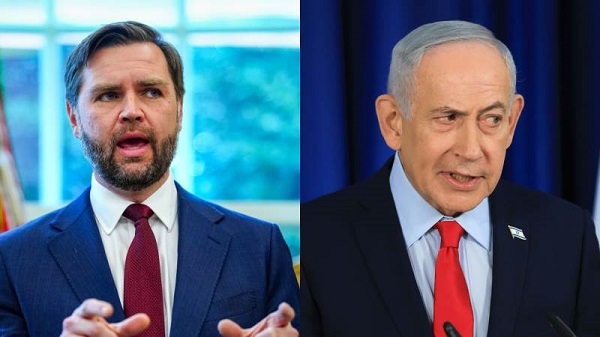
Vice President JD Vance admitted that the United States and Israel do not always want the same outcomes.
His comments came as Washington grappled with explosive intelligence reports alleging that Israeli intelligence services have been monitoring American officials involved in sensitive negotiations with Iran—claims that have reignited one of the most uncomfortable realities in the U.S.-Israel alliance.
Friends spy on each other. Allies pursue their own interests. And when those interests collide, tensions surface.
The allegation shaking Washington
According to a report by The New York Times, U.S. intelligence officials have raised concerns about Israeli efforts to gather information on senior American officials involved in the Trump administration’s diplomatic outreach to Iran.
Among those reportedly targeted were key figures shaping the administration’s Iran policy, including chief negotiator Steve Witkoff and senior Pentagon officials involved in national security planning.
Israeli officials have categorically denied the allegations, insisting that Israel does not spy on American officials and poses no threat to the United States.
Yet the accusations have resonated inside Washington because they touch on a long-standing source of friction that periodically emerges beneath the surface of the alliance: the belief among some American officials that Israel’s security priorities do not always align with broader U.S. strategic objectives.
Vance says the quiet part out loud
The significance of Vance’s comments was not what he said about the espionage allegations.
It was what he said about Iran.
Pressed about the reported intelligence operation, the vice president avoided discussing the accusations directly. Instead, he focused on the administration’s efforts to secure a long-term agreement limiting Iran’s nuclear program.
Then came the revealing admission.
“The Israelis and the United States, we have a lot of shared interests, but we also have some situations where our interests diverge,” Vance said.
In Washington, that sentence carries weight.
For years, administrations of both parties have generally avoided publicly emphasizing policy disagreements with Israel. Vance’s remarks suggest the Trump administration may be preparing Americans for the possibility that a future agreement with Iran could face opposition from Netanyahu’s government.
Netanyahu’s dilemma
Prime Minister Benjamin Netanyahu has spent much of his political career warning that negotiations with Tehran risk empowering a regime he views as an existential threat to Israel. Trump, by contrast, appears increasingly focused on securing an agreement that would prevent Iran from obtaining a nuclear weapon while avoiding a broader regional war.
Those objectives are not necessarily incompatible. But they are not identical either.
That distinction is becoming more visible as negotiations accelerate and as Washington reportedly pushes both Israel and Iran to avoid actions that could derail a potential deal.
The recent exchange of strikes between Israel and Iran has only heightened concerns that military escalation could undermine diplomatic efforts just as negotiations approach a critical stage.
An alliance under pressure
None of this suggests a rupture in U.S.-Israeli relations.
Military cooperation remains extensive. Intelligence sharing continues. American support for Israel remains deeply embedded across large parts of the U.S. political system. Yet the current dispute highlights a reality often obscured by political rhetoric.
The United States views the Middle East through the lens of global strategy. Israel views it through the lens of Middle East dominance.
Those perspectives frequently overlap. Sometimes they do not.
The bigger story
Whether the espionage allegations prove accurate may ultimately become a secondary issue. The more consequential development is the emerging public disagreement over Iran.
For years, disagreements between Washington and Jerusalem were largely managed behind closed doors. Today they are increasingly visible, unfolding in public statements, diplomatic maneuvering, and competing visions for the future of the region.
If Trump succeeds in securing an agreement with Tehran, it could reshape the Middle East’s strategic landscape. It could also test the limits of one of America’s most important alliances. And judging by the remarks coming out of Washington, that test may already be underway.
