

Ahmed Kamel – Egypt Daily News
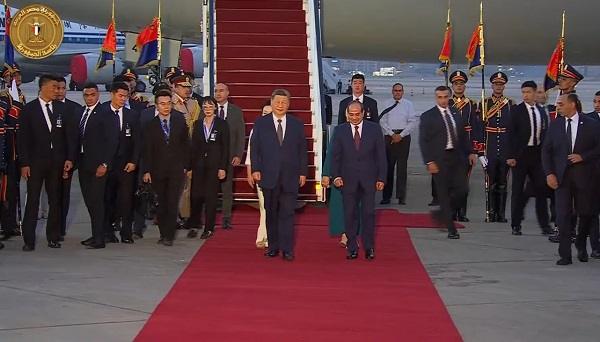
President El-Sisi and First Lady Entissar El-Sisi received the Chinese president upon his arrival, with the welcoming ceremony reflecting the importance both governments attach to their longstanding partnership. Children and young people carrying the Egyptian and Chinese flags took part in the reception, while Egyptian and Chinese citizens gathered at the airport to greet Xi and express their friendship toward the Chinese people.
The visit comes as Egypt and China mark seven decades since the establishment of diplomatic relations in 1956. Egypt was the first Arab and African country to establish formal diplomatic ties with the People’s Republic of China, a step that helped open the way for Beijing’s broader engagement with the Arab world.
According to the Egyptian presidency, Xi’s visit includes official talks with President El-Sisi focusing on ways to deepen the comprehensive strategic partnership between Cairo and Beijing. The discussions are expected to address cooperation in sectors of mutual interest, as well as regional and international developments.
The two leaders are also scheduled to exchange views on a number of political and economic issues affecting the Middle East and the wider international community. The visit is President Xi’s first trip to Egypt in more than a decade and is expected to provide fresh momentum to bilateral cooperation.
In a message delivered during an event marking the 70th anniversary of Egyptian-Chinese diplomatic relations, President El-Sisi welcomed President Xi as an honored guest and described him as a friend of Egypt and its people. The Egyptian president extended congratulations to both nations, emphasizing the depth of the relationship and the close ties between their peoples.
President El-Sisi said that he and President Xi had worked together for more than 12 years to promote friendship and cooperation between Egypt and China. During that period, he noted, bilateral relations had advanced to the level of a comprehensive strategic partnership, resulting in increased trade, investment, tourism, scientific exchanges and cultural cooperation.
The Egyptian president also highlighted the role of educational and youth exchanges in bringing the two societies closer together. He said cooperation between Egyptian and Chinese universities, research institutions and cultural organizations had contributed to greater understanding and stronger people-to-people relations.
The relationship between China and the Arab world has developed significantly since its early political foundations. One important milestone was the Bandung Conference in 1955, which brought together 29 Asian and African countries. The meeting promoted principles including peaceful coexistence, equality among nations, non-interference in domestic affairs and opposition to colonialism.
Following Egypt’s establishment of diplomatic relations with China in 1956, Beijing expanded its ties with other Arab states, including Syria, Morocco, Iraq and Algeria. During the 1970s and 1980s, China strengthened its relations with additional Arab countries, including members of the Gulf Cooperation Council. Energy later became a central component of the relationship, with Arab countries emerging as major suppliers of oil and natural gas to China.
Since the 1990s, cooperation has expanded beyond political solidarity and energy to include trade, investment, infrastructure, financing and industrial development. The establishment of the China-Arab States Cooperation Forum in 2004 created a platform for collective dialogue and coordination between Beijing and Arab governments.
In the years that followed, China established comprehensive strategic partnerships with several Arab countries, including Egypt, Saudi Arabia, the United Arab Emirates, Bahrain and Algeria. Cooperation now covers renewable energy, transport infrastructure, healthcare, agriculture, scientific research, digital services, space technology and artificial intelligence.
China generally describes these relationships as partnerships rather than traditional alliances. Its approach is based on mutual benefit, respect for national sovereignty and what it calls win-win cooperation. Chinese officials have frequently argued that partnerships allow countries to work together without creating exclusive blocs or treating other states as adversaries.
For Egypt, cooperation with China is also linked to national development plans and major infrastructure projects. The two countries share an interest in expanding investment, improving industrial capacity, increasing trade and supporting technological development. Their cooperation also intersects with China’s Belt and Road Initiative and Egypt’s efforts to strengthen its position as a regional center for trade, logistics and manufacturing.
The future of the relationship will depend on the ability of both sides to convert political ties into sustainable economic and technological projects. Regional instability, global economic pressures and security challenges in the Middle East remain important factors. Nevertheless, officials in Cairo and Beijing view the partnership as a long-term relationship built on mutual respect and shared interests.
As President Xi begins his multi-day visit, the Egyptian and Chinese governments are looking toward a new phase of cooperation. President El-Sisi said the two countries should work together to expand collaboration into additional fields and contribute to prosperity, development and peace for their peoples and the wider world.
