

Ahmed Kamel – Egypt Daily News
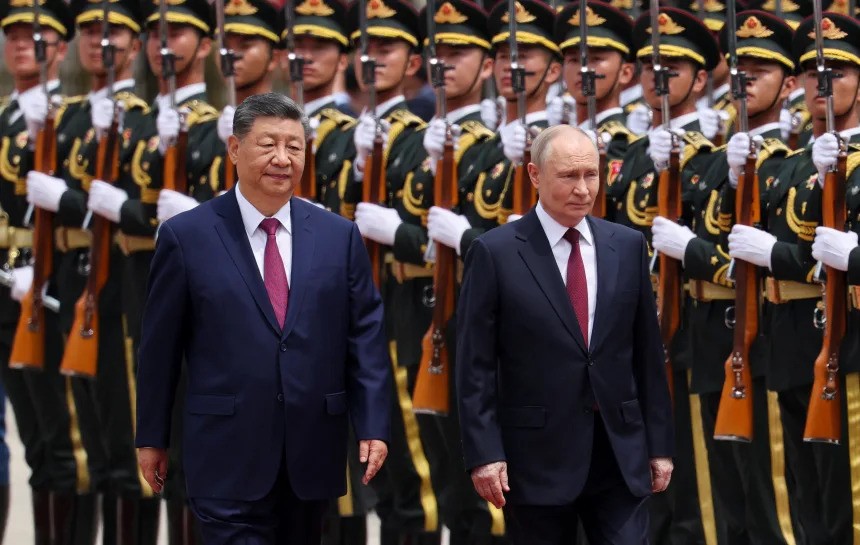
Chinese President Xi Jinping rolled out a full state welcome for Russian leader Vladimir Putin in Beijing on Wednesday, using the visit to reinforce the growing strategic partnership between China and Russia while delivering pointed criticism of US global influence.
Meeting inside Beijing’s Great Hall of the People, Xi described relations between the two countries as a stabilizing force during what he called a period of global “turbulence and transformation.” Without naming Washington directly, the Chinese leader warned against “unilateral hegemonic currents,” language Beijing frequently uses to criticize American foreign policy.
The visit came only days after Xi hosted US President Donald Trump in Beijing for high-level talks, placing China at the center of diplomacy involving both Washington and Moscow at a time of mounting international tensions.
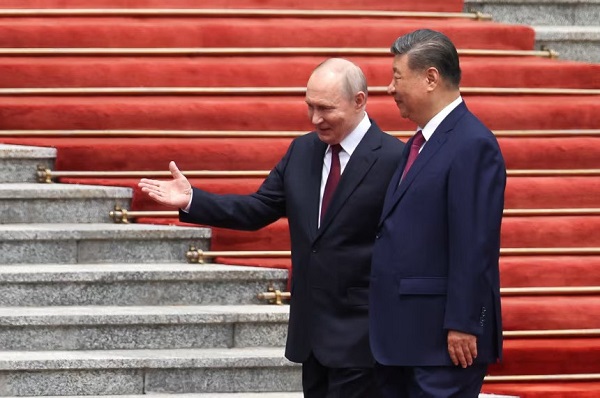
Unlike Trump’s visit, however, Putin’s trip carried heavier symbolism tied to long-term geopolitical coordination. The two leaders signed a broad joint statement reaffirming their commitment to what they described as a “multipolar world” and criticizing US military and strategic policies.
Among the sharpest points in the statement was opposition to Trump’s proposed “Golden Dome” missile defense project, which Moscow and Beijing said threatened global strategic stability by undermining the balance between offensive and defensive nuclear systems.
The two sides also used the meeting to coordinate messaging on the Middle East crisis. Xi called for an immediate end to the US-Israeli war involving Iran, warning that prolonged fighting risks further disruption to global energy supplies, trade routes and supply chains.
In a separate joint declaration released by Chinese state media, China and Russia condemned strikes on Iran and criticized what appeared to be the use of negotiations as cover for military escalation. The statement also referenced the assassination of leaders of sovereign states, an apparent allusion to the killing of Iran’s former Supreme Leader Ayatollah Ali Khamenei.
The Beijing talks reflected how closely China and Russia have aligned since Moscow’s invasion of Ukraine and the subsequent rupture between Russia and the West. China has become one of Russia’s most important economic lifelines, purchasing large volumes of Russian energy exports while expanding cooperation in banking, technology and industrial sectors affected by Western sanctions.
Putin called ties with Beijing “unprecedentedly high,” describing the relationship as one of the main stabilizing forces in world politics. The Russian leader also highlighted his personal relationship with Xi, noting the pair have met more than 40 times.
Chinese and Russian officials signed around 40 cooperation agreements during the visit covering areas including transport, technology, energy and agriculture. The two governments also agreed to extend visa-free travel arrangements for citizens until the end of 2027 and pledged deeper cooperation on artificial intelligence development.
The timing of Putin’s trip also carries strategic importance for both governments. Russia continues to face pressure on the battlefield in Ukraine, including large-scale drone attacks targeting Moscow and ongoing territorial setbacks. China, meanwhile, is navigating rising friction with the United States while trying to position itself as a central diplomatic actor across multiple global crises.
Despite the public display of unity, the relationship between the two powers has become increasingly uneven. Russia’s economy has grown more dependent on Chinese trade and financing since Western sanctions intensified, giving Beijing greater leverage in areas such as energy negotiations and regional coordination.
Wednesday’s carefully choreographed welcome complete with military honors, flag-waving crowds and state media exhibitions celebrating “unbreakable friendship”, underscored how both governments are presenting their partnership as a counterweight to US influence in an increasingly fragmented international order.
