

Ahmed Kamel – Egypt Daily News
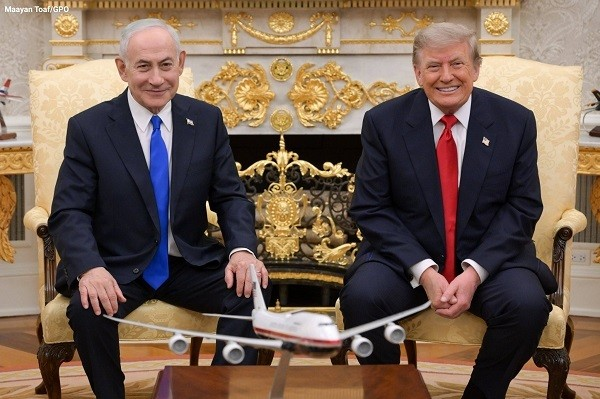
United States President Donald Trump hosted Israeli Prime Minister Benjamin Netanyahu at the White House on Tuesday for their first in-person meeting since launching a joint war against Iran. Press Secretary Karoline Leavitt characterized the high-stakes Oval Office session as positive and productive. The encounter followed a separate closed-door discussion between Trump and Ukrainian President Volodymyr Zelenskyy, as Washington serves as the focal point for concurrent global security crises.
The diplomatic showcase materialized hours after Trump publicly voiced intense irritation with the Israeli premier during a televised interview with Fox and Friends. The president complained that Netanyahu’s team had publicly leaked classified talking points regarding Iran’s underground nuclear buildup at Pickaxe Mountain.
Trump openly questioned why the details had to be announced to the world, stating he did not need his counterpart to brief him on information already tracked by American intelligence.
Deep Domestic and Bilateral Policy Strains Shadow Netanyahu’s October Reelection Campaign
Despite the public friction, official media broadcasts from the Oval Office depicted both leaders smiling alongside Vice President JD Vance, Secretary of State Marco Rubio, and Defense Secretary Pete Hegseth. Netanyahu is aggressively seeking Trump’s explicit endorsement to rescue his struggling domestic poll numbers ahead of Israel’s national election on October 27.
Bilateral relations have been heavily strained by a confirmed June phone call in which Trump labeled the prime minister insane over his management of Middle Eastern combat operations.
The prime minister faces a noticeable drop in support at home for the prolonged war with Iran, alongside plummeting approval ratings within the United States over his government’s military campaign in the Gaza Strip. Furthermore, Trump recently dismissed Netanyahu’s public criticism regarding a multi-billion-dollar American F-35 fighter jet sale to Turkey, stating that no foreign leader dictates United States defense exports. The two men also hold differing views on the scale of potential operations against Iranian infrastructure, with Trump pausing U.S. airstrikes to allow regional mediators from Pakistan, Egypt, and Qatar to negotiate a Strait of Hormuz transit proposal.
White House Links Regional Ceasefire Decisions to Abraham Accords Expansion and Saudi Normalization
The strategic White House consultations focused heavily on finalizing a framework agreement to end the Israel-Hezbollah conflict in Lebanon and expanding the Abraham Accords. Trump remains committed to incorporating Saudi Arabia into the regional normalization pact, having conditioned a thirty-year civilian nuclear cooperation deal on Riyadh signing the treaty.
However, the Saudi leadership continues to reject formal normalization without a concrete path toward Palestinian statehood, complicating the administration’s broader Middle East architecture.
Prior to Netanyahu’s arrival, Trump’s meeting with Ukrainian President Volodymyr Zelenskyy demonstrated a warming trend in U.S.-Ukraine relations as Kyiv successfully blunts Russian advances. Zelenskyy utilized the session to request technical manufacturing licenses to produce interceptors for U.S.-made Patriot air defense systems on European soil, alongside expanded partnerships for unmanned aerial vehicles.
Both foreign leaders initially traveled to Washington to attend the memorial service for the late Senator Lindsey Graham, a hawkish Republican who served as an influential advocate for both nations.
