

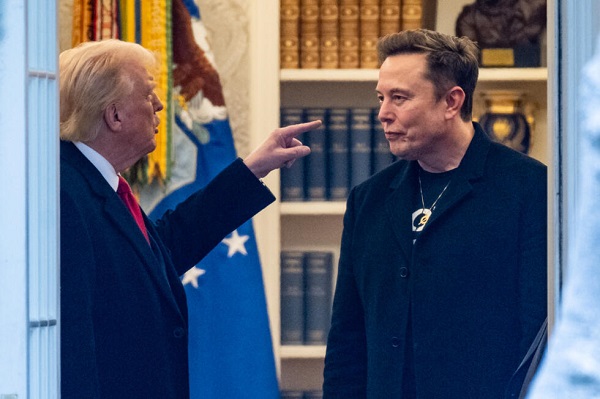
Egypt Daily News – Former allies turned political adversaries, President Donald Trump and billionaire entrepreneur Elon Musk are once again embroiled in a high-profile public feud, this time over a controversial federal spending bill and the future of government subsidies for electric vehicles.
The dispute reached new heights this week after Musk sharply criticized Trump’s flagship legislation, the so-called “Big Beautiful Bill,” which includes provisions to end federal tax incentives for electric vehicles and raises the national debt ceiling by $5 trillion. The Tesla and SpaceX CEO denounced the bill as “a disgusting abomination” and “pork-filled,” warning that it symbolizes a broken political system he referred to as the “Porky Pig Party.”
In a series of posts on X (formerly Twitter), Musk not only blasted the bill’s financial impact but threatened to fund primary challenges against Republican lawmakers who support it. “If it is the last thing I do on this Earth,” Musk wrote, “I will ensure those who promised to reduce spending and then voted for this betrayal are held accountable.”
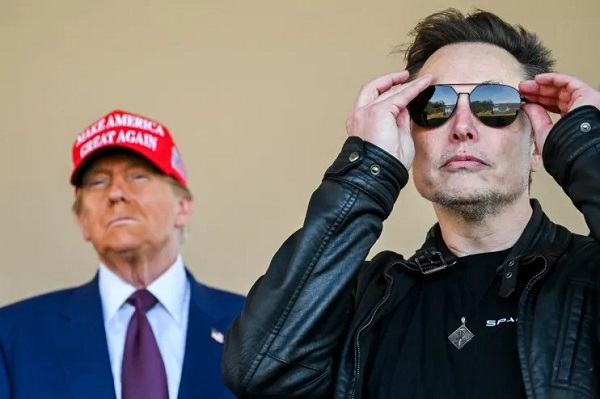
President Trump swiftly responded via his own platform, Truth Social, asserting that Musk’s criticism was driven not by fiscal concern but by the bill’s termination of electric vehicle mandates and associated subsidies. “Elon may get more subsidy than any human being in history,” Trump wrote. “Without subsidies, Elon would probably have to close up shop and head back home to South Africa.”
When pressed by reporters on July 1 about whether he would consider deporting Musk, a naturalized U.S. citizen originally from South Africa Trump stated, “We’ll have to take a look,” and joked, “We might have to put DOGE on Elon.” The remark referred to the Department of Government Efficiency (DOGE), a now-defunct federal initiative that Musk previously led to reduce bureaucratic waste.
Musk, for his part, responded to the threats with restraint, posting: “So tempting to escalate this. So, so tempting. But I will refrain for now.”
Political and Financial Stakes
The confrontation underscores the precarious relationship between the administration and one of its most influential corporate partners. Musk’s companies including Tesla, SpaceX, and The Boring Company, have received an estimated $38 billion in federal contracts, loans, subsidies, and tax incentives over the past two decades. These include crucial agreements with NASA and the Department of Defense.
While Trump contends that Musk’s opposition is a reaction to losing those benefits, Musk insists his concerns are rooted in fiscal responsibility. In one X post, Musk wrote, “I am literally saying CUT IT ALL. Now.”
Nevertheless, the president has not ruled out retaliatory measures, including the possibility of terminating federal contracts with Musk’s companies. “If DOGE looks at Musk, we’re going to save a fortune,” Trump told reporters during a visit to Florida.
From Adviser to Adversary
This latest dispute marks a sharp deterioration in what was once a productive, if uneasy partnership. Musk served as head of the DOGE office for the first several months of Trump’s second term, tasked with trimming federal inefficiencies. He resigned in late May to return to the private sector but soon began publicly criticizing the administration’s fiscal policy.
Despite a brief reconciliation in mid-June, when Musk apologized for previous remarks following a private conversation with the president, tensions reignited as the spending bill advanced through Congress. The final straw appears to have been the bill’s inclusion of measures dismantling environmental mandates Musk has long supported.
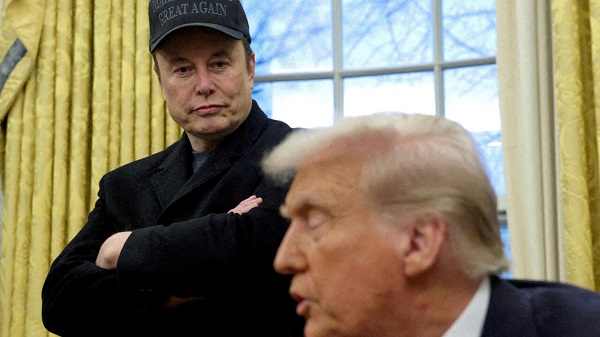
Trump has doubled down on his stance, stating that Americans should not be forced to adopt electric vehicles. “Electric cars are fine, but not everyone should be forced to own one,” the president said. “Elon is very upset that the EV mandate is going to be terminated.”
A Brewing Political Realignment?
The escalating conflict has fueled speculation that Musk may seek to launch or support a new political movement. In a June 30 post, he wrote, “It is obvious with the insane spending of this bill… that we live in a one-party country. Time for a new political party that actually cares about the people.”
Though no formal plans have been announced, Musk’s rhetoric and considerable financial resources make him a potentially disruptive force in American politics, particularly among fiscal conservatives and technology-focused voters disillusioned with traditional party structures.
As the feud unfolds, the stakes for both men and the country continue to rise. For Trump, Musk’s criticism threatens to fracture the Republican coalition ahead of key legislative battles. For Musk, retaliatory measures ranging from contract reviews to threats to deport him highlight the risks of crossing a president whose administration once championed him as a reformer.
Whether this is a temporary spat or the beginning of a lasting political rivalry remains to be seen. For now, it is clear that two of the most influential figures in American public life are headed for a collision course one that could have lasting implications for politics, technology, and governance in the United States.
