

Ahmed Kamel – Egypt Daily News
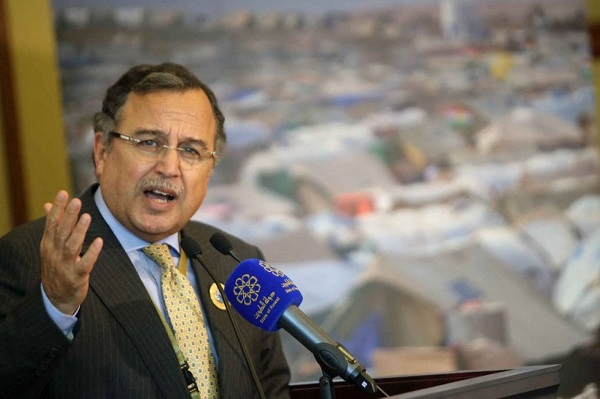
Senior Arab diplomats have agreed to appoint Nabil Fahmy as the next Secretary-General of the Arab League, succeeding Ahmed Aboul Gheit when his term concludes at the end of June. The decision, according to diplomatic sources cited by regional media outlets, was reached by consensus during the 165th session of Arab foreign ministers, with Fahmy expected to formally assume office on July 1 for a five-year term.
The appointment comes at a moment of heightened regional volatility, with Arab states grappling with security challenges, geopolitical rivalries, and shifting alliances. Officials familiar with the discussions described Fahmy as a consensus candidate capable of navigating complex diplomatic terrain while reinforcing collective Arab positions on key regional issues.
Fahmy, a veteran Egyptian diplomat born in 1951, brings decades of international experience to the role. The son of former Egyptian foreign minister Ismail Fahmy, he has long been embedded in the world of high-level diplomacy. His career includes serving as Egypt’s ambassador to the United States from 1999 to 2008, as well as ambassador to Japan, and representing Egypt in various United Nations disarmament committees.
He later assumed the role of Egypt’s foreign minister in the aftermath of the June 30 Revolution, a politically sensitive period during which Cairo sought to reassert its regional influence and recalibrate its international relationships. His tenure, which lasted until 2014, was marked by efforts to articulate Egypt’s political transition to global audiences and restore diplomatic balance.
Beyond government service, Fahmy also contributed to academia, serving as dean of the School of Global Affairs and Public Policy at the American University in Cairo, further strengthening his profile as both a practitioner and thinker in international relations.
Egyptian Foreign Minister Badr Abdelatty welcomed the consensus among Arab states, emphasizing Cairo’s appreciation for the unified backing of Fahmy’s nomination. In remarks delivered during the ministerial meeting, Abdelatty underscored the importance of Arab unity in the face of escalating regional threats.
He strongly condemned recent Iranian actions targeting several Arab countries, including members of the Gulf Cooperation Council, as well as Jordan and Iraq, describing them as violations of international law and infringements on national sovereignty. He reiterated Egypt’s full solidarity with affected states, pledging political, diplomatic, and material support.
“The security of Arab states is indivisible,” Abdelatty said, warning that any threat to one nation constitutes a direct threat to collective Arab national security. He also cautioned against attempts to destabilize the region through parallel entities or actions outside internationally recognized frameworks.
Fahmy’s appointment continues a long-standing tradition of Egyptian leadership within the Arab League. Since its founding in 1945, the position of Secretary-General has been held predominantly by Egyptian diplomats, with the notable exception of Chedli Klibi, who served between 1979 and 1990 after the organization temporarily relocated its headquarters to Tunis following Egypt’s signing of the Camp David Accords.
As Fahmy prepares to take office, expectations are high that his diplomatic experience and regional insight will help guide the Arab League through a period marked by uncertainty and transformation, where coordination and strategic clarity are increasingly seen as essential to addressing shared challenges.
