

Ahmed Kamel – Egypt Daily News
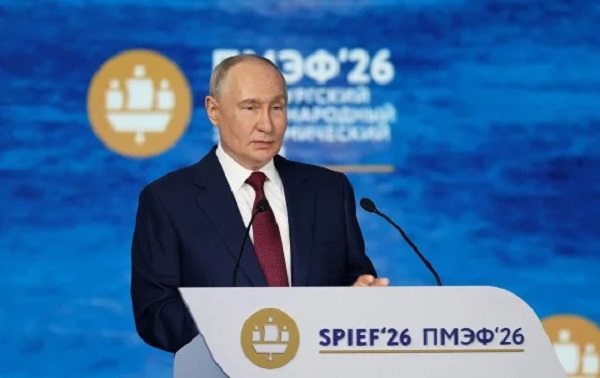
Russian President Vladimir Putin dismissed the prospect of a face-to-face meeting with Ukrainian President Volodymyr Zelenskyy on Friday, insisting that negotiations must first produce tangible results before the two leaders can sit down together.
The remarks came during the annual St. Petersburg International Economic Forum, Russia’s flagship business gathering often described as the country’s answer to Davos, where Putin sought to project confidence in Russia’s economic future despite the continuing war in Ukraine and growing geopolitical tensions.
Speaking before an audience of foreign delegates, government officials and business leaders, Putin said there was little value in a summit without prior agreements.
“First, let experts work, work something out, and then we can meet to sign things,” the Russian leader said, responding to Zelenskyy’s renewed call for direct talks between the two presidents.
The exchange followed an unusually personal challenge from Zelenskyy, who accused Putin of prolonging what he described as a needless conflict and suggested that age was beginning to affect the Russian leader’s judgment. Putin brushed aside the criticism, saying effective leadership was determined by performance rather than age and noting that many prominent political figures around the world were older than him.
The latest war of words unfolded as both Moscow and Kyiv continue to search for military and diplomatic advantages after more than four years of conflict.
Just days before the forum opened, Ukrainian drone attacks struck targets in and around St. Petersburg, Russia’s second-largest city and Putin’s hometown. The attacks disrupted air traffic, damaged infrastructure and underscored Ukraine’s growing ability to strike deep inside Russian territory despite Moscow’s extensive air defense network.
Putin acknowledged that some Ukrainian drones continue to penetrate Russian defenses and pledged further investment in air defense systems.
“To our regret, some of them break through,” he said, promising that Russia would strengthen its protective capabilities.
Despite the ongoing fighting, Putin maintained that Moscow remains open to a negotiated settlement. Speaking to foreign media representatives on the sidelines of the forum, he argued that Russia would prevail militarily if necessary but preferred a diplomatic conclusion to the conflict.
According to Putin, discussions with U.S. President Donald Trump have included potential compromises that could help end the war, although he declined to provide details. He insisted that any future agreement would require Ukraine’s participation and acceptance.
At the same time, the Russian leader reiterated Moscow’s claims over territories seized during the war, highlighting Russian control over large portions of eastern and southern Ukraine. Those territorial demands remain one of the biggest obstacles to any peace settlement, with Kyiv continuing to reject Russian sovereignty over occupied regions.
While the war inevitably dominated questions directed at Putin, his main address focused largely on economics and the emergence of what he described as a changing global order.
Presenting Russia as part of a rising coalition of non-Western powers, Putin argued that the balance of global economic influence is shifting away from traditional Western institutions. He highlighted the growing role of the BRICS grouping which includes Brazil, Russia, India, China and South Africa and claimed the bloc now surpasses the Group of Seven in economic weight.
“The paradigm is shifting,” Putin told delegates, portraying BRICS as a central pillar of a more multipolar international system. The message reflected Moscow’s broader strategy of deepening ties with Asia, Africa and the Global South as relations with Western governments remain strained following Russia’s invasion of Ukraine in 2022.
The forum itself illustrated that changing dynamic. While many Western executives and political leaders have avoided the event in recent years, delegations from China, Saudi Arabia, Central Asia, Africa and the Middle East maintained a visible presence.
Chinese Vice President Han Zheng joined Putin on stage during the event, while leaders from Uzbekistan and Tanzania also participated in high-profile discussions. Senior Iranian officials attended as well, reflecting Russia’s increasingly close partnerships outside the Western sphere.
Economic concerns, however, remain difficult for the Kremlin to ignore.
After years of heavy wartime spending helped shield Russia from the immediate impact of sanctions, signs of slowing growth are becoming more apparent. The government has increased taxes and domestic borrowing to manage budget pressures, while economists warn that military expenditures alone cannot sustain long-term expansion.
Putin acknowledged that Russia’s budget deficit could widen this year but argued that inflation was easing and would likely fall to just above 5 percent by year’s end.
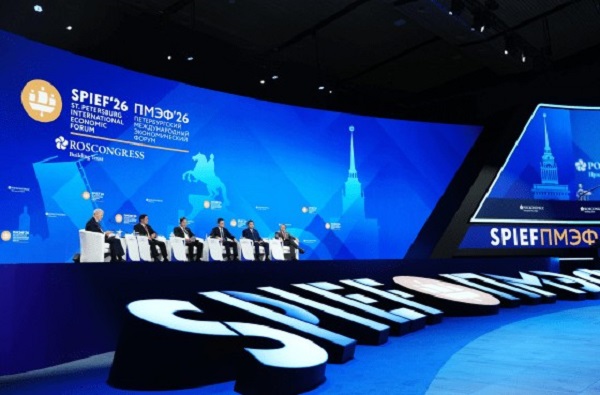
The gathering also featured a small American delegation, marking a rare official U.S. presence at the event in recent years. Among those attending was Rodney Mims Cook Jr., head of the U.S. Commission of Fine Arts, who said he had long admired St. Petersburg’s architecture and would draw inspiration from it for future projects in Washington.
Putin used the opportunity to send greetings to President Trump, whose administration has sought to maintain communication channels with Moscow even as the Ukraine war continues.
Yet despite discussions about investment, trade and a changing global economy, the shadow of the conflict remained impossible to escape. Ukrainian drone attacks, stalled battlefield gains, diplomatic deadlock and competing visions for peace all served as reminders that Russia’s most important challenge remains the war that has reshaped both its economy and its place in the world.
As Moscow and Kyiv continue to exchange attacks and political leaders trade public barbs, prospects for a breakthrough remain uncertain. For now, Putin appears willing to talk about peace, but not yet willing to sit across the table from the man leading Ukraine’s resistance.
