

Ahmed Kamel – Egypt Daily News
Egypt has opened the second edition of the El Alamein International Airshow, bringing together military aircraft, aerospace manufacturers and defense companies from more than 80 countries at one of the region’s largest aviation events.
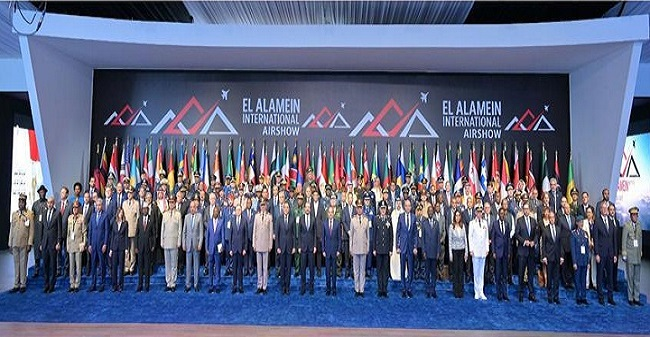
President Abdel Fattah El-Sisi inaugurated the exhibition at El Alamein International Airport on September 8, alongside the President of Cyprus and senior Egyptian officials. The three-day event is designed to promote cooperation across military aviation, civil aerospace, space technology and defense manufacturing.
The opening ceremony was attended by Prime Minister Mostafa Madbouly, Armed Forces Commander-in-Chief and Minister of Defense and Military Production General Ashraf Salem Zaher, Chief of Staff Lieutenant General Ahmed Khalifa, Civil Aviation Minister Sameh El-Hefny and Air Force Commander Lieutenant General Amr Saqr.
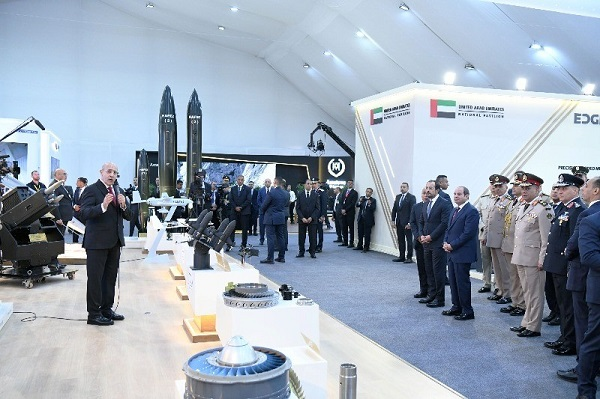
After the official welcome, the Egyptian and Cypriot presidents viewed a presentation on the exhibition and its objectives before touring the indoor halls and outdoor aircraft displays. They also received a briefing on the Arab Organization for Industrialization’s pavilion, which features locally produced defense equipment, unmanned systems, aircraft components and industrial technologies.
Organizers say the exhibition includes more than 250 exhibitors from around 50 countries. The program features static displays, scheduled flying demonstrations, professional meetings and technical discussions focused on aviation, defense systems, space services and aerospace engineering. The event is aimed at government officials, military delegations, industry representatives and aviation enthusiasts.
The United States brings five aircraft types
The United States has a significant presence at this year’s exhibition, with aircraft and personnel from the U.S. Air Force and the Texas Air National Guard participating alongside Egyptian and international counterparts.
The American aircraft lineup includes the C-130J Super Hercules, C-130H Hercules, A-10 Thunderbolt II, F-16 Fighting Falcon and F-15E Strike Eagle. Together, the aircraft represent a broad range of military capabilities, including tactical airlift, close air support, multirole combat, air superiority and long-range precision strike.
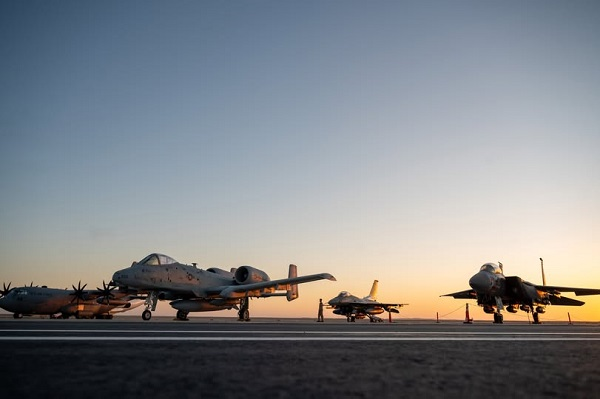
The C-130J and C-130H are used to transport troops, equipment and supplies, including to airfields with limited infrastructure. Their inclusion gives the American display a strong logistics component in addition to its combat aircraft.
The A-10 Thunderbolt II, commonly known as the Warthog, is designed for close air support and battlefield attack. Its distinctive 30-millimeter cannon, heavy armor and ability to carry a wide range of external weapons have made it one of the best-known ground-attack aircraft in the U.S. inventory.
The F-16 Fighting Falcon represents the multirole fighter category. Egypt operates a large fleet of F-16s, making the aircraft particularly relevant to the longstanding defense relationship between Cairo and Washington. The F-15E Strike Eagle adds a heavier strike capability, combining air-to-air performance with long-range precision attacks against ground targets.
The American presence extends beyond aircraft. A U.S. pavilion features more than 25 aerospace and defense companies. The companies are presenting products and services connected to military and commercial aviation, aircraft manufacturing, aerospace technology and space systems.
The U.S. participation gives the exhibition an important strategic dimension. It places American aircraft alongside rival and partner systems, allowing visiting delegations to compare different approaches to combat aviation, air mobility, surveillance and defense technology.
China presents four aircraft overseas for the first time
China is using the exhibition to make the overseas airshow debut of four People’s Liberation Army Air Force aircraft: the J-16 multirole fighter, Z-20 helicopter, YY-20 aerial-refueling tanker and KJ-500 airborne early-warning and control aircraft.
The four aircraft represent interconnected missions. The J-16 is designed for air-superiority and precision-strike operations. The YY-20 supports extended-range missions by refueling aircraft in flight. The KJ-500 provides airborne surveillance, target tracking and command-and-control functions, while the Z-20 is intended for utility and transport operations.
The Chinese aircraft arrived after participating in the Eagles of Civilization 2026 exercise with Egypt. The deployment allowed Beijing to display a broader air-operation system, combining combat aircraft, refueling, surveillance and helicopter support rather than showcasing a single platform in isolation.
The J-16 attracted particular attention as a twin-engine, two-seat fighter capable of carrying out air-to-air and air-to-ground missions. The YY-20 is based on China’s Y-20 transport aircraft but has been adapted for aerial refueling, giving it a role in extending the reach of fighter and strike aircraft.
The KJ-500, built around the Y-9 airframe, carries a radar system mounted above the fuselage. Its role is to detect and track aircraft and other aerial targets while supporting command decisions during complex operations.
Russia showcases fighters and air defense
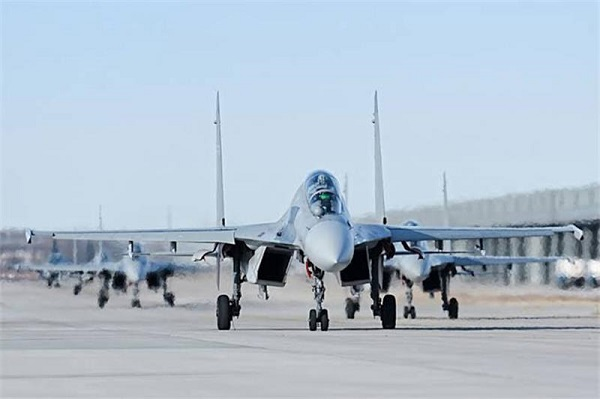
Russia’s contribution is led by the Su-57E export fighter, which performed a demanding aerial demonstration during the opening program. The aircraft carried out steep climbs, stall turns, spins, a falling-leaf maneuver and the Cobra maneuver before demonstrating low-speed control and preparing for landing.
Russia is also presenting the upgraded Yak-130M combat trainer and Ka-52E reconnaissance and attack helicopter. Its ground displays include the Pantsir-SMD-E, Viking, Tor and Antey-4000 air-defense systems, as well as counter-drone equipment such as the ZAK-30 Citadel and TKB-1167 Bizon.
The Russian presentation is intended to demonstrate a complete defense portfolio, ranging from fighter aircraft and helicopters to short-range air defense and systems designed to counter small unmanned aircraft.
A wider aerospace marketplace
Spain has contributed an Airbus A400M Atlas transport aircraft, while the United Arab Emirates is displaying the B-250 light-attack aircraft and a range of unmanned systems, guided weapons and air-defense technologies.
Egypt is emphasizing its own industrial capabilities through the Arab Organization for Industrialization and other state-linked companies. Its displays include unmanned aerial vehicles, loitering munitions, counter-drone systems, aerial bombs, aircraft engines and maintenance, repair and overhaul services.
The concentration of American, Chinese, Russian, European, Gulf and Egyptian systems at El Alamein underlines the exhibition’s broader commercial and strategic importance. Egypt is seeking to position the event as a meeting point for defense officials, manufacturers and aerospace companies seeking access to markets in Africa and the Middle East.
The show concludes on September 10 after a program of aircraft displays, technical seminars, company presentations and business meetings. For Egypt, the event is both an aviation showcase and an effort to strengthen its role as a regional hub for aerospace cooperation, defense production and military-technology partnerships.
