

Ahmed Kamel – Egypt Daily News
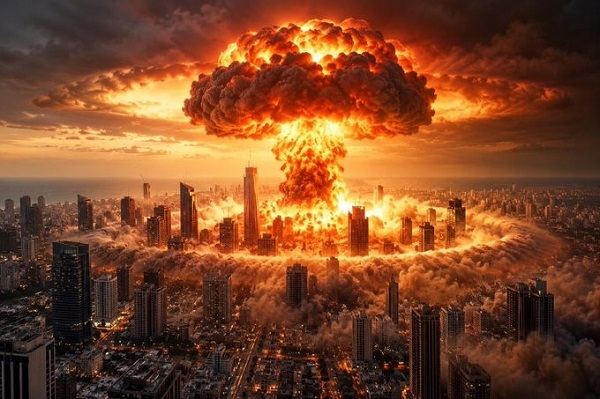
Two days before Israel’s October 27, 2026, parliamentary election, Prime Minister Benjamin Netanyahu published an AI-generated image depicting a nuclear explosion over a densely built city, warning that Iran posed an existential threat to Israel. Opposition leaders accused him of using fear to influence voters, turning the post into a flashpoint in the final days of an already heated campaign.
The image, shared on Sunday through Netanyahu’s social media accounts, shows a vast mushroom cloud rising above buildings engulfed by an explosion. The post did not explicitly identify the city in the image, but it appeared to depict Tel Aviv. Netanyahu paired it with a warning that Israel faced a “real and tangible existential danger” from Iran and its regional allies.
He urged Israelis to set aside domestic political disputes and focus on what he called the central issue: “ending the work in Iran.” The message echoed arguments Netanyahu has made throughout the campaign, presenting the Iranian threat as the most consequential question facing the country and suggesting that the next government’s ability to confront it should be a decisive consideration for voters.
Netanyahu also shared an argument by right-wing political commentator Yuval Blumberg that the possibility of Iran obtaining nuclear weapons made other political controversies seem insignificant. The text described disputes involving the government including the “Qatar-gate” affair and exemptions from military service for ultra-Orthodox Jews as a “giant smokescreen” obscuring the Iranian threat.
“If two atomic bombs fall in the center of the country, who will care about all these meaningless controversies?” the message asked. It warned that choosing a leader unable to confront Iran could put Israeli families at risk of what it called a “second Holocaust,” invoking the Nazi genocide of European Jews to emphasize the stakes.
The post also argued that Israel had a limited window to act while U.S. President Donald Trump remained in office. It said future generations would not forgive the country if it failed to use what it described as a historic opportunity to address the Iranian threat. The argument aligned Netanyahu’s campaign with the broader security debate over Iran, while implicitly presenting his continued leadership as necessary to pursue that policy.
In a separate video message, Netanyahu said Israel had intelligence indications that Iran and its allies might attempt attacks intended to disrupt the election. He said the Israeli military was prepared to act defensively and offensively, and warned Iran and its partners: “Don’t test us. You will suffer disproportionate blows.”
The threat of renewed military action against Iran has become a prominent issue in the campaign’s closing days. Critics have accused Netanyahu of seeking to restart the conflict to affect the vote or delay it, allegations he has denied. Media reports have said that Israel Defense Forces Chief of Staff Lieutenant General Eyal Zamir told participants at a recent private meeting that he did not see an operational need to strike Iran before the election.
The image and warning drew sharp criticism from opposition figures. Gadi Eisenkot, chairman of the Yashar Party, accused Netanyahu of repeating what he called a familiar campaign tactic: using lies and fear to influence voters. Eisenkot said the prime minister was threatening Israelis with mass destruction after, in his view, failing to achieve the war’s objectives against Iran.
“You’ve failed,” Eisenkot wrote, predicting that voters would express their judgment at the ballot box two days later. His response framed Netanyahu’s warning not as a necessary security alert, but as an attempt to shift the campaign’s focus and mobilize support through alarm.
Yair Golan, chairman of the Democrats party, also condemned the post. He described it as an image of an atomic bomb over Tel Aviv and called for Netanyahu to be kept away from social media. Golan said the prime minister and those around him had “lost it,” adding that the pressure was mounting as election day approached. He pledged that voters would replace those “spreading panic” and restore security and sanity to Israel.
The competing reactions reflect the campaign’s central tension: how to address genuine security concerns without turning them into election messaging. Netanyahu’s supporters can point to Iran’s nuclear ambitions and the possibility of attacks as urgent national issues. His opponents argue that the apocalyptic imagery and warnings risk amplifying public fear and making political disagreement appear secondary or disloyal.
With Israelis due to vote on Tuesday, October 27, the controversy placed Iran and Netanyahu’s handling of the threat—at the center of the campaign’s final stretch. Whether voters see the post as a necessary warning or an effort to sway them through fear remains a political question that the election itself will soon test.
