
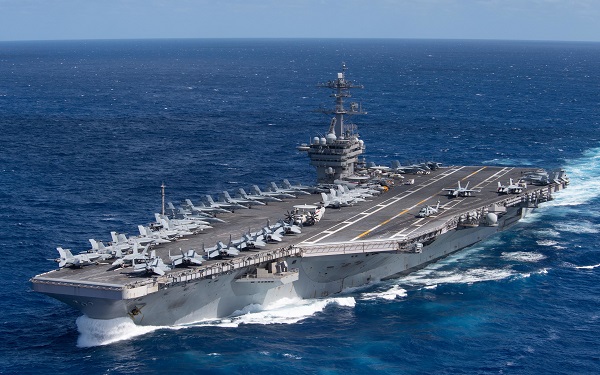
The USS Theodore Roosevelt has arrived in the Middle East, becoming the third US aircraft carrier deployed to the region as fighting with Iran continues and security concerns grow around the Strait of Hormuz.
The carrier’s arrival adds thousands of sailors and Marines to the US presence and brings another carrier strike group into a region where commercial shipping has faced repeated threats. The Roosevelt joins the USS George H.W. Bush and USS George Washington, alongside other naval forces operating in the area.
The deployment comes as President Donald Trump keeps open the possibility of further military action against Iran. The war, now in its ninth month, has involved US and Israeli strikes on Iranian targets and continuing Iranian threats to shipping in and around the strategic waterway. The Strait of Hormuz is a key route for global energy shipments, making disruption there a concern for governments, shipping companies and energy markets.
Iran’s Revolutionary Guard has said that oil tankers struck mines in the strait, while maritime security agencies have reported incidents involving commercial vessels. In one reported case, a tanker near Oman was hit by an unidentified projectile, causing a fire in its engine room. The crew were reported safe. The causes of the incidents and responsibility for them have not been independently established in every case.
The arrival of the Roosevelt follows its deployment from San Diego in September. Its presence increases US naval capacity in the region at a time when the administration has sent mixed signals about the conflict’s next phase. Trump has threatened additional large-scale strikes but has also described the military campaign as effectively over. The carrier’s arrival does not itself indicate that a new operation has been authorized.
The expanded deployment includes more than 20,000 sailors and Marines and hundreds of aircraft, according to regional reporting. The naval force also includes destroyers, cruisers and other ships. US officials have described the carrier’s arrival as a significant show of force, while the administration has not publicly set out a detailed timetable for how long the additional assets will remain.
The concentration of three carriers in the region is unusual. The US Navy also had three aircraft carriers in the Middle East in April, the first such deployment since 2003, according to reports. The current deployment reflects the scale of the military presence Washington has assembled during the conflict and the continuing importance it places on maritime security.
The pressure on shipping is occurring alongside a dispute over Iran’s nuclear programme. Tehran has said it will not allow United Nations inspectors access to damaged nuclear facilities until the war ends and its demands are met. The International Atomic Energy Agency has called for steps to resume inspections and has said it cannot confirm that nuclear material has not been diverted from peaceful purposes, amid the restrictions on its access.
Those issues complicate efforts to contain the conflict. The United States is seeking to protect its forces and maritime routes while maintaining pressure on Iran; Tehran has linked the reopening of the waterway to demands that include lifting sanctions and unfreezing Iranian assets. The lack of access to damaged nuclear sites adds another point of friction between Iran and international monitors.
The deployment also comes as regional governments weigh the risks of escalation. Gulf states have reason to be concerned about attacks affecting ports, energy infrastructure or shipping lanes, while the growing military presence may increase the possibility of miscalculation between opposing forces. Commercial operators must also decide whether to continue using routes exposed to threats or take more costly precautions.
The Theodore Roosevelt’s arrival therefore serves both operational and political purposes: it strengthens the US naval presence and signals that Washington is maintaining options as the conflict continues. But a larger deployment cannot by itself resolve the disputes driving the war or guarantee safe passage through Hormuz. Whether the carrier’s presence contributes to deterrence or becomes part of a further escalation will depend on decisions by Washington, Tehran and other regional actors in the days ahead.
