
The Presidency – Egypt News.
Today, President Abdel Fattah El-Sisi participated in the High-Level Strategic Dialogue session held as part of the activities of the Country Strategy Meeting on Egypt, organized by the World Economic Forum in Cairo on November 16 and 17, 2026. The session was attended by approximately 80 entities, comprising leaders and representatives of major global corporations, as well as heads and representatives of multilateral international financial institutions.
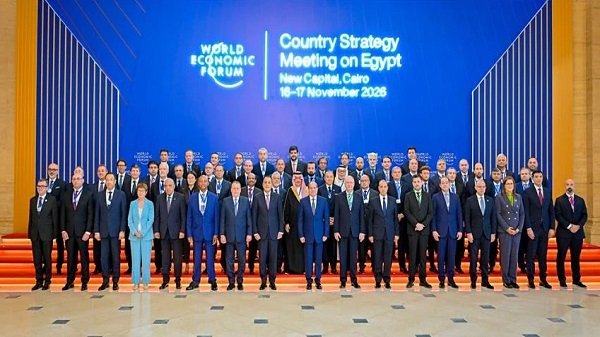
Spokesman for the Presidency Ambassador Mohamed El-Shennawy stated that, prior to the session, a commemorative photograph was taken of the President and the participants. The session then commenced with welcoming remarks by CEO of the World Economic Forum Mr. Alois Zwinggi, who welcomed the President’s participation in the High-Level Strategic Dialogue. He noted that the Forum was keen to convene this meeting with a broad range of business leaders and representatives, alongside senior Egyptian officials, to discuss Egypt’s strategic priorities and economic prospects in the coming period. This reflects Egypt’s regional stature and its position as a strategic hub connecting Africa, Asia, and Europe, particularly in the areas of trade, logistics, and energy flows.
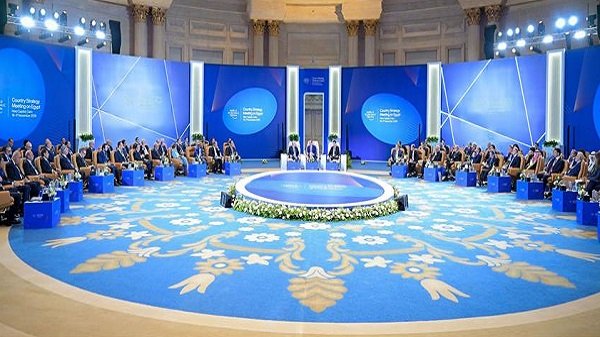
The President delivered a speech during the session.
President El-Sisi held an interactive dialogue with the participants, during which the Founder and Executive Chairman of African Rainbow Minerals Patrice Motsepe; the President of the European Bank for Reconstruction and Development (EBRD) Odile Renaud-Basso; the CEO of Majid Al Futtaim Group Ahmed Galal Ismail; and the CEO of SandboxAQ Jack Hidary, addressed inquiries to the President regarding Egypt’s investment climate, the incentives and advantages it offers to investors, and the opportunities available in light of Egypt’s position as a regional hub for trade, energy, manufacturing, and global value chains. They also inquired about existing opportunities for cooperation with Egypt, particularly in the fields of trade, industry, renewable energy, artificial intelligence, and the development of technological infrastructure.
In his remarks responding to the participants’ questions, President El-Sisi highlighted Egypt’s experience over the past 12 years and the challenges the Egyptian state had faced. The President affirmed that any investor wishing to operate in Egypt could feel assured about the security of their investments, explaining that Egypt emerged from the events of 2011 under difficult circumstances and facing major challenges, with some questioning its ability to overcome them. Nevertheless, the will of the Egyptian people enabled the country to confront economic, political, and security challenges, thereby helping the government take ambitious decisions and overcome difficulties and obstacles.
President El-Sisi added that the entire world recognizes the positive role played by the Egyptian state, which is undoubtedly linked to confidence in the Egyptian economy. The President noted that the state had pursued development across all sectors over the past 12 years, while, at a certain stage, simultaneously confronting the challenge of terrorism in the Sinai Peninsula. The President pointed out that the state had implemented an extensive plan to upgrade the country’s infrastructure, which had previously been underdeveloped. For example, the President noted that Egypt’s electricity generation capacity had increased from no more than 28 gigawatts to 64 gigawatts, while the main road network now extends over 30,000 kilometers and connects all Egyptian seaports. These ports had also expanded in both number and capacity and were now equipped to receive large vessels. The President further explained that the state allocates approximately EGP 1 trillion annually to infrastructure across all sectors, including seaports, logistics centers, airports, and storage facilities for strategic commodities and fuel.
President El-Sisi noted that the Iranian crisis had affected the outlook for logistics zones in light of the current situation in the Strait of Hormuz. The President also reviewed the developments in Egypt’s legislative framework aimed at encouraging investment, as well as the measures adopted by the state to promote investment, including those related to the repatriation of profits abroad, and the state’s settlement of arrears owed to foreign oil companies operating in Egypt.
President El-Sisi stated that, despite the state’s loss of approximately USD 20 billion in Suez Canal revenues over the past few years, the situation regarding vessel traffic through the Canal was improving. The President reiterated that Egypt was an attractive destination for investment in terms of its location, investment climate, and business environment, particularly given its political and economic stability.
In this regard, the President noted that, despite all the challenges, the state had successfully implemented economic reforms and carried out two programs with the International Monetary Fund (IMF), both of which had received the Fund’s commendation, reflecting the capabilities of the Egyptian state. President El-Sisi expressed appreciation for the considerable efforts undertaken by the IMF in cooperation with Egypt, extending a message of gratitude and respect to the Fund and its experts, especially as the state fulfilled all relevant targets.
President El-Sisi also pointed out that the public and the Egyptian people had borne the cost of all the measures implemented and targets set by the Fund. The President noted that this burden had been compounded by the difficult global circumstances, particularly given that many countries had been unable to secure public acceptance of similar measures and targets. Nevertheless, the Egyptian people had shouldered this burden. In this regard, the President extended his appreciation to the great Egyptian people.
President El-Sisi further reaffirmed that Egypt had achieved an economic growth rate of 5.1%, while the country’s ambition was to achieve an even higher rate. The President explained that Egyptian companies had gained a strong reputation and valuable expertise through their work over the past years, executing mega-projects across Arab and African countries. The President stressed that the Egyptian state supports the private sector’s involvement in leading development efforts.
President El-Sisi emphasized that the state was undertaking significant efforts to rebuild human capital and train qualified cadres, pointing out that Egypt now has 131 universities producing qualified graduates across all fields, who are capable of competing, particularly in artificial intelligence and digitization, while preparing youth for the requirements of the modern labor market.
The President stated that Egypt’s achievements were attributable to the stability it enjoys, including the continuity and stability of its reform programs and the consistent enforcement of laws. President El-Sisi affirmed that Egypt’s business environment was now ready to receive investment across all sectors, particularly in light of the economic and industrial zones established throughout the country and the facilities offered by the state, including through the Golden License. The President also highlighted the Suez Canal, through which 12% of global trade passes, as well as the massive network of ports that has been developed and connected to logistics corridors and hubs, stressing that these corridors do not compete with the Suez Canal but rather complement it.
In the same context, and in response to the specific inquiries, the President noted that Egypt had implemented its economic reform program in cooperation with numerous institutions, most notably the IMF, with whom the cooperation program is nearing completion, yielding improved macroeconomic indicators. President El-Sisi added that Egypt’s legislative and tax systems had undergone a number of reforms, alongside efforts to integrate the informal economy, stimulate investment, and achieve a comprehensive transition to digitization.
President El-Sisi further explained that Egypt had been keen to adopt a tax reform program aimed at improving relations between the tax administration and taxpayers and addressing the accumulated backlog of disputes that had persisted for years. The President noted that Egypt had also implemented numerous measures to simplify company incorporation procedures, including the Golden License program, in addition to reducing customs clearance times at ports.
The President added that the government was working to implement the State Ownership Policy Document in the economy. These efforts had resulted in a 25.9% increase in private-sector investment during the first quarter of fiscal year 2025/2026, bringing its share to 66% of total investments. President El-Sisi underscored that the state had succeeded in attracting a number of major global companies to invest in Egypt, capitalizing on the advantages the country offers. The President stressed that the state would continue to develop its investment-supportive policies.
The President also highlighted Egypt’s growing role in implementing development projects across African countries. Prominent examples include the Julius Nyerere Dam Project in Tanzania, the Jiji and Murembwe hydropower plant projects in Burundi, and the Mohéli Port Project in the Comoros. The President affirmed that these projects open up prospects for trilateral cooperation between Egyptian and international companies in executing development projects across Africa, leveraging the expertise acquired by Egyptian companies through their work in African countries.
The President further noted that the state had worked to provide stable energy supplies to support industrial and productive development and had succeeded in increasing electricity generation capacity. President El-Sisi added that Egypt was working to diversify its energy sources and strengthen reliance on new and renewable energy, with the aim of raising the share of new and renewable energy to 45% by 2028.
The President asserted that Egypt was taking serious steps towards achieving its strategic objective of becoming a regional energy hub in the Eastern Mediterranean and Africa. This would be achieved by capitalizing on Egypt’s strategic location and its natural gas and electricity transmission and distribution networks, the liquefied natural gas (LNG) plants in Idku and Damietta, its refineries, and its modern seaports with their substantial capacities. These efforts also include expanding electricity interconnection projects with neighboring countries, as well as Greece, Italy, and Cyprus; intensifying new offshore natural gas exploration activities; and improving the investment climate in the energy sector.
President El-Sisi pointed out that all arrears owed to foreign partners in the oil and gas sectors were fully paid by June 30, 2026. The President also highlighted cooperation with Cyprus to transport natural gas extracted in Cyprus to the liquefaction plants in Idku and Damietta for re-export to Europe, with this arrangement expected to become operational by 2028.
In a related context, President El-Sisi mentioned that recent crises in the region had reaffirmed that the Suez Canal remains an indispensable artery of international trade. The President stressed that diversifying transportation routes does not mean that an equivalent alternative exists or that another route can replace the Canal. These crises had also underscored the importance of Egypt’s strategic location in providing additional options for international trade flows through maritime and land connectivity arrangements.
President El-Sisi also addressed the African dimension of the investment opportunities offered by Egypt, noting that the country’s capabilities and infrastructure enable it to strengthen connectivity not only between Asia and Europe, but also between these two continents and Africa, building on ongoing north-south and east-west connectivity projects with countries across the continent.
With regard to artificial intelligence, President El-Sisi pointed out that Egypt had recently issued the second edition of its National Artificial Intelligence Strategy. The President highlighted the country’s efforts to develop its information and digital infrastructure, provide the infrastructure required for data centers and cloud computing, and secure the energy supplies needed to operate them.
President El-Sisi reaffirmed that Egypt possesses the necessary capabilities to attract major investments by leading international companies, particularly in the fields of data centers, cloud computing, the development of models and algorithms, research and development, and the establishment of centers of excellence and innovation. The President emphasized that Egypt had also intensified its investments in education, training, capacity-building, and entrepreneurship to prepare a new generation of specialists in these fields.
