
Ahmed Kamel – Egypt Daily News
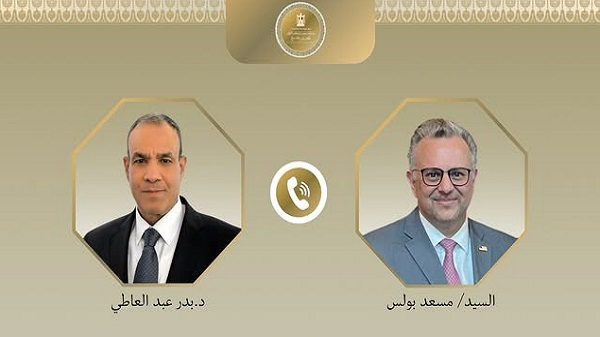
Egyptian Foreign Minister Badr Abdelatty and Massad Boulos, US President Donald Trump’s senior adviser for Arab and African affairs, discussed the war in Sudan, efforts to pursue a political settlement and developments in Libya during a telephone call this week, according to Egypt’s Foreign Ministry.
The conversation was part of ongoing consultations between Cairo and Washington on regional issues of shared concern. The officials also addressed maritime boundary delimitation, with particular reference to international law and the United Nations Convention on the Law of the Sea. The ministry’s statement did not provide further details about the maritime discussion.
On Sudan, Abdelatty reiterated Egypt’s support for the country’s unity, sovereignty and territorial integrity. He stressed the importance of preserving Sudan’s national institutions and said regional and international efforts should be intensified to reach a comprehensive political settlement. Such a settlement, he said, should bring the crisis to an end and respond to Sudanese aspirations for security and stability.
Sudan has been engulfed in fighting since April 2023, when conflict broke out between the Sudanese Armed Forces and the paramilitary Rapid Support Forces. The war followed a breakdown in relations between the two forces over, among other issues, plans to integrate them. Fighting has caused widespread displacement and a severe humanitarian crisis, with civilians facing shortages and deteriorating living conditions.
Egypt’s emphasis on preserving state institutions reflects its stated concern that Sudan’s fragmentation could deepen instability. Cairo has repeatedly called for the country’s unity and territorial integrity to be protected, while urging diplomatic efforts to end the conflict. The latest phone call placed those priorities within a broader exchange with Washington about how regional and international actors might help create conditions for a settlement.
The two officials also discussed Libya, where political divisions have left the country without a unified national administration. Abdelatty stressed the importance of protecting Libya’s unity, sovereignty and territorial integrity, and of supporting the unification of its national institutions. He called for coordinated regional and international efforts to help Libyan parties reach a comprehensive, sustainable political agreement.
Abdelatty said that any settlement should be Libyan-led and Libyan-owned. That formulation underscores the position that the country’s political future should be determined by Libyans, even as outside governments and international organizations support negotiations. Egypt’s stated approach focuses on a process that can address the political division while preserving the unity of the state and its institutions.
Libya remains split between rival political authorities. The internationally recognized Government of National Unity, led by Abdul Hamid Dbeibeh, is based in Tripoli and controls much of the west. In the east, a rival administration appointed by the House of Representatives is headed by Osama Hammad and exercises authority over the east and parts of the south. The division has complicated efforts to organize national elections and establish a single government.
The United Nations has facilitated discussions among Libyan political actors over a constitutional framework for simultaneous presidential and parliamentary elections. The aim is to create a route out of the prolonged transitional period and help reunify state institutions. The Egyptian minister’s call for a comprehensive and sustainable settlement aligns with Cairo’s stated support for a political process capable of ending the divisions, although the ministry did not announce a new initiative or specific timetable during the talks.
The conversation also covered maritime boundary delimitation under international law, particularly the Law of the Sea convention. The statement did not specify which boundaries or proposals were discussed, nor did it announce an agreement. The issue adds a legal and diplomatic dimension to the discussions, alongside the more immediate security and political concerns in Sudan and Libya.
Taken together, the call addressed three connected areas of regional diplomacy: ending Sudan’s conflict, advancing a Libyan political process and handling maritime boundaries through international legal principles. The ministry’s account emphasized sovereignty, territorial integrity, national institutions and negotiated political solutions. It offered no indication that the two governments had agreed on concrete measures, but described the exchange as part of continuing coordination between Cairo and Washington on regional developments.
