

Ahmed Kamel – Egypt Daily News
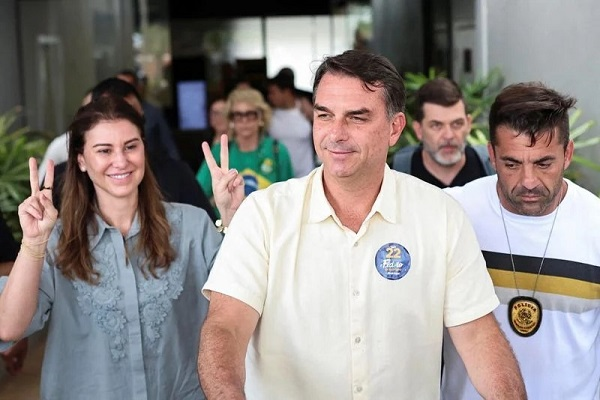
Flávio Bolsonaro’s reported arrival in Miami has intensified scrutiny of Brazil’s unresolved post-election dispute. The defeated presidential candidate left Brazil with his wife and two daughters as authorities investigated allegations against him and a court order required him to surrender his passports.
U.S. President Donald Trump said he approved of Bolsonaro coming to the United States. Asked about the family, Trump called them “fine people.” He also criticized Brazil’s election, describing it as strange and terrible, though he said he had not taken sides. Trump said he knew both Bolsonaro and President Luiz Inácio Lula da Silva.
Reports placed Bolsonaro in Miami late Tuesday, where his brother Eduardo, who lives in the United States, was said to have met him. Brazilian authorities had not officially confirmed his location in the material provided. The family was reported to have travelled through Argentina and then onward by plane, but accounts of the journey differed: Argentine officials denied that Bolsonaro had entered the country, while other reports said the family had crossed the border before departing for Ecuador.
The uncertainty over his whereabouts was sharpened by the legal order. Police said Bolsonaro had not turned over his passports within the 24-hour deadline set during a corruption investigation. The allegations include money laundering; Bolsonaro denies wrongdoing. The order came as he faced the end of his Senate term, due on January 31, 2027, after which he would lose the special jurisdiction he currently has before Brazil’s Supreme Court.
Bolsonaro has not formally accepted the result of Sunday’s election. He said he intended to challenge it, arguing that a two-hour extension of voting ordered because of transport problems made the result impossible to recognize. His Liberal Party, however, acknowledged Lula’s victory on Monday. Bolsonaro’s argument has also faced questions because his own campaign reportedly sought a voting extension after heavy rain in Brazil’s conservative south.
The supplied accounts give two different sets of final vote totals. One says Lula received 51.75% and Bolsonaro 48.25%; another reports 51.79% for Lula and 48.21% for Bolsonaro. Both versions describe Lula as the winner, but the discrepancy means the exact figures should be checked against the official final tally before publication.
Lula called Bolsonaro’s departure shameful, saying he should have remained in Brazil to prove his innocence. His comments came amid growing attention to whether the senator would return and how the investigations might proceed. Bolsonaro’s allies had been unable—or unwilling—to clarify his location. Paulo Figueiredo, a right-wing influencer who has acted as an informal spokesperson for the family, declined to answer reporters’ questions.
Trump’s comments have brought Washington into a dispute that is primarily about Brazil’s election and legal proceedings. Although he said he had not taken sides in the contest, the supplied report says two senior U.S. State Department officials supported Bolsonaro’s campaign, including through sanctions aimed at weakening Lula. It also says the Trump administration announced visas for Bolsonaro and his family. Those claims would require careful confirmation before being stated as established fact.
The family’s situation evokes the path taken by former president Jair Bolsonaro after he lost the 2022 election to Lula. Jair Bolsonaro went to the United States before returning to Brazil; he was later convicted of plotting a coup and sentenced to 27 years in prison, according to the supplied text. Flávio’s reported move abroad does not establish that he intends to follow the same course, but it has invited comparisons.
For now, key details remain unsettled: whether Flávio Bolsonaro is in Miami, whether he complied with the passport order, and whether he will pursue his election challenge from abroad. His party has recognized Lula’s win, but the senator himself has not conceded. With an active investigation and a court directive hanging over him, his next steps could shape both his legal position and the opposition’s response to the new government.
