
Ahmed Kamel – Egypt Daily News
President Abdel Fattah el-Sisi called on Russia and African countries to translate political and economic understandings into practical projects, saying the partnership should help African economies move beyond exporting raw materials and build more diverse productive capacity.
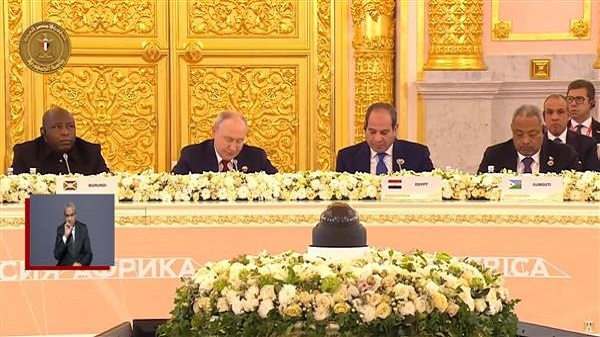
Speaking at the third Russia-Africa summit in Moscow, President Sisi said the gathering offered an opportunity to assess past cooperation and set a more ambitious, action-oriented course for the future. He emphasized that the partnership should respect African priorities, serve mutual interests and deliver tangible results that support sustainable development across the continent.
President Vladimir Putin received President Sisi at the Kremlin before the Egyptian leader took part in the summit’s plenary session. In his address, President Sisi presented Egypt’s relationship with Russia as an example of the broader cooperation possible between Moscow and African states. He pointed to the two countries’ comprehensive strategic partnership and major joint projects, including the El Dabaa nuclear power plant and a planned Russian industrial zone in Egypt’s Suez Canal Economic Zone.
President Sisi said those projects could provide a foundation for wider cooperation in energy, industry and investment, both in Egypt and elsewhere in Africa. His remarks framed the relationship not only as a series of bilateral initiatives, but also as a potential model for collaboration across the continent.
Five priorities for African development
The Egyptian president outlined five broad priorities for advancing development in Africa. They include building strategic transport corridors and logistics zones; increasing trade among African countries; expanding cooperation in energy and electricity interconnection; strengthening water and food security alongside agricultural development; and deepening collaboration in communications, information technology and artificial intelligence.
President Sisi said Egypt’s future was closely tied to the future of Africa, and argued that sustainable development depended on stronger coordination among African states and greater African ownership of development priorities. The message placed regional integration and practical infrastructure among the key requirements for economic transformation.
He also called for a more equitable and representative international system. President Sisi said Africa should have a stronger voice in shaping major global decisions, including within international institutions and the United Nations Security Council. He called for Security Council reform in line with the Ezulwini Consensus and the Sirte Declaration, African Union positions that set out demands for greater representation of the continent.
Warnings over sovereignty and regional tensions
Turning to regional affairs, President Sisi expressed concern about rising tensions in the Horn of Africa. He said Egypt opposed threats to the sovereignty of states in the region and interference in their internal affairs. He also rejected actions that could exploit regional instability to militarize the Red Sea or establish a military presence there by countries that do not border its shores.
On Sudan, President Sisi opposed any attempt to undermine the country’s unity, sovereignty, territorial integrity or national institutions. He called for coordinated efforts to end the war and support a political process leading to Sudanese-led dialogue.
Water governance was another major subject in the address. President Sisi said Egypt, whose water resources are limited and whose reliance on the Nile is substantial, attaches particular importance to cooperation over transboundary rivers under international law. He called for adherence to principles of avoiding harm, advance notification, consultation and consensus.
Water shared across national borders, he said, should serve as a bridge for cooperation and understanding rather than a source of conflict. He situated that position within Egypt’s approach to cooperation with Nile Basin countries and the African Water Vision 2063.
Partnership plan adopted for 2027–2029
Egyptian presidential spokesman Mohamed El-Shennawy said the summit’s plenary session adopted a package of documents to guide Russia-Africa cooperation in the coming period. These included the summit’s final declaration, a declaration on cooperation in the peaceful use of artificial intelligence technologies, and an action plan for the Russia-Africa Partnership Forum covering 2027 to 2029.
President Sisi welcomed the action plan, describing it as a framework for strengthening the strategic partnership and developing areas of shared cooperation. He reiterated that the partnership’s success should be judged by whether political and economic understandings produce concrete outcomes and sustainable projects.
The agenda combined economic priorities with calls for greater African representation in global institutions and warnings about regional security. Across those themes, Sisi emphasized implementation: infrastructure, trade, energy, technology and agricultural development were presented as areas where cooperation should produce measurable benefits.
Following the plenary session, President Sisi was scheduled to attend a working lunch for the heads of state and delegations participating in the third Russia-Africa summit.
