

Ahmed Kamel – Egypt Daily News
Egypt has firmly rejected what it described as a “fantastic” acquisition offer from an Emirati logistics group, underlining the government’s determination to retain control over one of the country’s most strategically important port operators.
The Holding Company for Maritime and Land Transport, a state-owned enterprise, announced that it has no intention of selling its stake in Alexandria Container and Cargo Handling Company (ACCHC), despite interest from Black Caspian Logistics Holding Limited, a subsidiary of Abu Dhabi Ports Group. The Emirati firm has indicated it plans to submit a mandatory tender offer at 22.99 Egyptian pounds per share in an effort to raise its ownership to 90 per cent of ACCHC’s capital.
In an official letter sent to ACCHC and disclosed to the Egyptian Stock Exchange, the holding company said it remains fully committed to its investment and has no plans to divest any portion of its approximately 35.37 per cent stake. The statement emphasized that the company intends to preserve all its shareholder rights and views the asset as a long-term strategic holding rather than a candidate for exit.
Black Caspian Logistics currently owns 19.32 per cent of ACCHC, following its acquisition in November 2025 of a stake previously held by the Saudi Egyptian Investment Company. The move was widely seen as part of Abu Dhabi Ports Group’s broader regional expansion strategy, which has included investments in ports, terminals, and logistics corridors across Africa, the Middle East, and Central Asia.
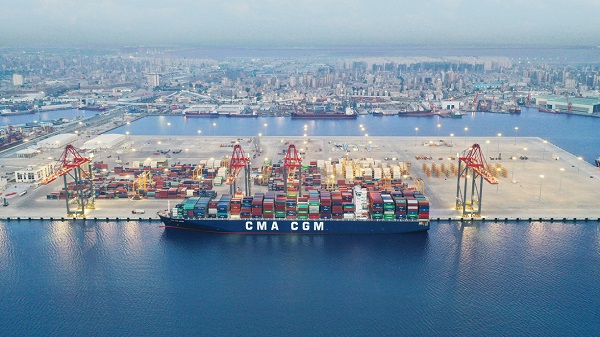
Founded in 1984 and listed on the Egyptian Stock Exchange since 1995, Alexandria Container and Cargo Handling Company is Egypt’s largest container terminal operator and a cornerstone of the country’s maritime infrastructure. The company operates two main terminals at the ports of Alexandria and El Dekheila, which together handle a significant share of Egypt’s seaborne trade. With a combined design capacity of 1.5 million twenty-foot equivalent units (TEUs) per year, ACCHC plays a vital role in supporting imports, exports, and regional transshipment.
Operationally, the company has continued to post solid results. In the 2024/2025 financial year, ACCHC handled approximately 1.07 million TEUs, representing an operating rate of around 71 per cent. This performance reflects both steady demand and the company’s strong operational efficiency amid global shipping volatility and regional supply chain disruptions.
Financially, ACCHC stands out as one of the most profitable state-linked companies in Egypt. Revenues in the last financial year reached 8.37 billion Egyptian pounds, while net profit for the first quarter of the 2025/2026 fiscal year amounted to roughly 1.73 billion pounds. By June 2025, the company’s net cash position stood at around 9.7 billion pounds, underscoring its strong balance sheet and limited reliance on external financing. Its profit margin, reported at 64 per cent, is exceptionally high by global port industry standards.
Analysts say these figures help explain the holding company’s refusal to consider selling, even at what market participants have described as an attractive valuation. Beyond profitability, ACCHC is widely viewed as a strategic national asset, given Egypt’s geographic position on key global trade routes and the government’s broader plans to transform the country into a regional logistics and transport hub.
The decision also comes at a time when Egypt is carefully balancing the need to attract foreign investment with maintaining state influence over critical infrastructure. While Cairo has pursued privatization and asset sales in several sectors as part of economic reform efforts, ports and transport assets remain politically and economically sensitive.
For Abu Dhabi Ports Group, the rejection represents a setback but not necessarily the end of its ambitions in Egypt, where it already maintains a presence and continues to explore partnerships and investments. For Egypt, the move sends a clear signal that while foreign capital is welcome, control over key maritime gateways remains non-negotiable.
As global competition for logistics assets intensifies, the standoff highlights the growing strategic importance of ports in regional economic policy and the limits of cross-border acquisitions when national interests are at stake.
