

Ahmed Kamel – Egypt Daily News
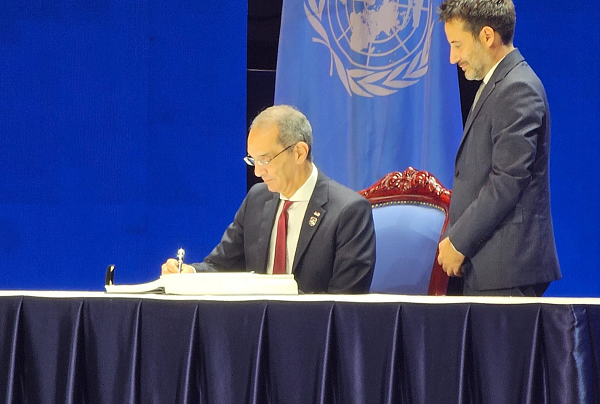
Egypt has officially signed the United Nations Convention against Cybercrime during a conference in Hanoi, Vietnam. The signing was carried out by Dr. Amr Talaat, Minister of Communications and Information Technology, who led Egypt’s high-level delegation. The ceremony was attended by Vietnamese President Luong Cuong, UN Secretary-General António Guterres, UNODC Executive Director Ghada Waly, Egypt’s Ambassador to Vietnam Hany Mostafa, and representatives from over 60 countries.
The UN Convention against Cybercrime is the first comprehensive international legal framework aimed at addressing cyberthreats and transnational crimes in the digital space. Adopted by the UN General Assembly on December 24, 2024 (Resolution No. 79/243), it seeks to enhance global cooperation in preventing and combating cybercrime, particularly through exchange of electronic evidence, technical assistance, and capacity-building, with a focus on supporting developing nations. The Convention includes a preamble and nine chapters covering criminalization, jurisdiction, procedural measures, international cooperation, preventive actions, and implementation mechanisms. It will take effect 90 days after ratification by at least 40 countries.
Egypt’s signing reflects its active involvement in negotiations since 2021, engaging ministries such as Foreign Affairs, Justice, and Communications, as well as national bodies like the Administrative Control Authority (ACA) and National Telecom Regulatory Authority (NTRA). The commitment underscores Egypt’s dedication to international collaboration in securing digital ecosystems and strengthening the rule of law in cyberspace.
During the ceremony, Dr. Talaat conveyed greetings from President Abdel Fattah El-Sisi, appreciating Vietnam’s role as host and highlighting the recent elevation of Egypt–Vietnam relations to a comprehensive partnership. He described the Convention as a historic step toward a secure and just international digital order, reflecting shared global commitments to multilateralism, justice, and responsible digital governance.
Dr. Talaat emphasized that justice in the digital era must extend to cyberspace, and highlighted Egypt’s two decades of efforts in building a robust national cybersecurity system. This includes legislation, judicial cooperation, and technical institutions such as the Egyptian Computer Emergency Readiness Team (EG-CERT), which collectively protect citizens, institutions, and national infrastructure in line with the Digital Egypt Vision for a secure, inclusive, and sustainable digital society.
Egypt also announced plans to establish an Egyptian–African Center for Preventing and Combating Cybercrime in collaboration with the UNODC. The center will act as a regional hub for capacity-building, knowledge exchange, and technology transfer, enhancing Africa’s digital resilience and promoting shared sovereignty in cyberspace.
Dr. Talaat concluded by reaffirming that digital security is a shared global responsibility and stressed that ICT should be a force for development and peace, not disruption or division. By signing the UN Convention against Cybercrime, Egypt joins a growing coalition of nations committed to a safe, just, and sustainable digital future.
