
Ahmed Kamel – Egypt Daily News
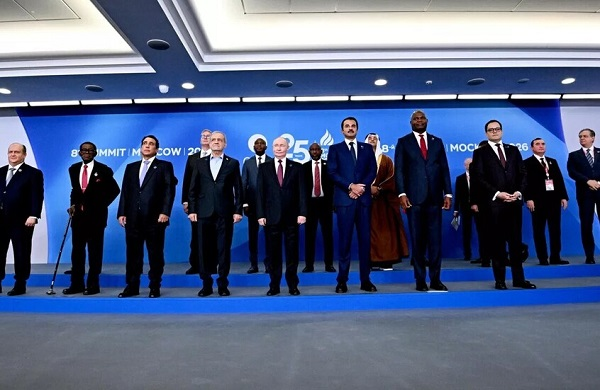
Leaders and representatives of the Gas Exporting Countries Forum adopted the Moscow Declaration at the conclusion of the forum’s eighth summit, held in the Russian capital on Tuesday under the chairmanship of President Vladimir Putin. Delegations approved the final document after the summit’s plenary session at the Moscow World Trade Center.
The gathering brought together several heads of state and government, including Iranian President Masoud Pezeshkian, Qatar’s Emir Sheikh Tamim bin Hamad Al Thani, Mozambique’s President Daniel Francisco Chapo, Equatorial Guinea’s President Teodoro Obiang Nguema Mbasogo and Libya’s Presidential Council chairman, Mohamed al-Menfi. Venezuela’s acting president, Delcy Rodríguez, addressed the summit by video. Algeria was represented by its prime minister, while other member states sent ministers responsible for energy.
The declaration is intended to set out shared priorities for the forum’s members, which include some of the world’s major natural gas producers. Kremlin aide Yuri Ushakov said before the summit that the document would emphasize the role of member countries as reliable suppliers and their contribution to global energy security.
The announced priorities included expanding cooperation to diversify gas trade routes, adopting modern technologies and reducing environmental impacts. The declaration was also expected to address the goal of securing fairer and more predictable natural gas prices, while limiting market volatility.
The summit followed the forum’s 28th ministerial meeting, held in Moscow on October 26. Ministers discussed challenges to global energy security and possible ways to improve stability in gas markets. Their deliberations took place amid disruption to international energy flows and continuing disagreements over sanctions and trade restrictions.
Russian Energy Minister Sergey Tsivilyov said the crisis in the Strait of Hormuz had affected about 20% of global liquefied natural gas supplies. He also argued that unilateral restrictions imposed on several forum members—including Russia, Iran and Venezuela had contributed to market volatility and higher prices. His comments presented the forum as a venue for producers to coordinate their positions amid instability, though the summit’s announcement did not detail specific measures to address supply disruptions or price movements.
The Gas Exporting Countries Forum is an intergovernmental organization with 12 full members: Russia, Iran, Qatar, Algeria, Bolivia, Egypt, Equatorial Guinea, Libya, Nigeria, Trinidad and Tobago, the United Arab Emirates and Venezuela. Figures released by the Kremlin ahead of the summit said the members collectively hold about 70% of proven global natural gas reserves, account for 38% of worldwide production and supply 42% of gas exports and 47% of liquefied natural gas exports.
Alongside the summit, Putin held bilateral talks with Pezeshkian, focusing on relations between Russia and Iran and the situation in the Middle East. Putin said the two presidents had discussed regional developments and expressed hope that the situation would move in a positive direction.
The Russian president also said bilateral trade had increased by 10.4% during the first eight months of the year. He reiterated Moscow’s commitment to joint projects with Tehran and said work was continuing on the Bushehr nuclear power plant in Iran. Putin said Russia was meeting its obligations across the countries’ shared projects and welcomed Pezeshkian’s visit.
The summit and bilateral meeting highlighted overlapping diplomatic and economic priorities for Moscow and Tehran. Both countries are members of the gas forum and face restrictions that they say affect their energy sectors. Their leaders used the meetings to emphasize cooperation, although the statements provided no detailed timetable for new projects or specific agreements beyond the continued work at Bushehr.
The Moscow Declaration’s practical impact will depend on how its broad goals are translated into cooperation among the member states. Diversifying trade routes, improving price predictability and limiting market disruption are shared interests for gas producers, but they involve complex infrastructure, commercial arrangements and geopolitical conditions. The summit concluded with a common statement of priorities, while leaving the details of implementation to future discussions among governments and energy officials.
