
Ahmed Kamel – Egypt Daily News
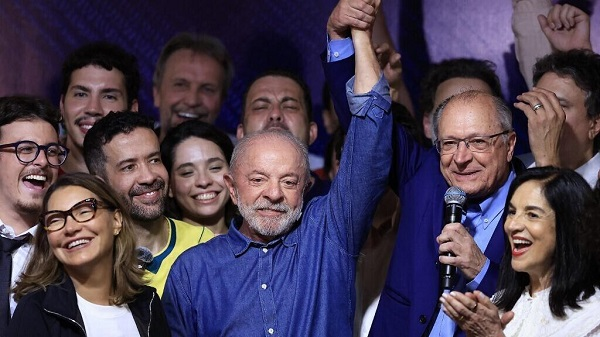
World leaders began responding after Brazil’s electoral authorities declared President Luiz Inácio Lula da Silva the winner of Sunday’s presidential runoff, giving him a fourth, non-consecutive term. Lula defeated right-wing challenger Flávio Bolsonaro in a closely watched contest that has drawn attention well beyond Brazil, with governments and political figures signaling their hopes for continued cooperation with Latin America’s largest economy.
The result gave Lula 51.8% of the vote, a lead of nearly 4.4 million votes, with all ballots counted, according to the electoral court. Bolsonaro did not concede and called for the results to be annulled, citing disruptions following a last-minute decision to extend voting by two hours. The outcome is also a notable reversal: Bolsonaro led after the first round, but Lula won the runoff.
In Latin America, congratulations came from leaders with different political outlooks. Mexican President Claudia Sheinbaum said Brazil’s voters had made their choice and described the outcome as a victory for democracy. Cuban President Miguel Díaz-Canel also congratulated Lula, calling the result historic and linking it to the pursuit of peace, sovereignty and social justice. Venezuela’s foreign ministry praised Brazilian participation in the election and said it wanted to continue cooperation with its neighbor.
Some right-leaning leaders in the region also emphasized the importance of maintaining ties with Brasília. Chilean President José Antonio Kast said he looked forward to working with Brazil, particularly on economic integration and combating organized crime. Peru’s Keiko Fujimori highlighted cooperation and sustainable development in the Amazon, while Ecuadorian President Daniel Noboa pointed to common regional challenges and the benefits of working together.
In Argentina, President Javier Milei had not issued a public response, while former president Cristina Fernández de Kirchner congratulated Lula. In North America, Canadian Prime Minister Mark Carney welcomed the result and described the recent development of relations between Ottawa and Brasília as an opportunity to deepen economic and political cooperation. U.S. President Donald Trump had not commented on Lula’s victory by Monday. He had previously praised Flávio Bolsonaro’s performance in the first round. Democratic Senator Bernie Sanders, meanwhile, called Lula’s win an extraordinary victory and said the Brazilian leader had defended workers and democracy.
European leaders also welcomed Lula’s return to office, stressing trade, climate policy and cooperation through international institutions. European Commission President Ursula von der Leyen said democracy and multilateralism had prevailed and called for continued work with Brazil on open trade, climate action and a rules-based international order. European Council President António Costa congratulated Lula by phone and said the two sides should continue working together to deepen relations and address global challenges.
French President Emmanuel Macron, Dutch Prime Minister Rob Jetten and Portuguese Prime Minister Luís Montenegro were also among those offering congratulations. Macron called for stronger ties between France and Brazil, describing their relationship as a strategic partnership with a role to play in addressing major global issues.
The European response reflects the importance of Brazil to the European Union’s efforts to expand commercial links with South America. Lula’s government has worked with European leaders on the EU-Mercosur trade agreement, involving Brazil, Argentina, Paraguay and Uruguay. A change in Brazil’s political direction could have complicated those discussions: Flávio Bolsonaro had advocated loosening some constraints associated with the bloc and pursuing separate trade deals.
The prospect of closer cooperation comes amid wider uncertainty over trade, including tariffs imposed by the Trump administration. Brussels and Brasília share interests in maintaining open trade and strengthening multilateral cooperation, though they do not agree on every international issue. Brazil’s close relationship with Russia, for example, has highlighted differences in their approaches to global conflicts. Brazil is also a member of the BRICS group.
Russian President Vladimir Putin sent Lula a congratulatory message, calling him a “dear friend” and praising the bilateral relationship. Putin also commended the Brazilian public’s support for Lula’s approach to sustainable social and economic development.
Spain’s Prime Minister Pedro Sánchez framed Lula’s victory in domestic political terms as well as diplomatic ones. He celebrated the result as a success for progressive politics and suggested that a similar shift could happen in Spain. His comments came as his government faces pressure from conservative opposition parties, giving the message significance beyond the two countries’ bilateral relationship.
Lula’s election victory does not end Brazil’s political uncertainty. Flávio Bolsonaro’s challenge to the result sets up a potential dispute even as international leaders move to recognize the outcome. Lula will also take office in a deeply divided country, with a right-leaning Congress that could make governing difficult. For foreign governments, congratulations signal an interest in preserving working relationships with Brasília; the next test will be whether those diplomatic expectations translate into sustained cooperation on trade, climate policy and regional security.
