
Ahmed Kamel – Egypt Daily News
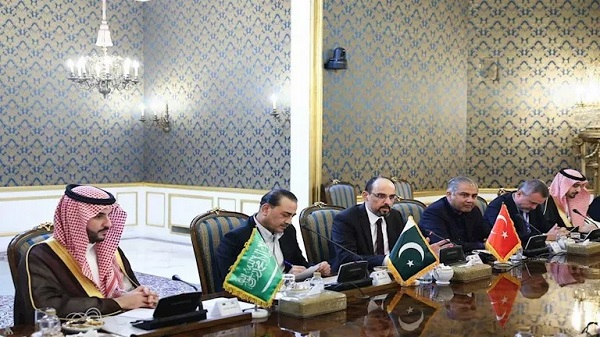
Senior officials from Saudi Arabia, Pakistan and Turkey met Iranian leaders in Tehran on Monday as regional governments sought to prevent renewed fighting. The talks brought together representatives of countries with differing security relationships, against a backdrop of heightened concern about the Iran war, attacks on Saudi Arabia and efforts to revive diplomacy.
The visiting officials included Saudi Defense Minister Prince Khalid bin Salman, Pakistan’s army chief, Field Marshal Asim Munir, and Ibrahim Kalin, the head of Turkey’s intelligence service. They met Iranian officials, including President Masoud Pezeshkian and senior security figures. Iran’s Foreign Ministry said the discussions would address pressing regional security threats, while Saudi Arabia described the visit as an effort to explore ways to reduce tensions and support regional stability.
The meeting took place as Saudi Arabia, Pakistan and Turkey were seeking to coordinate their responses to threats against Saudi territory. The three countries signed a collective defense agreement in August. Under the agreement, an armed attack against one member is to be treated as an attack against all three. The pact’s commitments were already under pressure: Saudi Arabia had reported intercepting missiles and drones, and Houthi attacks had added to concerns about the conflict spreading.
The Tehran meeting placed Iran in direct discussions with the three members of the defense pact. It was the first high-level meeting between Iran and all three countries since hostilities had escalated. The gathering did not, however, mean that Iran had joined the pact or that the four governments had formed a new alliance. Their talks brought together countries with different interests at a moment when each faced risks from a wider regional confrontation.
Iranian President Masoud Pezeshkian said his country supported agreements that could deepen regional cooperation, resolve differences and make better use of the capabilities of Islamic countries. Iran has argued that regional security should be built through the participation of countries in the region, rather than through external pressure or intervention. Saudi Arabia, for its part, said its delegation wanted to find ways to de-escalate tensions and strengthen regional security.
The talks also unfolded alongside diplomatic efforts by Qatar and Pakistan. Qatari mediators traveled to Tehran on Sunday, working in coordination with the United States, according to regional officials. Pakistan and Qatar had previously helped broker a temporary agreement intended to ease the confrontation between Washington and Tehran, reopen the Strait of Hormuz and begin negotiations on a wider settlement. That arrangement broke down as attacks resumed.
The immediate agenda in Tehran was not fully set out publicly. Iranian Foreign Ministry spokesperson Esmail Baghaei said the meeting’s agenda had not been fixed in advance, but that the discussions would address major threats to regional security. Reporting on the talks identified the war in Yemen and Houthi attacks on Saudi Arabia among the subjects raised. The meeting came as the Saudi government faced a direct security challenge and its partners were considering how to fulfill the defense pact’s commitments.
The diplomatic initiative also took place amid a broader confrontation involving Iran and the United States. Negotiations between Tehran and Washington had stalled, while both sides continued to exchange warnings. Iranian officials said diplomacy remained possible but objected to what they described as unilateral U.S. demands. The regional talks offered another channel for discussion, but did not resolve the larger disagreements between Iran and Washington.
The nuclear issue was an important point of distinction. The reported focus of the four-way discussions was security coordination and reducing the risk of escalation, rather than negotiations over Iran’s nuclear program. The broader U.S.-Iran dispute, however, still includes nuclear questions, and previous mediation efforts had linked those issues to proposals for a wider settlement.
The meeting’s significance lies in the effort to keep communication open among governments that could otherwise find themselves on opposing sides of a widening conflict. Saudi Arabia, Pakistan and Turkey have committed to collective defense, while Iran is a major regional power whose actions and relationships affect the same security environment. Bringing their officials together did not erase these differences, but it created an opportunity to discuss immediate risks and possible routes to de-escalation.
Whether the Tehran discussions lead to lasting arrangements remains uncertain. The four governments have not publicly announced a binding agreement establishing a new security framework. Their statements and reported exchanges instead point to continued dialogue, mediation and coordination as urgent priorities. With tensions still elevated and attacks continuing, the central test will be whether the diplomatic contacts can reduce the danger of renewed fighting and prevent the conflicts already underway from drawing in more countries.
