

Ahmed Kamel – Egypt Daily News
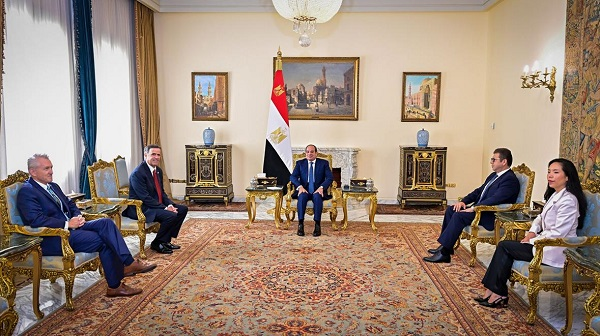
President Abdel Fattah El-Sisi and US Central Intelligence Agency Director John Ratcliffe held talks in Cairo on Sunday focused on the Iran crisis, the Gaza ceasefire, Sudan, Somalia and the broader security relationship between Egypt and the United States.
The meeting brought together two senior intelligence and political officials at a time of heightened tensions across the Middle East and the Horn of Africa. Egypt’s General Intelligence Service Director Hassan Rashad also attended the talks.
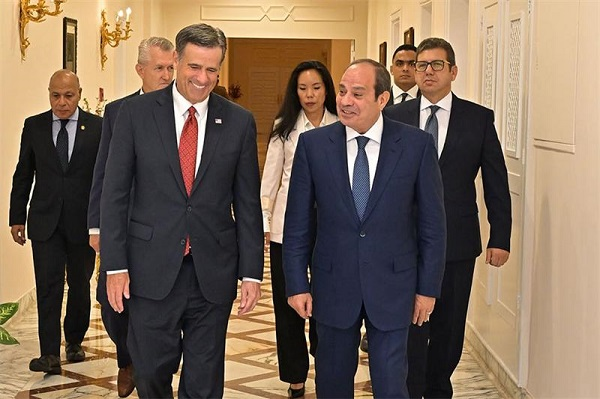
According to Egyptian Presidential Spokesman Mohamed El-Shennawy, the discussions began with bilateral relations and ways to strengthen the long-standing strategic partnership between Cairo and Washington. President El-Sisi said Egypt valued its historic ties with the United States and emphasized the continued development of cooperation in the political, security and economic fields.
The Egyptian president described the United States as a key strategic partner and praised the level of consultation between the two countries on regional and international issues. He also welcomed what he described as US President Donald Trump’s efforts to promote peace, security and stability.
Ratcliffe conveyed Trump’s greetings to President El-Sisi and reaffirmed Washington’s interest in maintaining close coordination with Egypt. The CIA director highlighted Egypt’s central role in regional diplomacy and security, particularly in efforts to contain conflicts and support negotiated settlements.
The talks took place against the backdrop of the continuing Iran crisis. President El-Sisi said Egypt supported efforts to reach a comprehensive agreement that could restore regional security and stability while protecting freedom of navigation. He reiterated Cairo’s opposition to attacks against Arab states and called for regional disputes to be addressed through political and diplomatic channels.
Egypt has consistently argued that military escalation alone cannot resolve the region’s crises. During the meeting, President El-Sisi stressed the importance of addressing the underlying causes of conflicts while preserving national institutions, state sovereignty and territorial integrity.
The two sides also reviewed the situation in Gaza and the future of the ceasefire agreement. President El-Sisi called for the full implementation of the second phase of Trump’s plan to consolidate the truce. He praised the efforts of mediators working to establish a detailed roadmap for carrying out the next stage.
The Egyptian president said the immediate priorities should be maintaining the ceasefire, protecting civilians and ensuring that humanitarian assistance reaches Gaza in sufficient quantities and without obstruction. Egypt has played a central role in negotiations involving Israel, Palestinian factions and international mediators, and Cairo has repeatedly called for sustained humanitarian access to the Gaza Strip.
President El-Sisi also said that conditions must be created for the political process to resume. He reaffirmed Egypt’s support for a just and comprehensive settlement of the Palestinian issue based on international resolutions and the establishment of two states.
Ratcliffe praised Egypt’s role in helping secure the Gaza ceasefire and acknowledged Cairo’s continuing efforts to support a wider peace process. His comments underscored the importance Washington places on Egypt’s diplomatic influence, particularly because of its geographic position, its relationship with the Palestinian leadership and its longstanding contacts with multiple regional parties.
Security cooperation was another central issue during the meeting. Ratcliffe referred to existing coordination between the CIA and Egypt’s General Intelligence Service in counterterrorism, intelligence sharing, organized crime and the fight against transnational criminal networks.
The two agencies also discussed regional security developments and the exchange of assessments concerning threats affecting the Middle East and Africa. Their cooperation reflects broader efforts to confront militant organizations, cross-border crime and risks to international maritime routes.
Sudan was also high on the agenda. President El-Sisi reaffirmed Egypt’s support for Sudan’s unity, stability and legitimate state institutions. He said Sudan’s sovereignty and territorial integrity were fundamental principles that could not be compromised.
Egypt has sought to position itself as an important regional actor in efforts to end Sudan’s war. Cairo has participated in diplomatic initiatives aimed at stopping the fighting, reducing humanitarian suffering and encouraging a political settlement. The conflict has also created direct security and humanitarian concerns for Egypt, which shares a long border with Sudan and has received large numbers of people fleeing the violence.
The discussions further covered Somalia and the wider Horn of Africa. President El-Sisi expressed Egypt’s support for efforts to strengthen security and stability in Somalia and rejected any actions that could undermine the country’s sovereignty or territorial integrity.
Ratcliffe praised Egypt’s role in supporting stability across Africa and emphasized the need for sustained US-Egyptian consultation on Somalia, Sudan and maritime security. The Horn of Africa has become increasingly important to regional powers because of its proximity to the Red Sea, the Gulf of Aden and major international shipping routes.
The meeting demonstrated the breadth of the Egypt-US security relationship. While Gaza and Iran dominated the immediate political agenda, the talks also addressed a wider network of challenges stretching from North Africa to the Middle East and the Horn of Africa.
For Cairo, the meeting provided an opportunity to reaffirm its diplomatic priorities: preventing further regional escalation, protecting Arab state sovereignty, maintaining international navigation and preserving a role for political negotiations. For Washington, cooperation with Egypt remains important because of Cairo’s influence over several regional crises and its established intelligence links with governments and non-state actors across the region.
