

Ahmed Kamel – Egypt Daily News
Yemen’s internationally recognized government has announced the start of a large-scale military operation aimed at recapturing territory held by the Houthi movement and restoring state authority across the country.
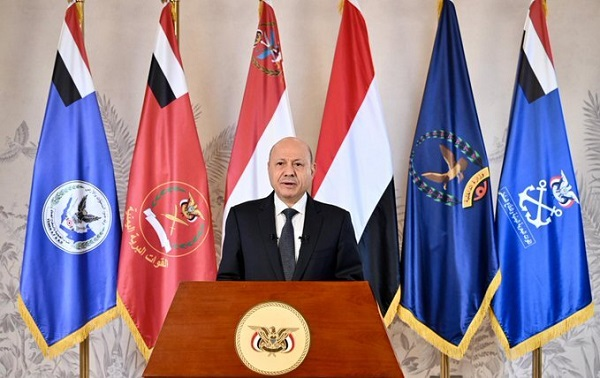
Rashad Al-Alimi, chairman of Yemen’s Presidential Leadership Council and the country’s commander-in-chief, made the announcement in a televised address on Sunday. He said the decision followed weeks of Houthi mobilization, attacks and threats against civilians, state facilities, neighbouring countries and international shipping routes.
“Today, we announce the start of military operations to retake the remaining territory of the republic and extend the authority of the state and its institutions across the entire national territory,” Al-Alimi said.
The announcement marks a major escalation in Yemen’s long-running conflict and comes as government forces, backed by Saudi Arabia, attempt to halt recent Houthi advances in the southwest of the country. The latest fighting has concentrated around Taiz, a strategically important city that remains divided between government forces and the Iran-aligned movement.
Al-Alimi said the government had moved from a period of preparation to an active campaign after what he described as the exhaustion of all opportunities for de-escalation. He accused the Houthis of continuing to send fighters to the front lines and of escalating attacks despite efforts to preserve a degree of calm.
The Yemeni leader insisted that the campaign was not directed against the people of Sanaa, Saada or any particular province. He also said it was not a conflict against a religious sect, tribe or community, but an effort to restore the authority of the state.
He ordered the armed forces, security services, military formations and allied popular resistance groups to begin carrying out approved operational plans. At the same time, he called on the forces involved to comply with the law and protect civilians, homes and private property.
“The mission is not only to recover territory, but to return the state to that territory,” Al-Alimi said. He urged troops to avoid revenge and collective punishment, warning that civilians and their property must be protected in every area retaken by government forces.
The escalation follows a series of Houthi advances that have altered the military situation in western and southern Yemen. The group has reportedly captured areas along the Red Sea coast and moved closer to the Bab Al-Mandab Strait, one of the world’s most important maritime passages.
The strait connects the Red Sea with the Gulf of Aden and is used by ships travelling between Europe, Asia and the Indian Ocean. Any sustained fighting near the waterway could create further risks for commercial shipping and increase pressure on already disrupted global trade routes.
The Houthis have threatened to target Saudi vessels attempting to pass through the strait. The group has also claimed responsibility for missile and drone attacks against Saudi energy installations, including facilities belonging to Saudi Aramco in Riyadh and the Khurais area.
The claims were not immediately confirmed by Saudi authorities or Aramco. The Houthis said the attacks were carried out in response to dozens of Saudi airstrikes against Sanaa and other parts of Yemen. Saudi-led forces have not confirmed all the reported strikes, while government-aligned officials have described their operations as targeted attacks against Houthi military positions.
The fighting has also intensified around Taiz. Houthi forces reportedly seized a major road linking the city with Aden, the temporary seat of Yemen’s internationally recognized government. The loss of the route could restrict supplies and reinforcements reaching government-held areas and increase the risk of a siege.
Taiz is Yemen’s third-largest city and has long been one of the main strongholds of opposition to the Houthis. Control of surrounding roads, mountain positions and supply corridors is therefore strategically important to both sides.
Government military officials have claimed that their forces conducted hundreds of operations against Houthi positions in Taiz and neighbouring areas. They have also reported casualties among Houthi fighters and the destruction of vehicles and military equipment. Those battlefield claims could not be independently verified.
The renewed fighting is already worsening the humanitarian situation. Thousands of civilians have reportedly been displaced from their homes, while interruptions to roads and supply routes have pushed up food prices and restricted humanitarian access.
Aid agencies have warned that an expanded offensive could produce a new wave of displacement in areas that are already struggling with hunger, damaged infrastructure and limited medical services. Any battle for Taiz could be especially damaging because of the city’s large population and its importance as a centre for trade and transportation.
Al-Alimi said the government would maintain an offer of safe return and amnesty for fighters who abandon their weapons and leave the Houthi movement. He also reaffirmed his commitment to addressing the southern issue through the Saudi-sponsored southern dialogue.
The latest operation threatens to end the relative reduction in large-scale fighting that followed the United Nations-backed truce of 2022. Although that truce formally expired, it produced a period of reduced violence and raised hopes that the parties might eventually reach a political settlement.
Those hopes now face renewed pressure. If the military campaign expands across several fronts, Yemen could experience deeper instability, further displacement and greater risks to maritime security. The immediate challenge for the government and its allies will be to regain territory without causing extensive civilian harm, while preserving a political pathway to end the conflict.
