

Ahmed Kamel – Egypt Daily News
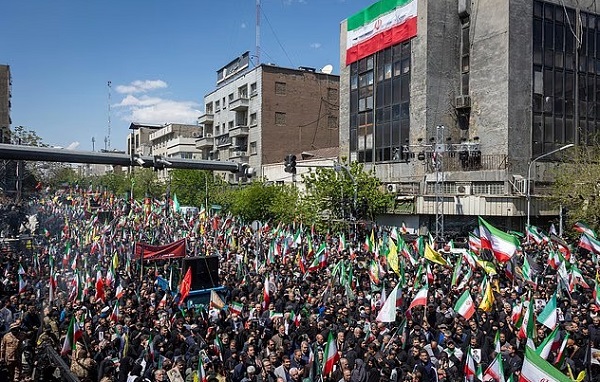
Large crowds gathered across Iran on Thursday for mass demonstrations marking 40 days since the death of former Supreme Leader Ali Khamenei, as a fragile ceasefire between Iran, the United States, and Israel showed signs of unraveling.
In the capital Tehran, thousands filled the streets carrying portraits of Khamenei and waving national flags in a display of mourning and defiance. Similar gatherings were reported in other cities, including Urmia in the northwest and Gorgan in the northeast. The events marked the end of the traditional 40-day mourning period observed in Islamic culture.
The commemorations come at a moment of renewed uncertainty in the region. A two-week ceasefire agreement reached earlier this week is already under strain, with conflicting interpretations among the parties involved. While the United States and Israel maintain that the truce does not extend to Lebanon, Iran and mediators insist the agreement was meant to halt hostilities across multiple fronts, including Iraq, Lebanon, and Yemen.
The disagreement has been accompanied by a sharp escalation in violence. Israeli forces have intensified their operations in Lebanon, targeting positions linked to Hezbollah, in what has been described as one of the heaviest waves of strikes since the conflict expanded.
Khamenei, who led Iran for more than three decades, was killed in a strike on February 28 that also claimed the lives of senior military officials. His death marked a turning point in the conflict, triggering retaliatory missile and drone attacks by Iran against Israeli and regional targets.
Despite the ongoing tensions, Iranian officials and state media portrayed the ceasefire as a strategic victory. President Masoud Pezeshkian took part in the commemorations, appearing alongside mourners in Tehran. Many participants echoed official rhetoric, describing the outcome as a sign of resilience despite the ongoing conflict.
At the same time, public sentiment reflected skepticism over diplomatic efforts. Some attendees expressed doubts about upcoming negotiations expected to take place in Islamabad, accusing Western powers of acting in bad faith and warning against trusting ceasefire commitments.
Iran’s leadership has yet to fully reappear in public following the transition of power. Khamenei’s successor, Mojtaba Khamenei, has remained absent from public view after reportedly being injured in a separate strike.
Meanwhile, diplomatic activity continues on multiple fronts. U.S. officials are expected to travel to Pakistan for talks aimed at stabilizing the situation, while Israeli Prime Minister Benjamin Netanyahu has signaled interest in opening negotiations with Lebanon, including discussions over the disarmament of Hezbollah. Lebanese officials have indicated cautious openness to such efforts, though the situation on the ground remains volatile.
Beyond the immediate conflict, global economic concerns are also emerging. Limited shipping activity has resumed through the Strait of Hormuz, a critical route for global energy supplies. However, traffic remains significantly below normal levels, underscoring continued uncertainty despite the ceasefire announcement.
As regional tensions persist and diplomatic efforts struggle to gain traction, the mass gatherings in Iran highlight both a moment of national mourning and a broader signal of defiance in the face of an increasingly unstable geopolitical landscape.
