
Ahmed Kamel – Egypt Daily News
Israeli Prime Minister Benjamin Netanyahu and his main challenger, Gadi Eisenkot, each presented himself as the country’s best choice after Tuesday’s election, but partial results and exit polls pointed to no clear winner. With both political blocs projected to fall short of a parliamentary majority, Israel could face weeks of coalition negotiations or another election.
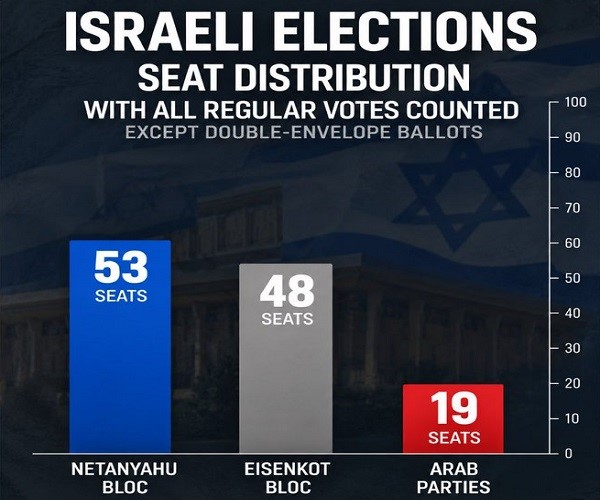
The Central Elections Committee was still counting ballots on Wednesday. Early projections were expected to shift, and definitive results were not anticipated until Thursday. With about 48.4% of votes tallied, Israeli media projected 55 seats for Netanyahu’s bloc and 50 for Eisenkot’s, with 15 seats going to Arab parties. Neither bloc was close to the 61 seats needed for a majority in the 120-seat Knesset.
A later count, covering roughly 70% of votes, showed Netanyahu’s Likud party with around 20% of the popular vote, down from 23.4% in the 2022 election. Eisenkot’s party had nearly 16%. The figures did not settle how many seats each party would ultimately win, but they reinforced the central challenge for both candidates: assembling enough partners to govern.
Netanyahu addressed supporters at Likud’s Jerusalem headquarters shortly after 3 a.m. on Wednesday, calling for a “strong, right-wing national government.” He highlighted Israel’s military record and invoked the possibility of renewed joint action with U.S. President Donald Trump against Iran. Israel, he said, faced a historic opportunity to remove what he described as the Iranian existential threat.
Trump, who had endorsed Netanyahu, told reporters that the result appeared close and that Netanyahu had done well. He suggested the outcome could amount to a tie, which he characterized as a win in the circumstances.
Eisenkot, a former military chief who leads the Yashar party, said voters had rejected Netanyahu’s continued leadership. He called the prime minister a caretaker without a mandate or public trust and urged him to leave politics. Eisenkot also warned security officials not to allow political considerations to override national security.
The projected results would represent a setback for Netanyahu’s right-wing and religious coalition, which once held 68 seats. Far-right parties led by Itamar Ben-Gvir and Bezalel Smotrich were projected to win a combined 13 seats within Netanyahu’s bloc, with neither making major gains. Yet a stalemate could still benefit Netanyahu: he could remain caretaker prime minister during lengthy negotiations, or potentially until another election.
The Arab-led parties may hold a pivotal position. They won a combined 14% of the popular vote in early results, and the Joint List’s leader, Yousef Jabareen, said the alliance was prepared to help remove Netanyahu’s government. He called for a “genuine and equal” Jewish-Arab political partnership. The Joint List’s headquarters in Nazareth erupted in applause and whistles as exit-poll results appeared.
Whether Arab parties can help form a government remains uncertain. Netanyahu has ruled out relying on them. Eisenkot has left open the possibility of cooperation under certain conditions, including recognition of Israel as a Jewish state, but some potential partners in his opposition bloc have also rejected sitting with Arab-led parties. The Joint List had discussed a possible supply arrangement with a new coalition, while opposition figure Yair Golan urged his bloc to work with Arab parties. These competing positions leave Eisenkot with no straightforward route to a majority.
President Isaac Herzog said he would consult every parliamentary faction once official results were available and ask which leader had the best chance of forming a government. He urged parties to negotiate with an open mind and said they should do everything possible to avoid another election. Under Israel’s system, voters choose parties rather than directly electing a prime minister, and coalition-building is essential because no party has won a majority on its own.
Turnout was 77.7%, according to the Central Elections Committee the highest since 1999 and more than seven percentage points above the 2022 election. The high participation reflected the election’s stakes and the country’s divisions. Netanyahu urged supporters to vote during the day, describing the election as an emergency and a matter of life and death.
The campaign unfolded under the shadow of the Hamas-led October 7, 2023, attack, in which 1,200 people were killed and 251 taken hostage, according to the figures in the supplied reports. Voters also weighed the wars that followed in Gaza, Lebanon and with Iran, as well as questions about the security failures that preceded the attack. Netanyahu’s critics demanded accountability and an inquiry, while his supporters credited him with leading Israel through a difficult period and confronting its adversaries.
Eisenkot, 66, has emphasized his security credentials while presenting himself as a domestic centrist. He lost a son and two nephews in the Gaza war and has pledged to end the exemptions from military service granted in practice to many ultra-Orthodox men a particularly divisive issue after years of conflict. He has also argued that Israel’s campaign in Gaza failed because Hamas remained in control. He opposes Palestinian statehood and says Hamas’s military wing must be dismantled.
For now, neither candidate can claim a mandate. If the early projections hold, Netanyahu may lead the largest bloc but remain short of a governing majority, while Eisenkot will need to reconcile his openness to Arab-party cooperation with opposition partners who reject it. The final count and the negotiations that follow will determine whether Israel forms a new government or returns to the polls.
