

Ahmed Kamel – Egypt Daily News
At least 64 people were killed and around 80 injured when two high-speed trains collided in Spain’s Toledo province on Wednesday, authorities said. Rescue workers continued searching the wreckage, and officials warned that the number of victims could change as the operation progressed.
The crash occurred near the towns of Urda and Los Yébenes, on a route between Madrid and Seville. Spain’s rail infrastructure operator, ADIF, said train services were suspended between Madrid, Ciudad Real and Andalusia. The cause of the collision remained unknown.
The trains were operated by state-owned RENFE and private company IRYO. Regional authorities said 397 passengers were aboard the RENFE train and 147 on the IRYO service. The trains were travelling in the same direction when the RENFE train struck the rear of the IRYO train, which had stopped, according to a spokesperson for the Castilla-La Mancha regional government. The impact derailed two carriages.
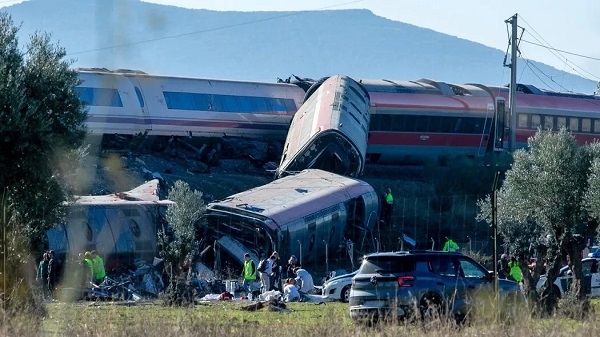
The wreckage was scattered down a gravel slope in a flat area surrounded by olive fields. Images from the site showed twisted metal and debris, while emergency crews worked to reach people in the most damaged carriages. Spanish Health Minister Mónica García said rescuers were focused on recovering survivors and bodies from two severely damaged train cars. Injured passengers were being taken to hospitals in the region.
Castilla-La Mancha regional president Emiliano García-Page said at least 80 people had been injured and warned that the death toll could rise. The regional government confirmed the figure of 64 deaths as rescue efforts continued. Officials had not publicly established how fast the trains were moving or why one had stopped.
The mayor of nearby Urda, Manuel Galán, said civil protection authorities had asked the town to prepare a sports pavilion to receive injured passengers. Ambulances and medical helicopters were dispatched to the scene, while passengers who were not injured were transported away by bus. A military emergency brigade joined firefighters, police and medical personnel in the response.
Prime Minister Pedro Sánchez canceled his scheduled engagements to focus on the disaster. In a message posted on social media, he said he was dismayed by the crash and that emergency teams were working at the scene. Spain’s King Felipe VI and Queen Letizia also expressed concern and condolences to the victims’ families, while European Commission President Ursula von der Leyen said Europe mourned with them. Spain’s soccer federation postponed 24 Copa del Rey matches scheduled for Wednesday.
The collision has renewed attention on railway safety in Spain, which suffered another deadly high-speed train crash in January. In that incident, an IRYO train derailed in southern Spain and struck an oncoming RENFE train. Forty-five people died, according to the latest report cited in coverage of Wednesday’s disaster. The January crash shook public confidence in the country’s rail network and prompted scrutiny of its infrastructure and safety systems.
Wednesday’s collision was the second major train accident in Spain this year and, with the reported death toll of 64, surpassed the January disaster. The country’s deadliest rail accident in recent decades occurred in 2013, when a high-speed train derailed near Santiago de Compostela, killing 80 people.
Spain has built an extensive high-speed rail system, with thousands of kilometres of track and services connecting Madrid with cities across the country. RENFE remains the state-owned operator, while IRYO is a private competitor that began operating in Spain in 2022. The presence of two operators on the same network has made coordination between trains and infrastructure systems an important part of the safety discussion, though officials have not identified any such issue as a cause of Wednesday’s crash.
For now, authorities have not announced a definitive explanation. Investigators will need to establish why the IRYO train stopped, what information was available to the RENFE train crew, and whether signalling or other safety systems functioned as intended. Officials have not confirmed the preliminary account circulating in some reports that the stopped train was not communicated to the following service.
The immediate priority remained the rescue operation, treatment of the injured and identification of those killed. Rail service on the affected corridor was suspended, with no reopening time announced in the reports available Wednesday.
