

Ahmed Kamel – Egypt Daily News
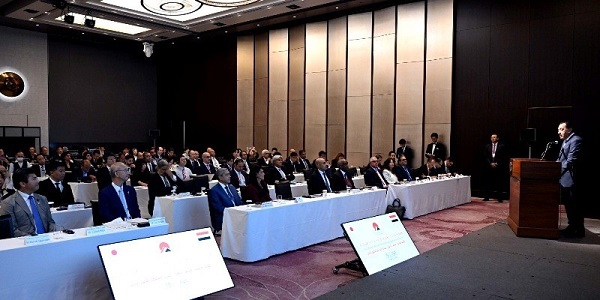
In a bid to boost bilateral trade and attract foreign direct investment, Egyptian Prime Minister Mostafa Madbouly called on Japanese companies to expand their business footprint in Egypt, particularly in the Suez Canal Economic Zone. The remarks came during his keynote speech at the Egypt-Japan Business Forum held in Tokyo on Tuesday, as part of his official visit to Japan representing President Abdel Fattah El-Sisi at the ninth Tokyo International Conference on African Development (TICAD 9).
The forum witnessed participation from senior officials, including Minister of Planning and Economic Development Rania Al-Mashat, Minister of Education and Technical Education Mohamed Abdel Latif, Japan’s Minister of State for Economy, Trade and Industry Yuichiro Koga, and Chairman of the Suez Canal Economic Zone Authority Walid Gamal El-Din. Also present were Egyptian Ambassador to Japan Mohamed Abou Bakr, business leaders from both countries, and co-chairs of the joint business council Ibrahim El-Araby (Egypt) and Jun Karube (Japan).
Addressing attendees, Madbouly highlighted Egypt’s economic transformation over the past decade, pointing to sweeping reforms and massive investments aimed at improving the country’s competitiveness and investment climate. “Egypt has undergone a developmental leap, marked by enhanced infrastructure and policies that empower the private sector and attract international investors,” he said.
Madbouly emphasized that Egypt has invested $550 billion in infrastructure projects, which have significantly improved the ease of doing business. He credited recent economic reforms including fiscal and monetary policy adjustments, public investment governance, and a shift to a flexible exchange rate regime with restoring macroeconomic stability and balancing the foreign exchange market.
In a direct appeal to Japanese investors, Madbouly outlined a series of incentives Egypt offers to international businesses. These include streamlined company registration processes, a push to reduce customs clearance times to as little as two days, and a newly adopted framework of tax incentives aimed at supporting business expansion and industrial growth.
The Prime Minister underscored Egypt’s strategic location, serving as a gateway between Africa, Europe, and West Asia, and situated on key global shipping routes. “This makes Egypt a regional hub for global supply chains, as well as a center for producing, storing, and transporting renewable and green energy,” he noted. He called on Japanese companies to capitalize on this advantage by expanding their operations in Egypt across various key industries.
Significantly, Madbouly proposed the creation of a dedicated Japanese industrial zone within the Suez Canal Economic Zone. Such a move, he said, would provide Japanese firms with access to regional markets through Egypt’s extensive network of free trade agreements with major economic blocs, enabling seamless exports without customs barriers.
He further encouraged Japanese participation in Egypt’s strategic drive to localize key industries, especially in the automotive sector, renewable energy, and water desalination areas where the Egyptian government is offering substantial investment incentives to attract foreign technology and expertise.
The Prime Minister concluded his remarks by expressing hope that the forum would yield tangible results and deepen the economic partnership between Egypt and Japan. He pointed to the long-standing and elevated political ties between the two countries, which were officially upgraded to a “strategic partnership” in April 2023, as a foundation for stronger business and investment collaboration.
The forum, held against the backdrop of tightening global economic conditions and rising trade protectionism, reflects Cairo’s broader effort to diversify its economic partnerships and position itself as a key player in regional and global supply chains.
