

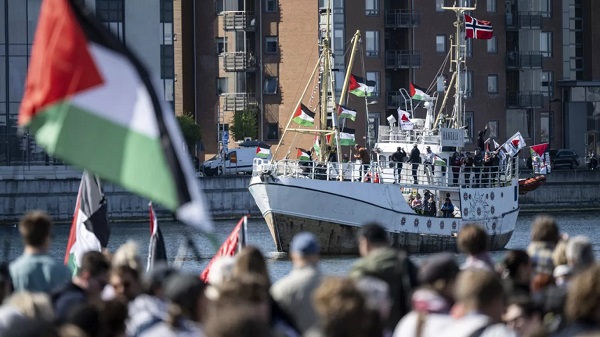
Egypt Daily News – The Israeli military has intercepted the civilian aid vessel Hanzala in international waters, detaining all 21 passengers on board as the ship attempted to reach the Gaza Strip in defiance of the longstanding naval blockade. The operation took place on Saturday, July 26, approximately 40 nautical miles off the coast of Gaza, prompting strong condemnation from organizers and human rights groups.
The Hanzala, which departed from Italy nearly a week earlier, was part of the Freedom Flotilla Coalition—an international initiative aimed at breaking the siege on Gaza and delivering humanitarian assistance directly to its residents. The ship was carrying critical supplies, including baby formula, diapers, medicine, and food intended for civilians suffering under worsening humanitarian conditions in the besieged Palestinian enclave.
Live Broadcast Cut Before Raid
The boarding was captured on a live stream before the video feed was abruptly cut off. According to a statement from the Freedom Flotilla Coalition, Israeli forces stormed the unarmed vessel at approximately 11:43 a.m. local time. Since then, all contact with the crew has been lost.
The coalition denounced the seizure of the ship, calling it a “violent and illegal interception” in international waters far outside Israel’s territorial jurisdiction and a “blatant violation of international maritime law.”
The ship’s passengers included elected officials, lawyers, journalists, environmentalists, and human rights defenders from 12 countries. Among them were notable figures such as Amazon Labor Union founder Christian Smalls (U.S.), Palestinian-American attorney Huwaida Arraf, Jewish-American activist Jacob Berger, and veteran U.S. soldier Bob Subery. Also aboard were European parliamentarians Emma Fourreau (France) and Gabriel Cathala (former MP), as well as medical and humanitarian professionals from multiple countries including the UK, Norway, Italy, Tunisia, Iraq, and Morocco.
Israel Calls Interception ‘Legal’, Plans Deportations
In a statement, Israel’s Ministry of Foreign Affairs defended the action, claiming the Hanzala was attempting to “illegally enter the maritime area off Gaza’s coast.” The ministry added that the ship was being escorted safely to the Israeli port of Ashdod, and that all passengers were unharmed.
“Unauthorized attempts to break the blockade are dangerous, illegal, and undermine ongoing humanitarian efforts,” the statement read.
Israeli public broadcaster Kan reported that the activists would be interrogated before being deported to their home countries.
Hunger Strike Threat and Pattern of Interceptions
Before departing, the activists had warned that if detained, they would launch an open-ended hunger strike and would not accept any food from Israeli authorities. The Freedom Flotilla Coalition reiterated that stance after the interception, demanding the immediate release of all detainees and the delivery of aid to Gaza.
The group also highlighted that this was the third such interception this year alone. In May, a drone strike reportedly targeted another flotilla ship, Al-Dameer, in European waters, injuring four people. In June, Israeli forces seized the vessel Maddeline and detained 12 civilians aboard.
“These repeated attacks on peaceful civilian missions are grave violations of international law,” the coalition said, accusing Israel of ignoring orders from the International Court of Justice to facilitate the entry of humanitarian aid into Gaza.
Anne Wright, a retired U.S. Army colonel and member of the coalition’s steering committee, stated, “Israel has no legal authority to detain international civilians in international waters. Their arrest is arbitrary and unlawful and must end immediately.”
International Reaction and Legal Implications
The incident has already begun to draw international attention, with human rights advocates calling for accountability and renewed pressure on Israel to lift the blockade on Gaza. Legal experts warn that the interception may amount to an act of piracy under international law, given the ship’s location and the absence of any direct threat.
The Gaza Strip remains under a severe blockade imposed by Israel and Egypt since 2007, with conditions in the territory deteriorating further amid ongoing conflict, restricted access to aid, and limited movement of goods and people. The United Nations and multiple aid agencies have repeatedly described the situation as a humanitarian catastrophe.
While the Hanzala mission was symbolic in scale, supporters argue it underscores a larger message: that international civil society is unwilling to accept the continued siege of Gaza in silence.
