

Ahmed Kamel – Egypt Daily News
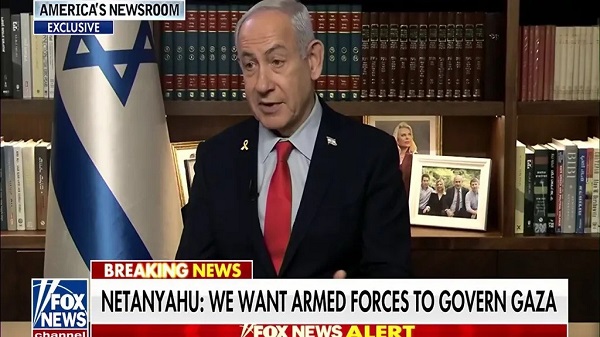
Israeli Prime Minister Benjamin Netanyahu stated on Thursday that Israel intends to establish temporary military control over the Gaza Strip without permanently governing it, suggesting that authority over the enclave could eventually be handed over to unarmed Arab forces. The remarks, broadcast in a televised interview with Fox News, come amid growing internal divisions in Israel over the future of Gaza and a backdrop of escalating military operations.
“We intend to control it,” Netanyahu said when asked whether Israel aims to fully occupy Gaza. “But we don’t want to retain it. We don’t want to govern Gaza. We want to establish a security zone, remove Hamas, and then hand over governance to a civilian authority Arab, unarmed, efficient that is not a threat to us and can provide a better life for the people of Gaza.”
Netanyahu added that Hamas cannot be part of Gaza’s future and accused the group of perpetuating “terror and repression.” “We want to free ourselves and the people of Gaza from Hamas’ horrific rule,” he said.
His comments aired just hours before a key meeting of Israel’s Security Cabinet to determine next steps in the war against Hamas, now stretching into its tenth month since the October 7, 2023, Hamas-led attack on southern Israel that triggered the current conflict.
Military Tensions and Political Division
Despite Netanyahu’s firm tone, Israeli media have reported growing tensions between the country’s political leadership and its military command regarding the Gaza strategy. According to Israeli press, IDF Chief of Staff Lt. Gen. Herzi Halevi and other senior officers have expressed opposition to a full-scale reoccupation of the Gaza Strip, citing risks and long-term consequences.
Former Chief of Staff and current Defense Minister Yoav Gallant has emphasized that the military will implement decisions made by the political echelon, stating: “Once political decisions are made, the army will act with determination and professionalism, as it has on all fronts, until the objectives of the war are achieved.”
Currently, the Israeli military claims to control approximately 75 percent of Gaza’s territory, with many of its operations conducted from fortified positions along the border.
Hamas: Netanyahu Is Sacrificing Hostages
In a statement issued on Thursday, Hamas condemned Netanyahu’s remarks as “a coup” against the ongoing ceasefire negotiations and accused the prime minister of deliberately undermining efforts to secure the release of hostages.
“What Netanyahu proposed confirms that he is actively working to eliminate the chances of a hostage deal, choosing instead to sacrifice the captives for his own personal and ideological gains,” Hamas said.
The militant group designated as a terrorist organization by the U.S., the EU, Germany, and others continues to insist on a complete Israeli withdrawal and lifting of the blockade in any negotiation.
Hostage Families Stage Offshore Protest
As the debate over Gaza’s future intensifies, families of Israeli hostages held by Hamas took to the sea in protest on Thursday. Boats carrying relatives of those abducted in the October 7 attack sailed from the port of Ashkelon toward the shores of Gaza in a symbolic demonstration to demand their release.
More than 20 participants, holding yellow flags and pictures of the captives, called out their loved ones’ names as they neared the blockade zone. “They wanted to get as close as possible to those they miss,” said organizers of the maritime protest.
Of the 251 people taken hostage during Hamas’s cross-border assault, 49 are still believed to be in Gaza, including 27 who, according to Israeli authorities, are presumed dead.
Civilian Toll Rises in Gaza
On the ground, the violence continues to exact a heavy toll. The Gaza Civil Defense reported Thursday that at least 35 Palestinians were killed in a series of Israeli airstrikes and artillery fire in the past 24 hours. Civilian infrastructure remains severely damaged, and humanitarian conditions continue to deteriorate under the ongoing blockade and bombardment.
A Shifting Vision for Post-War Gaza
Netanyahu’s vision for Gaza marks a significant shift from earlier rhetoric that left the question of long-term governance ambiguous. By stating explicitly that Israel does not seek to govern the territory but will establish temporary control, the prime minister appears to be responding to both international criticism and domestic pressure from the military establishment.
Still, the plan raises serious questions: Which Arab actors would agree to administer Gaza? What security guarantees would be in place? And how would such a transition be managed without Hamas’s participation?
With the war grinding on and ceasefire negotiations stalled, the human, political, and strategic costs continue to mount both in Gaza and in Israel.
