

Ahmed Kamel – Egypt Daily News
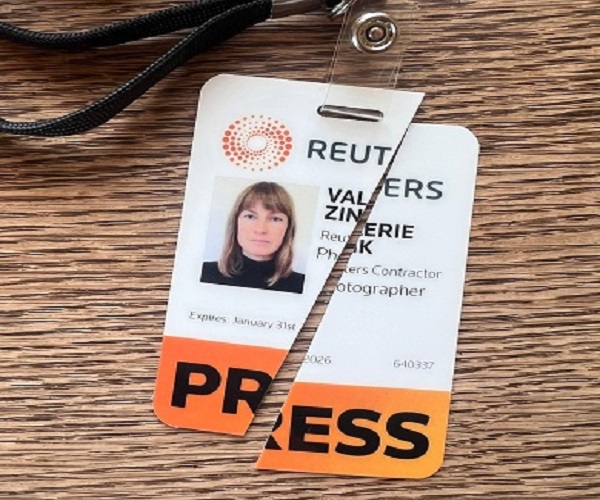
Canadian photojournalist Valeria Zink has made headlines following her resignation from Reuters, citing the agency’s coverage of the war in Gaza and broader Western media narratives as her primary reasons. In a candid television interview aired Monday evening, Zink explained that her decision was deeply personal, driven by what she described as a growing sense of moral and professional unease.
At the heart of her resignation was the killing of Palestinian journalist Anas Al-Sharif and members of Al Jazeera’s news team in Gaza. “Anas was a symbol of resistance during the genocide. I followed his reporting closely throughout the war,” she said. “He took off his press vest and made a plea to the international community to protect journalists after Israel placed him on an assassination list.”
Zink noted that Al-Sharif was fully aware of the dangers he faced. “He knew Israel wanted him dead. As a mother of two children myself, reading about his willingness to sacrifice his life while also being a father deeply affected me,” she explained. “When Israel bombed the Nasser Medical Complex and killed more journalists, I couldn’t wait another day. That was my breaking point.”
Her criticism extends beyond individual tragedies to systemic issues in how major Western outlets, including Reuters, covered the conflict. Zink accused her former employer of uncritically echoing Israeli state propaganda, especially in framing journalists particularly those from Al Jazeera as combatants. “There was an implicit narrative suggesting that they were part of the resistance and therefore legitimate targets. I couldn’t be part of that anymore.”
After resigning, Zink released a public statement that sparked a wave of solidarity within the journalism community. Several colleagues, she said, also chose to resign in protest, unwilling to remain complicit in what they perceived as biased coverage and editorial manipulation.
“Since my resignation, many journalists have reached out to me privately. They’ve shared stories about the restrictive editorial policies they work under particularly when it comes to words like ‘Palestine’, ‘occupation’, ‘genocide’, or ‘apartheid’,” she revealed. “There’s a systemic effort to sanitize the language, to shape the story in a way that avoids offending political sensitivities, especially those aligned with pro-Israel lobbying groups.”
Zink described a highly controlled media environment where language and framing are tightly regulated. Certain narratives are given prominence, while others particularly those that highlight Palestinian suffering or criticize Israeli actions are sidelined or outright censored. “There’s an extreme imbalance in the editorial policies.
The pressure isn’t only internal. In Canada, any journalist who even slightly criticizes Israel or calls out the blockade and famine in Gaza is met with a barrage of hate mail, threats, and psychological intimidation,” she said.
She warned of a growing climate of fear among journalists, especially freelance and independent reporters, who are increasingly targeted by Zionist lobby groups. “It’s a way of silencing dissent. Any criticism of Israel leads to immediate sanctions whether that’s internal discipline, blacklisting, or targeted harassment.”
Though Zink is no longer covering Gaza directly, she sees her resignation as a minimal act of integrity. “I’m now working independently in Canada. I don’t report on Gaza specifically anymore, but I felt this was the least I could do,” she said.
Her story reflects broader concerns within global journalism: about truth, accountability, and the limits of press freedom in politically charged conflicts. For Zink, stepping away from Reuters wasn’t just a professional decision it was a moral necessity.
