

Ahmed Kamel – Egypt Daily News
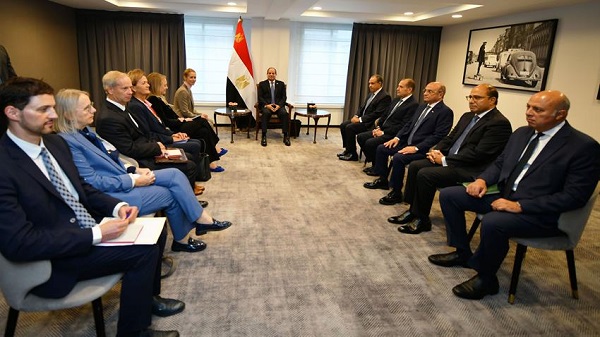
President Abdel Fattah El-Sisi met with Ms. Kaja Kallas, the High Representative of the European Union for Foreign Affairs and Security Policy and Vice President of the European Commission, during his visit to the Belgian capital, Brussels. The meeting, which took place at the President’s residence, was attended by Egyptian Foreign Minister Badr Abdel Aaty, the EU Ambassador to Egypt, the Deputy Head of the EU External Action Service, and the Director-General for the Middle East and North Africa at the EU diplomatic corps.
During the talks, President El-Sisi expressed his appreciation for the longstanding strategic partnership between Egypt and the European Union. He emphasized the importance of strengthening political and security coordination to serve the shared interests of both the Middle East and the EU, especially at a time of rising instability in the region.
The President outlined Egypt’s approach to regional crises, describing it as balanced, responsible, and aimed at promoting long-term security and stability rather than short-term political gains. He noted that this approach has proven effective over the past decade.
A key example cited was Egypt’s role in curbing irregular migration; since September 2016, no illegal migration boats have left Egypt’s shores, significantly reducing pressure on European borders. At the same time, Egypt currently hosts around ten million foreigners who have fled instability and conflict in their home countries.
President El-Sisi stressed that the most effective way to address the root causes of irregular migration is to invest in stability and development in the migrants’ countries of origin. He called on the EU to support this approach through cooperative initiatives and political engagement.
The discussion also covered Egypt’s efforts to resolve regional conflicts, with the President underscoring the importance of upholding the sovereignty and territorial integrity of states, and rejecting external interference. In this context, he highlighted Egypt’s role in facilitating the Sharm El-Sheikh Agreement aimed at ending hostilities in Gaza, achieved in coordination with international mediators.
President El-Sisi expressed Egypt’s hope for deeper collaboration with the European Union to implement the terms of the Gaza ceasefire agreement and what was referred to as the “Trump Peace Plan.” He emphasized the need to maintain the ceasefire, ensure consistent humanitarian aid delivery, and initiate reconstruction efforts in Gaza.
The President also referenced a major reconstruction and recovery conference scheduled to be held in Egypt in November 2025, aimed at mobilizing international support for Gaza.
Ms. Kallas, in turn, praised Egypt’s pivotal role in promoting peace and stability across the region—not only in Gaza, but also in conflict zones like Sudan and Libya. She welcomed the progress made through the Sharm El-Sheikh Agreement and affirmed the EU’s readiness to participate in implementing peace frameworks and supporting reconstruction efforts.
She emphasized the need to preserve the integrity of the Palestinian Authority and highlighted the European Union’s intention to actively contribute to rebuilding Gaza, including participation in the November 2025 reconstruction summit hosted by Egypt. Kallas also reaffirmed the EU’s commitment to maintaining the Gaza ceasefire and addressing broader regional crises, including in Sudan, Libya, and Ukraine, within the framework of international law.
The meeting also addressed broader geopolitical issues, including maritime security in the Red Sea and the Horn of Africa, and the importance of safeguarding water resources. Both sides agreed on the need to respect international legal norms and uphold the sovereignty of states across all regions.
Finally, the two leaders reaffirmed their shared vision for a cooperative international order grounded in respect, development, and mutual interests. The meeting underscored the evolving partnership between Egypt and the European Union and the role that coordinated diplomacy can play in addressing today’s most pressing global challenges.
