

Ahmed Kamel – Egypt Daily News
President Abdel Fattah El-Sisi has called on African countries to strengthen economic cooperation, attract more investment and move away from dependence on raw-material exports, arguing that the continent must develop its own manufacturing and technology capabilities.
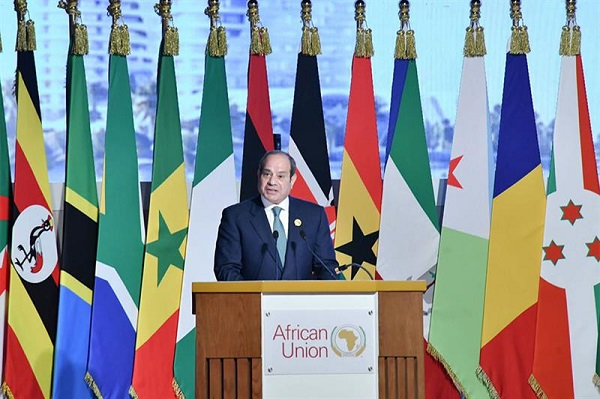
President El-Sisi made the remarks during a luncheon hosted in New Alamein for African heads of state and delegations attending the eighth Mid-Year Coordination Meeting of the African Union. The event also brought together representatives of financing institutions, international companies and business leaders who participated in the Alamein-Africa Business Forum.
In his address, the Egyptian president said Africa was facing a period of complex and interconnected challenges that required unprecedented solidarity among its countries. He argued that the continent’s strength would depend on its ability to unite politically, integrate its economies and coordinate its development priorities.
“Africa’s strength lies in its unity and the integration of its economies,” President El-Sisi said, according to the Egyptian presidency. He urged African governments and institutions to turn that principle into practical cooperation in trade, investment, infrastructure, manufacturing and energy.
Addressing international companies attending the luncheon, President El-Sisi said Africa should no longer be viewed primarily as a market for imported goods. Instead, he described the continent as an emerging partner in manufacturing, technology and innovation.
Africa’s young population, he said, represents one of its greatest economic assets. The continent has a large and expanding workforce, as well as a growing number of educated young people who could support industrial development, digital transformation and new technology-based businesses.
However, President El-Sisi stressed that this potential could not be fully realized unless international companies contributed to the transfer of technology and helped localize production. He called on global firms to establish stronger partnerships with African businesses, train local workers and participate in projects designed to expand the continent’s productive capacity.
The president identified infrastructure, development corridors and renewable energy as priority areas for investment. Roads, railways, ports, electricity networks and digital infrastructure are widely considered essential to improving trade between African countries and reducing the cost of moving goods across the continent.
Renewable energy was also highlighted as a strategic sector. Africa possesses significant solar, wind and other renewable resources, but many countries continue to face limited access to reliable electricity. Greater investment in clean-energy projects could help address power shortages while supporting industrialization and reducing exposure to fossil-fuel price fluctuations.
President El-Sisi also called on African countries to move quickly from exporting unprocessed resources to building value-added production chains. Many African economies remain dependent on the export of minerals, agricultural commodities, oil and other raw materials, leaving them vulnerable to changes in global prices.
Developing local industries would allow countries to process more of their own resources before exporting them. This could generate employment, raise government revenues, develop technical skills and create stronger links between agriculture, manufacturing, transport and financial services.
The president said that building value chains within Africa would contribute to the creation of a more resilient continental market capable of withstanding international crises and economic shocks. A stronger internal market would also support the interests of future generations by reducing dependence on external suppliers and creating more opportunities for African companies.
President El-Sisi urged governments to accelerate implementation of the African Continental Free Trade Area, which is intended to create one of the world’s largest single markets by gradually reducing barriers to trade among African countries.
He called for efforts to remove customs obstacles and non-tariff barriers that continue to slow the movement of goods, services and capital. Differences in regulations, border procedures, transport systems and payment mechanisms have made it difficult for many companies to trade across national boundaries.
The Egyptian president also stressed that economic growth would remain difficult without changes to the global financial system. African countries are confronting high borrowing costs, increased debt-servicing obligations and difficult financing conditions, even though they have contributed relatively little to the climate crisis.
He renewed calls for reform of the international financial architecture and urged the creation of innovative and affordable financing mechanisms for development projects. He also called for consideration of exemptions related to carbon taxes, warning that measures designed to address climate change should not place additional pressure on African economies.
The remarks placed investment, trade and financial reform at the center of Africa’s development debate. They also reflected Egypt’s efforts to promote deeper continental integration and encourage international partners to view Africa as a production base and investment destination rather than simply a source of commodities.
President El-Sisi concluded by thanking the participants for attending the luncheon and expressed his hope that the discussions would continue beyond the forum. The challenge now is to convert political commitments into bankable projects, stronger private-sector partnerships and practical measures that allow African economies to create more value within the continent.
