

Ahmed Kamel – Egypt Daily News
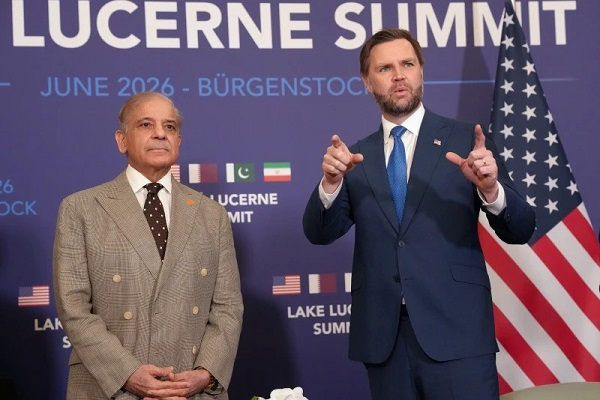
U.S. Vice President JD Vance met with senior Iranian officials in Switzerland on Sunday in a high-stakes effort to expand upon a fragile interim agreement reached last week between Washington and Tehran. The talks, held at a resort overlooking Lake Lucerne, mark one of the most significant direct engagements between the two countries in recent years.
The meeting brought together Vance, Iran’s parliamentary speaker Mohammad Bagher Qalibaf, and Foreign Minister Abbas Araghchi, with mediators from Pakistan and Qatar participating in discussions aimed at transforming a temporary ceasefire arrangement into a broader framework addressing nuclear concerns, regional security, and maritime stability.
Opening the discussions, Vance emphasized the possibility of a new chapter in U.S.-Iran relations.
“The question before us now is how much more can we accomplish together? Can we turn over a new leaf?” he said. “Can we change relations in the Middle East permanently, or do we go back to doing things the old way?”
Nuclear Program Remains Central Issue
At the heart of the negotiations is Iran’s nuclear program, which Washington continues to view with suspicion due to concerns that it could eventually be used for military purposes. Tehran has repeatedly denied such intentions, insisting that its nuclear activities are solely for peaceful purposes.
The United States hopes to secure Iran’s commitment to long-term negotiations that would place limits and monitoring mechanisms on its nuclear activities. However, Iranian officials have made it clear that the country’s right to enrich uranium remains non-negotiable.
Iranian President Masoud Pezeshkian reiterated that position on Sunday, stating that Tehran would not abandon uranium enrichment despite ongoing diplomatic efforts.
Iran’s cautious approach reflects years of strained relations and previous negotiations that were disrupted by military confrontations. Iranian officials have repeatedly stressed that implementation and trust-building are more important than the signing of agreements.
Lebanon Conflict Threatens Progress
While nuclear negotiations dominate the agenda, regional tensions continue to cast a shadow over diplomatic efforts.
Iranian officials indicated that the immediate focus of discussions would be the conflict in Lebanon between Israel and Hezbollah, the Iranian-backed militant group. Although a renewed ceasefire brokered on Saturday appeared to be holding, the situation remains fragile.
Vance acknowledged progress on Lebanon during his remarks, but developments quickly highlighted the volatility of the situation. Shortly afterward, President Donald Trump issued a warning to Iran through social media, threatening further military action if Tehran failed to restrain Hezbollah’s activities.
The contrasting messages underscored the challenges facing negotiators attempting to build momentum toward a broader agreement while violence continues elsewhere in the region.
Strait of Hormuz Concerns
Another major objective for Washington is securing guarantees that the Strait of Hormuz will remain open to international shipping.
The narrow waterway carries roughly one-fifth of the world’s traded oil and serves as one of the most strategically important maritime routes on the planet. Any disruption to traffic through the strait can have immediate consequences for global energy markets.
Recent claims by Iran that it had once again closed the passage raised concerns among governments and investors. However, U.S. Central Command disputed those assertions, maintaining that commercial traffic continues to move through the area under close monitoring.
Ensuring uninterrupted access to the strait has become a critical element of the current negotiations, particularly as global markets remain sensitive to energy supply disruptions.
Political Pressure on Both Sides
The agreement reached last week has generated controversy in both countries.
In the United States, some Republican lawmakers and conservative commentators have criticized the Trump administration’s approach, comparing it to previous nuclear agreements negotiated during the Obama administration. Critics argue that the new framework may provide Iran with economic benefits without permanently ending its nuclear ambitions.
Under the interim arrangement, Iran gains greater freedom to export oil and potentially access billions of dollars in previously frozen assets. In return, Tehran has agreed to dilute portions of its stockpile of highly enriched uranium and participate in further negotiations.
At the same time, Iranian leaders face domestic pressure not to appear weak in dealings with Washington, particularly after years of sanctions, military confrontations, and failed diplomatic efforts.
High Stakes for Global Markets
Financial markets are closely watching the outcome of the Switzerland talks.
The announcement of the interim agreement last week contributed to a sharp decline in oil prices, reflecting investor optimism that major disruptions to energy supplies could be avoided. However, any breakdown in negotiations or renewed escalation in Lebanon could quickly reverse that trend.
The Trump administration has sought to reassure Americans that recent tensions with Iran will not lead to prolonged increases in fuel prices, a politically sensitive issue during the busy summer travel season.
With negotiators now entering a 60-day period to finalize technical details, the coming weeks are expected to determine whether the Lake Lucerne discussions represent the beginning of a lasting diplomatic breakthrough or merely another temporary pause in decades of confrontation between Washington and Tehran.
For now, both sides appear willing to continue talking. Whether those talks can overcome deep mistrust, regional conflicts, and domestic political pressures remains the defining question facing negotiators.
