

Ahmed Kamel – Egypt Daily News
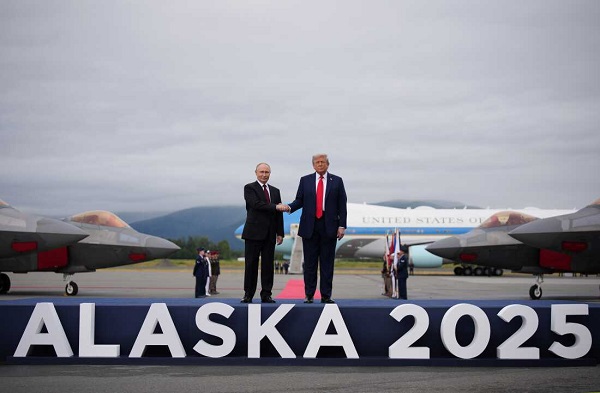
In a moment charged with symbolism and global consequence, former U.S. President Donald Trump and Russian President Vladimir Putin shook hands on American soil for the first time in a decade, launching a highly anticipated summit aimed at bringing an end to the war in Ukraine. The meeting, hosted at Alaska’s Elmendorf-Richardson military base, marks the most significant direct engagement between the United States and Russia since Moscow launched its full-scale invasion of Ukraine over three years ago.
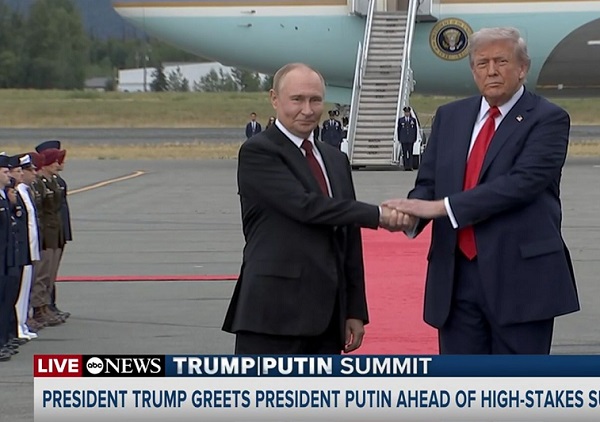
The two leaders greeted one another on the red carpet at Elmendorf Air Force Base in Anchorage, flanked by military jets and watched overhead by a dramatic flyover that included American fighter planes and a B-2 stealth bomber. The setting underscored both the gravity and the strategic weight of the summit, which could potentially shift the trajectory of the war and reshape the future of European security.
A Risky Diplomatic Gamble
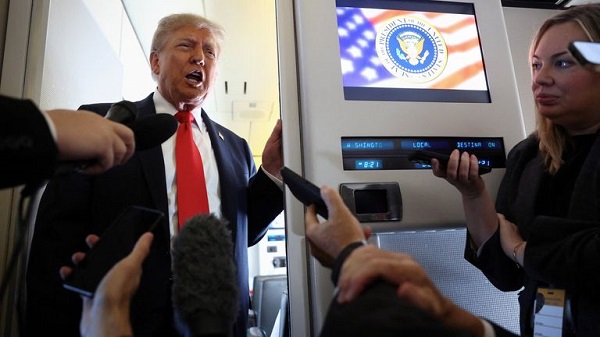
For Trump, who has returned to the international spotlight amid a polarized political landscape, the stakes could not be higher. Speaking aboard Air Force One en route to Anchorage, he declared that the primary goal of the summit was simple and urgent: “to stop the killing.”
“I don’t know if it’s going to be today,” Trump said bluntly, “but I’m not going to be happy if it’s not today. Everyone said it can’t be today but I want the killing to stop.”
Trump has positioned himself as a negotiator uniquely capable of brokering peace, a claim he often repeated during his previous presidency. This summit, however, represents a far more complex diplomatic terrain. While critics view the meeting as a dangerous concession to a pariah state, his allies have framed it as a bold, necessary step toward ending a brutal conflict that has devastated Ukraine and strained the West’s resolve.
Putin, arriving on U.S. soil for the first time in a decade, appears equally determined to use the moment to advance his long-standing strategic objectives: the recognition of Russia’s territorial gains in Ukraine, the prevention of Kyiv’s NATO membership, and a rollback of Western influence in Eastern Europe.
An Unconventional Start
In a move that raised eyebrows even among seasoned diplomats, Trump invited Putin to join him in the presidential limousine shortly after their handshake. The brief shared ride from the tarmac was seen as an unusual gesture of camaraderie between two adversaries. While similar overtures during Trump’s 2018 summit with North Korean leader Kim Jong Un were blocked by advisers, this time, the moment went ahead a reflection, perhaps, of changed priorities and personnel in Trump’s inner circle.
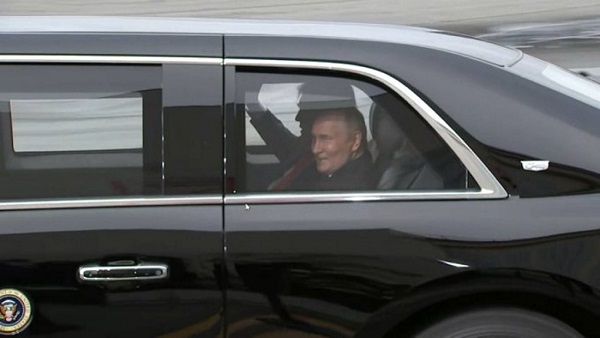
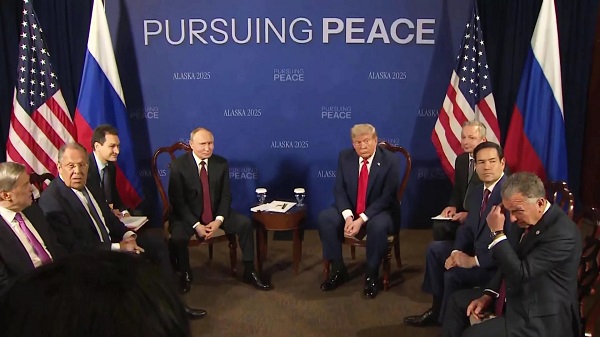
Though initially announced as a private one-on-one, the meeting format was later revised. The White House confirmed that the leaders would be joined by their top aides, citing a desire for more substantive dialogue. Nonetheless, their private car ride ensured that Trump and Putin still had an unscripted moment alone.
The Battle Behind the Talks
The diplomatic context surrounding the summit remains fraught. Moscow has insisted that any peace deal must include Ukraine ceding territories annexed by Russia in 2022 regions still contested on the battlefield as well as recognition of Crimea, annexed in 2014. Putin is also demanding that Ukraine abandon its NATO aspirations, scale down its military, and adopt Russian as an official language alongside Ukrainian.
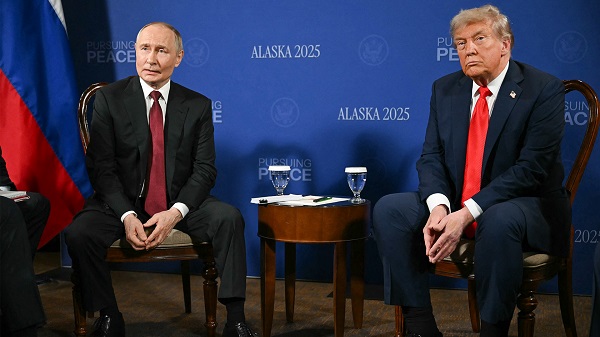
Ukrainian President Volodymyr Zelenskyy, who was not invited to the summit, has made it clear that any settlement must reflect the will of the Ukrainian people and include robust guarantees against future Russian aggression. His exclusion from the talks has drawn criticism from European leaders and defenders of the “nothing about Ukraine without Ukraine” doctrine.
Trump, for his part, has floated the possibility of a follow-up summit involving Zelenskyy, though no timeline has been agreed upon, and Moscow has yet to endorse the idea.
Sanctions and Signals
In the hours leading up to the summit, Russian Foreign Minister Sergey Lavrov told state media that he expected some U.S. sanctions to be lifted as a result of the meeting. His optimism was buoyed by the U.S. Treasury’s decision to temporarily suspend select sanctions until August 20, a move seen by some observers as a gesture of goodwill to grease the wheels of diplomacy.
“They will definitely be lifted for some, that’s for sure,” Lavrov said.

Meanwhile, Trump issued a stark warning: if Putin proved unwilling to negotiate in good faith, he would walk away. “If he doesn’t want to cooperate, then I’m gone,” Trump said in a pre-summit interview with Fox News host Bret Baier.
Symbolism and Substance
The selection of Anchorage as the meeting site was not without symbolism. The summit is being held near Fort Richardson National Cemetery, where nine Soviet pilots and four military personnel are buried airmen who died while ferrying American aircraft to the Eastern Front during World War II as part of the Lend-Lease program. Kremlin spokesman Dmitry Peskov described the site as a reminder of a time when the U.S. and Russia, though vastly different, could find common ground in the face of global threat.
“Such mutual political will is in short supply these days,” Peskov remarked.
The Delegations
Both leaders brought a cadre of senior officials to Anchorage for what is expected to be an intensive round of negotiations.
The Russian delegation includes:
- Foreign Minister Sergey Lavrov
- Foreign Policy Advisor Yuri Ushakov
- Defense Minister Andrey Belousov
- Finance Minister Anton Siluanov
- Economic Representative Kirill Dmitriev
The U.S. delegation comprises:
- Secretary of State Marco Rubio
- Treasury Secretary Scott Bessent
- Commerce Secretary Howard Lutnick
- Special Envoy Steve Witkoff
- Press Secretary Karoline Leavitt
- CIA Director John Ratcliffe
- Chief of Staff Susie Wiles
- Deputy Chief of Staff Dan Scavino
Following a private conversation with interpreters, Trump and Putin are expected to engage in extended delegation talks. Brief remarks to the press were scheduled to precede a possible joint press conference later in the day, though White House aides cautioned that a press appearance was contingent on the outcome of the discussions.
Uncertain Outcomes
Despite the high-profile theatrics and bold ambitions, the path to peace remains deeply uncertain. While Trump hopes to return from Alaska with the foundations of a ceasefire, both sides remain entrenched in their positions. The war has taken a staggering human toll, and trust between Moscow, Kyiv, and the West is at its lowest point in decades.
Still, the summit represents a rare and fragile opportunity for diplomacy. Whether it becomes a breakthrough or just another chapter in the long, brutal conflict will depend on what unfolds behind closed doors in Anchorage.
